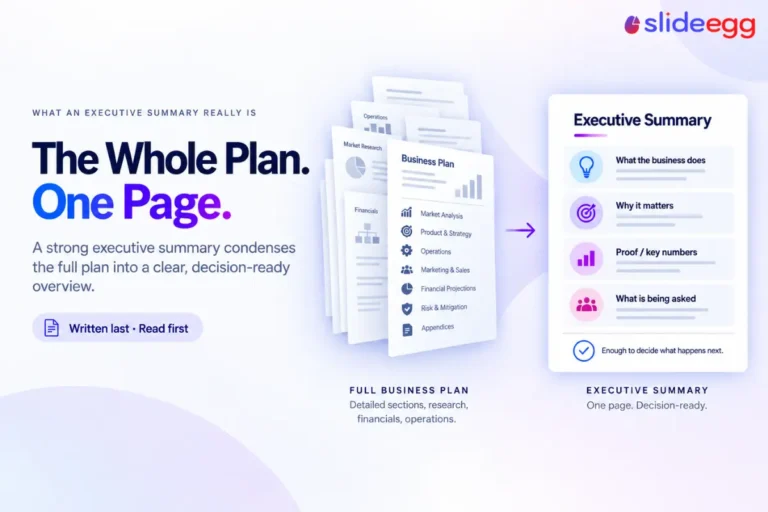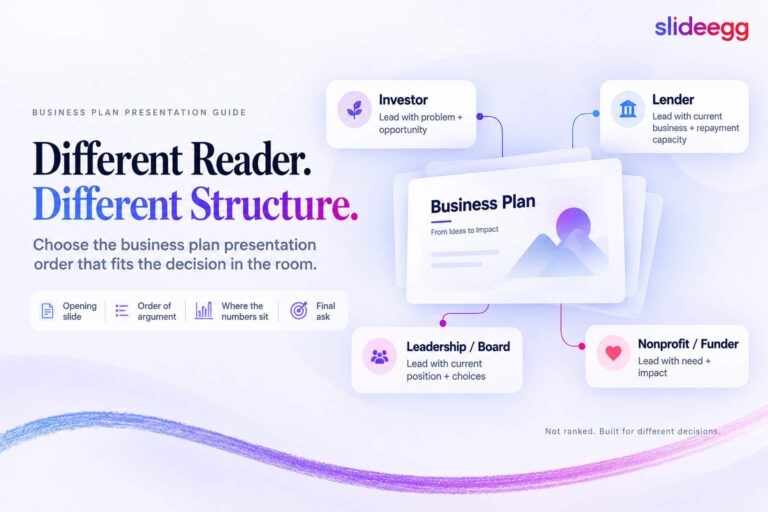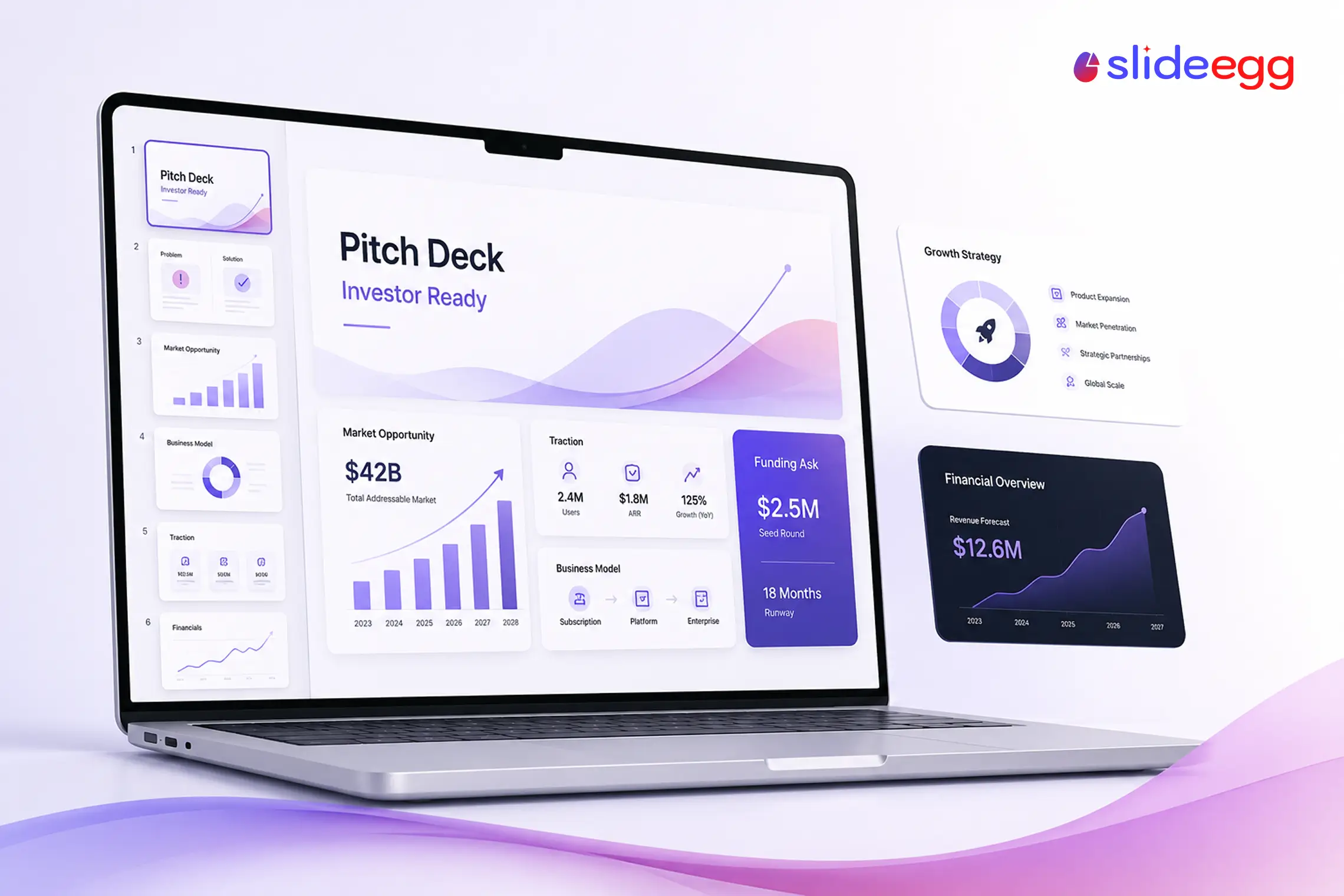
A pitch deck does not win funding by itself. But a poor deck can make a strong startup look unclear, risky, or unprepared.
That is why the template matters. Not because investors care about decoration. They care about speed. They want to understand the problem, product, market, traction, team, and funding ask without digging through messy slides.
The best pitch deck templates for startups help founders tell that story in the right order. They give structure without forcing every startup into the same shape.
This guide helps you choose the right pitch deck template based on your startup stage, investor audience, and business model. It also explains what to include, what to remove, and how to prepare before the meeting.
What Is the Best Pitch Deck Template for Startups?
The best pitch deck template for startups is one that matches your funding stage, business model, and investor audience.
A pre-seed startup needs a simple deck focused on the problem, solution, team, market, and early validation. A seed-stage startup needs traction, product progress, a business model, and use of funds. A Series A startup needs stronger financials, a growth strategy, retention, unit economics, and market expansion plans.
Do not choose a template only because it looks modern. Choose one that helps investors understand your startup faster.
Why the Right Pitch Deck Template Matters
Founders often treat pitch deck templates like design shortcuts. That is too narrow.
A good template helps you answer investor questions in the right order. It keeps the story tight. It also stops you from adding random slides that do not support the pitch. The right template also keeps your charts, financial slides, and investor story easier to edit. If you are comparing tools, our guide on Investor Pitch PowerPoint Templates vs. Canva explains when a dedicated pitch deck template works better than a general design tool.
A weak template creates problems. It may have too many decorative slides, weak chart layouts, no financial section, no funding ask slide, or no space for traction proof.
The right template should help you show:
- What problem are you solving
- Why the problem matters now
- Who your customer is
- How your product solves the problem
- What progress have you made
- How the business makes money
- Why your team can execute
- How much funding do you need
- What the funding will help you achieve
If a template cannot support these points, it is not right for investor pitching.
How We Selected These Pitch Deck Templates
We selected these pitch deck templates based on how effectively they help founders communicate with investors.
Each template was evaluated using the following criteria:
Investor Story Structure: The template should support a logical flow from the problem and solution to the market opportunity, traction, business model, financials, and funding ask.
Startup Stage Relevance: The deck should be suitable for a specific fundraising stage, such as idea stage, pre-seed, seed, or Series A.
Slide Usefulness: The layouts should help founders present meaningful business information instead of adding decorative or unnecessary slides.
Financial Presentation: The template should provide suitable layouts for revenue, pricing, projections, funding use, or growth assumptions where required.
Editing Flexibility: Founders should be able to replace the content, colours, charts, images, and branding without rebuilding the presentation.
Visual Clarity: Investors should be able to understand the main message, data, and business opportunity quickly.
No single pitch deck template is right for every startup. The best choice depends on your funding stage, business model, investor audience, available proof, and meeting objective.
8 Best Pitch Deck Templates for Startups to Impress Investors
1. Clean Investor Pitch Deck Template

Source: Download the Clean Investor Pitch Deck Template from SlideEgg
A clean investor pitch template designed to help startups present their business idea, market opportunity, solution, growth plan, and funding needs in a clear and professional way.
Pro Tip: Keep your investor pitch simple, data-driven, and focused on the business opportunity. Investors should quickly understand the problem, your solution, market size, traction, and why your business can grow.
2. Startup Pitch Deck Template

Source: Startup Pitch Deck Template
A clean startup pitch deck template that helps founders present their problem, solution, market opportunity, traction, business model, financial plan, and funding ask in a clear investor-ready flow.
Pro Tip: Start with the problem and market impact before showing your product. Investors need to understand why the business matters before they care about features, pricing, or design.
3. Minimal Business Plan Pitch Deck Template
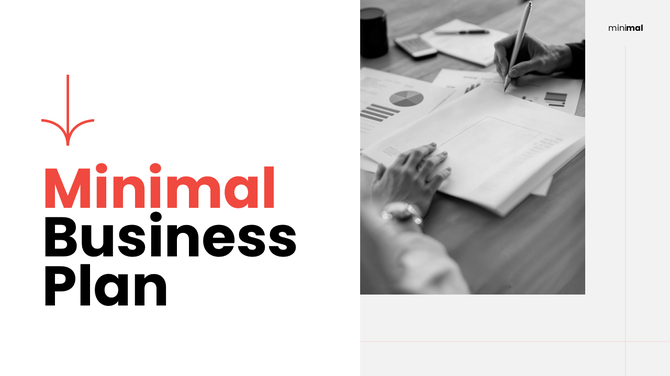
Source: Minimal Business Plan Pitch Deck Template
A minimalist business plan template designed to present your business overview, problem, solution, target market, strategy, financial highlights, and growth plan in a clean professional format.
Pro Tip:
Keep the business plan focused on clarity, not decoration. Show the problem, solution, target customer, cost savings, and growth strategy in a simple flow so viewers understand the business quickly.
4. Financial Investor Pitch Deck

Source: Financial Investor Pitch Deck Template
A professional financial investor pitch deck template designed to present your financial services, market size, pricing plan, profit and loss, team, and business strategy in a clear investor-focused format.
Pro Tip:
Keep the financial story sharp. Show your market size, revenue plan, pricing, and profit potential clearly so investors can quickly understand how the business makes money.
5. Startup Investor Pitch Deck Template

Source: Startup Investor Pitch Deck Template
A startup investor presentation template designed to show startup growth, investment strategy, company overview, financial summary, operational improvements, and future business plans in a clean, professional format.
Pro Tip:
Focus on investor value. Clearly show how the startup can grow, how funding supports that growth, and what long-term return or business impact investors can expect.
6. Marketing Pitch Deck Template

Source: Marketing Pitch Deck Template
A growth-focused marketing pitch template designed to present customer challenges, marketing strategy, services, performance model, ROI, market opportunity, pricing strategy, and call to action in a clear, business-ready format.
Pro Tip:
Do not make the pitch only about creative ideas. Show clear proof: lead quality, acquisition cost, revenue impact, ROI, and why your marketing plan can drive measurable growth.
7. Business Startup Presentation Template

Source: Business Startup Presentation Template
A business startup presentation template designed to showcase your startup idea, company overview, market analysis, financial summary, business model, team impact, and future growth strategy in a clear professional format.
Pro Tip:
Do not keep the presentation too general. Show the exact problem, target market, revenue plan, and growth strategy so viewers understand why the startup can succeed.
8. Investor Pitch Deck Template
Source: Free Investor Pitch Deck Template
An investor pitch deck template designed to help startups present their business idea, market opportunity, solution, growth plan, and investment story in a clear, professional format.
Pro Tip:
Do not fill every slide with long text. Keep the pitch focused on the problem, solution, market size, traction, revenue plan, and funding need.
| Template | Best For | Fundraising Stage | Difficulty | Investor Focus | Customization Level |
| Clean Investor Pitch Deck Template | Formal investor meetings | Seed to Series A | Medium | Full business case | High |
| Startup Pitch Deck Template | Early startup pitching | Pre-seed to seed | Easy | Problem, solution, market, team | Medium |
| Minimal Business Plan Pitch Deck Template | Bank, angel, or full-plan pitch | Pre-seed to seed | Medium | Business model and planning | High |
| Financial Investor Pitch Deck | Finance-heavy startups | Seed to Series A | Hard | Revenue and financials | High |
| Startup Investor Pitch Deck Template | Startup growth and investor updates | Seed | Medium | Growth plan and funding story | High |
| Marketing Pitch Deck Template | Martech or agency startups | Pre-seed to seed | Medium | Customer acquisition and ROI | Medium |
| Business Startup Presentation Template | Early startup overview | Idea to pre-seed | Easy | Startup idea and market | Medium |
| Free Investor Pitch Deck Template | Simple investor pitch | Pre-seed to seed | Easy | Clear story and funding ask | Medium |
How to Choose the Right Pitch Deck Template
Do not start by asking, “Which template looks best?”
Start with these questions.
1. What stage is your startup in?
If you are at the idea stage, use a simple startup pitch deck. If you have early users, use a seed funding deck. If you have revenue and retention, use a Series A or growth strategy deck.
2. Who is the audience?
Angel investors may care more about the team, problem, and early proof. VCs usually expect market size, traction, business model, and scale. Banks or lenders may require a deep structural layout instead. For a breakdown of what banking institutions require versus VCs, read our benchmark comparison of 10 Business Plan PowerPoint Examples.
3. What proof do you have?
Your proof decides the deck type.
If you have user interviews, show validation.
If you have product usage, show traction.
If you have revenue, show metrics.
If you have retention, show cohorts or repeat usage.
4. What is the meeting goal?
A first meeting needs a short, clear deck. A follow-up meeting may need financial projections, a roadmap, and appendix slides.
5. What should the investor remember?
Choose a template that supports one clear message. Do not try to show everything.
Slides Every Startup Pitch Deck Should Include
Most startup pitch decks need these slides:
- Cover slide
- Problem
- Solution
- Target customer
- Market opportunity
- Product or service
- Business model
- Traction or validation
- Go-to-market strategy
- Competition
- Team
- Financials
- Funding ask
- Appendix
A 10-slide deck can work for an initial pitch, while the fuller 14-slide structure allows founders to include financials, a funding ask, and supporting material. Keep the main presentation concise and move secondary evidence to the appendix.
How Many Slides Should a Startup Pitch Deck Have?
A startup pitch deck should usually have 10 to 15 slides.
Use this guide:
| Stage | Recommended Slide Count | Focus |
| Idea stage | 6–8 slides | Problem, solution, customer, team |
| Pre-seed | 8–10 slides | Vision, validation, early plan |
| Seed | 10–12 slides | MVP, traction, market, use of funds |
| Series A | 12–15 slides | Revenue, retention, growth, financials |
| Follow-up deck | 15–20 slides | More proof and appendix details |
How to Customize a Pitch Deck Template
A template is only a starting point. The final deck must feel specific to your startup.
Replace every placeholder: Do not leave sample numbers, fake names, or generic labels.
Rewrite slide headings as conclusions: Instead of “Market Size,” write “We are entering a $2B service gap in small clinic operations.”
Use real product visuals: Use screenshots, mockups, workflow images, or customer journey visuals.
Remove irrelevant slides: If a slide does not support your pitch, remove it.
Pitch Deck Mistakes Investors Notice Immediately
Investors often identify weaknesses before the founder finishes presenting. The most damaging mistakes usually fall into two groups.
Content Mistakes
- An unclear or exaggerated problem
- No customer validation or traction evidence
- An unrealistic market-size calculation
- A generic competitor comparison
- Financial projections with no stated assumptions
- No clear funding amount
- No explanation of how the funds will be used
Design Mistakes
- Slides filled with long paragraphs
- Text that is too small to read
- Charts without labels or conclusions
- Inconsistent spacing, fonts, or colours
- Decorative icons that communicate nothing
- Low-quality screenshots
- Excessive animation
- Weak contrast between text and background
Investors do not reject a startup because its slides are plain. They lose confidence when the deck makes the business difficult to understand.
Storytelling Tips for Startup Pitch Decks
A strong pitch deck is not just a list of slides. It is a business story.
Use this simple order:
- Show a painful problem.
- Explain who feels it.
- Show why current options fail.
- Present your solution.
- Prove people care.
- Explain how the business grows.
- Show why your team can execute.
- Ask for the right amount of capital.
- Connect the funding to a clear milestone.
The investor should finish the deck knowing what you do, why it matters, and what happens next.
Pitch Deck Checklist Before Meeting Investors
Use this checklist before sending or presenting your deck.
Story checklist
- The problem is clear.
- The solution is easy to understand.
- The target customer is specific.
- The market opportunity is believable.
- The business model is explained.
- The funding ask is clear.
Slide checklist
- Each slide has one main point.
- Text is short.
- Charts are readable.
- All placeholders are removed.
- All numbers are checked.
- Slide order feels logical.
Investor checklist
- You can explain every metric.
- You know your main risks.
- You can defend market size.
- You can explain competitors.
- You know how funds will be used.
- You have backup slides ready.
Presentation checklist
- You practiced the 3-minute version.
- You practiced the 10-minute version.
- You prepared answers for hard questions.
- You exported a PDF copy.
- You tested the deck on another screen.
- You checked the file size before sending.
Common Questions Investors Usually Ask
What problem are you solving?
Answer with the customer’s pain, not your product feature.
Who has this problem?
Name the customer segment clearly.
Why now?
Explain the market change, technology shift, regulation, behavior change, or timing advantage.
How do you make money?
Explain pricing, revenue model, and who pays.
What traction do you have?
Use real numbers, pilots, users, revenue, retention, or customer proof.
Who are your competitors?
Include direct competitors, indirect competitors, and current alternatives.
What is your advantage?
Explain product, distribution, data, team, cost, speed, or market insight.
How will you get customers?
Show the channel plan and what you have tested.
How much are you raising?
Give a clear amount.
How will you use the funds?
Connect the money to milestones, not vague growth.
What could go wrong?
Show that you understand risk and have a plan.
How Different Startups Should Choose Their Pitch Deck
Tech Startup
Use an investor pitch deck or product pitch deck. Focus on problem, product, technical advantage, market, team, and roadmap.
SaaS Startup
Use a SaaS pitch deck. Include MRR, ARR, churn, retention, CAC, LTV, pricing, and go-to-market strategy.
AI Startup
Use an AI startup deck. Explain what the AI does, what data advantage you have, and why the result is better than current options.
Healthcare Startup
Use a healthcare-focused investor deck. Include clinical need, user trust, validation stage, compliance, adoption barriers, and evidence.
EdTech Startup
Use an investor or startup pitch deck customised for the education market. Show the learning problem, target learner, purchasing decision-maker, adoption model, measurable outcomes, and pricing structure.
FinTech Startup
Use a fintech pitch deck. Include trust, compliance, risk controls, security, revenue model, and customer acquisition.
Ecommerce Startup
Use a business model or growth strategy deck. Focus on customer acquisition, margins, repeat purchases, logistics, and brand positioning.
Service Startup
Use a business plan pitch deck. Explain customer pain, service model, pricing, delivery process, team, and growth plan.
Manufacturing Startup
Use a business plan and financial projection deck. Include production capacity, supply chain, margins, equipment needs, and funding use.
Final Takeaway
The best pitch deck template is not the one with the most stylish slides. It is the one that helps investors understand your startup quickly.
Choose the template that fits your stage, proof, business model, and meeting goal. Then remove anything generic. Add real numbers, clear claims, and a focused story.
A strong template gives structure. Your startup must provide the proof.
Ready to build your startup pitch deck?
Browse SlideEgg’s pitch deck PowerPoint templates to find editable investor decks, startup pitch decks, financial pitch decks, business proposal decks, and demo day templates for PowerPoint, Google Slides, and Canva.
FAQ
Can one pitch deck template work for both angels and VCs?
Yes, but the content should change. Angels may focus more on founder fit and early promise. VCs usually expect a stronger market size, traction, growth plan, and financial logic.
Should I choose a simple or highly designed pitch deck template?
Choose simple if your numbers and story are strong. Choose a more visual template only if your product or market needs explanation. Investors prefer clarity over decoration.
Do I need a different pitch deck for pre-seed and seed funding?
Yes. A pre-seed deck can focus on the problem, team, early validation, and vision. A seed deck should show clearer traction, product progress, and use of funds.
What is the biggest mistake founders make when using templates?
They leave generic placeholder text and charts inside the deck. Every slide must be replaced with real startup-specific proof.
Should I include financial projections in an early startup pitch deck?
Yes, but keep them simple. Show assumptions, revenue logic, burn rate, runway, and how the funding will be used. Do not show unrealistic growth without explanation.
What pitch deck template is best for a SaaS startup?
A SaaS startup should use a template with slides for MRR, ARR, churn, CAC, LTV, retention, product workflow, and go-to-market strategy.
What pitch deck template is best for a non-tech startup?
Use a business plan pitch deck or market opportunity deck. It should explain customer demand, revenue model, operations, competition, and growth plan clearly.