Most business plan round-ups show you decks. This one explains what each structure has to do, what it should lead with, how the argument is ordered, and when copying it would be the wrong call.
Ten structures below, each built for a different reader and a different decision.
Quick Answer
- Run any structure through four checks: what the opening slide claims, whether evidence comes before or after the ask, where the financials sit, and what the last slide asks for.
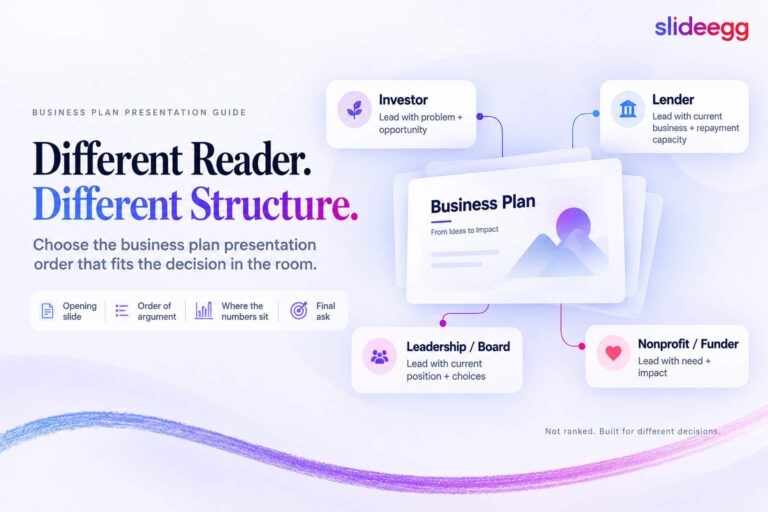
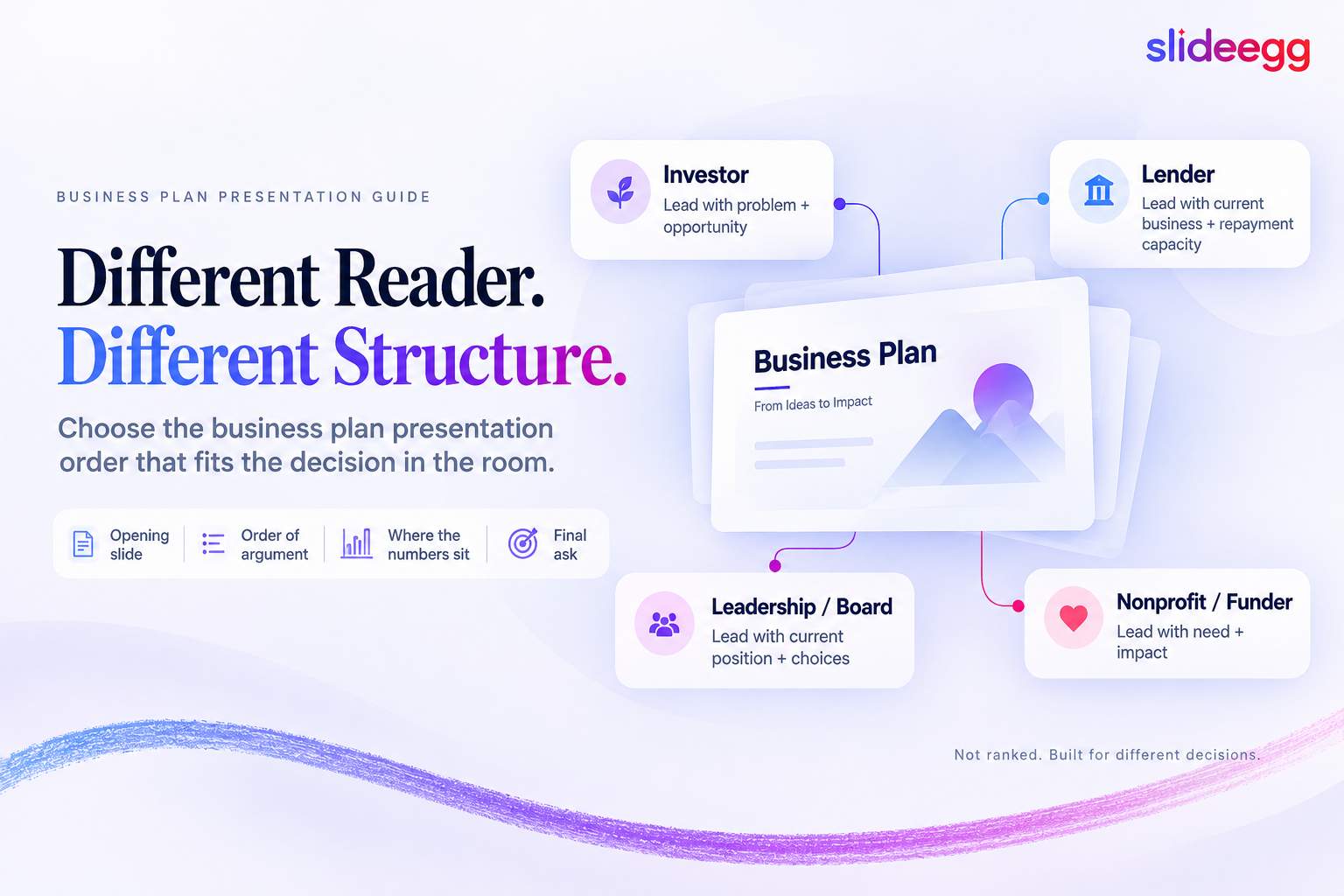
- A startup pitch leads with the problem; a loan application leads with trading history; a nonprofit plan leads with need, none open with a company description.
- The hardest number a reader will interrogate belongs early, not buried behind a supporting narrative.
- Every structure below can drop two or three standard sections, because a specific reader doesn’t need all of them.
- The closing slide should request a specific decision, approve the budget, fund the round, sign the lease, not “thank you.”
How to read a business plan presentation structure

Before copying any structure, look at four things. They tell you more than the design does.
- What the opening slide claims. A deck that opens with the company is talking to someone who already cares. A deck that opens with the problem is talking to someone who doesn’t yet.
- The order of the argument. Evidence before the ask, or the ask before the evidence? Both work for different audiences. Investors want the opportunity framed before the number. Lenders want the number and then the proof it’s repayable.
- Where the numbers sit. Financials late in the deck mean it’s selling a story. Financials early means it’s answering a question. Neither is wrong; they signal who the deck was built for.
- What the last slide asks for. A deck ending on “thank you” has no next step. One ending on a specific decision, approve the budget, fund the round, sign the lease, is doing its job.
Run every structure below through those four, and the differences will stop being cosmetic.
The 10 structures
1. Early-stage startup pitch
Who it’s for: founders raising pre-seed through Series A, pitching to angels or a partner meeting.
What it should open with: the problem, then a one-line thesis on why now. The company comes third.
Why that works: it front-loads the only thing an early-stage reader can evaluate. With limited trading history, the argument rests on the size and shape of the problem, and the deck functions as a filter, someone should be able to stop after slide three and know whether to keep reading. Traction and market sizing come early because those are the disqualifying questions.
When not to use it: once real revenue exists, or for a bank. Leading with the problem starts to look like avoiding the numbers, and a lender reading a growth-first deck sees risk where an investor sees upside.
Venture capital business plan template · Investor pitch deck templates
2. Bank loan application

Who it’s for: owners presenting to a lender for debt finance.
What it should open with: the business as it exists now, trading history, current revenue, and what the money is for.
Why that works: a lender is assessing whether the business can service the debt, not how large it might become. Opening with what already exists answers that question first. Every slide after it either supports repayment capacity or gets cut, which is a harsher edit than most plans survive.
When not to use it: for investors. The conservatism that reassures a lender reads as a lack of ambition to someone buying equity.
We don’t currently have a loan-specific deck, start from the financials collection and add your trading history and repayment schedule.
Financial projection templates
3. Corporate strategy plan
Who it’s for: strategy leads and department heads presenting direction to a board or leadership team.
What it should open with: the current position, where the business stands now, before any proposal.
Why that works: the audience already knows the company, so the structure skips introduction entirely and spends its slides on choices. It reads as a decision document rather than a description, which is what a board meeting needs.
When not to use it: with anyone external. It assumes context only insiders have.
Business strategy templates · SWOT analysis templates
4. Annual business plan
Who it’s for: leadership teams presenting the year ahead, usually alongside last year’s results.
What it should open with: performance against the previous period’s targets.
Why that works: it earns the right to talk about next year by settling last year first. A plan opening with new goals while the old ones are unresolved loses the room immediately.
When not to use it: for a new venture with no prior period. Without a baseline, the structure has nothing to stand on.
Annual business plan template · Strategic roadmap templates
5. SaaS business plan
Who it’s for: software founders where the economics matter more than the product.
What it should open with: the business model, how the product converts to recurring revenue.
Why that works: SaaS readers evaluate unit economics before features. Putting acquisition cost, retention, and payback ahead of the product tour signals you know which questions actually get asked.
When not to use it: for a business with one-off sales. Recurring-revenue framing doesn’t transfer to transactional models.
SaaS business overview template · Business Model Canvas templates
6. Professional services firm
Who it’s for: consultancies, agencies, and advisory firms pitching capability or planning growth.
What it should open with: the problem the firm solves and the evidence it has solved it before.
Why that works: service businesses sell judgment, which can’t be demonstrated the way a product can. The structure leads with proof, named engagements, outcomes, and the team’s track record, because that is the entire basis on which the reader decides.
When not to use it: for a product business. Case-study-first framing wastes slides when the product can simply be shown.
Consulting firm business plan template
7. Food and hospitality
Who it’s for: restaurants, cafés, and food trucks, usually applying for a loan or a lease.
What it should open with: the concept and the location, together.
Why that works: in hospitality, those two are one decision. A concept that works on one street fails two streets over, and anyone who knows the sector judges them as a pair. The structure reflects how the business is actually evaluated.
When not to use it: where the location is incidental, anything remote, online, or distributed.
Food truck business plan template
8. Trade and service business
Who it’s for: cleaning, plumbing, trucking, contracting, owner-operated service businesses.
What it should open with: service area and capacity. How far you travel, how many jobs you can take.
Why that works: it’s built around the real constraint. Trade businesses aren’t usually limited by demand; they’re limited by hours and vehicles, so a plan projecting revenue without showing capacity gets dismissed by anyone who knows the sector. This structure puts the constraint on the table and plans around it.
When not to use it: for anything that scales without headcount. Capacity-first framing understates a software or content business.
Cleaning services business plan template
9. Franchise business plan
Who it’s for: franchisees applying to a franchisor or seeking finance to buy into a system.
What it should open with: the franchise model and the specific territory being taken.
Why that works: the reader isn’t evaluating the concept, the brand is already proven. They’re evaluating this operator in this location. The structure skips product and market validation entirely and spends its slides on local demand, operator experience, and the unit economics of one site.
When not to use it: for an independent business. It assumes a proven model you don’t have to argue for.
Franchise business plan template
10. Nonprofit business plan
Who it’s for: nonprofits presenting to funders, boards, or grant committees.
What it should open with: the need being addressed and who it affects.
Why that works: the reader assesses impact per dollar, not return on capital. The structure replaces market opportunity with demonstrated need and swaps revenue projections for a sustainability model. Copying a commercial structure here is the most common mistake in the category.
When not to use it: for anything revenue-generating. The absence of a profit argument is the point, and it doesn’t transfer.
Nonprofit business plan template
What the strongest structures do

- They open where the reader’s skepticism already is. Lead with whatever your audience doubts most. A startup pitch leads with the problem; a loan application leads with trading history; a nonprofit plan leads with need. None should open with a company description.
- They put the hardest number early. Whatever figure the reader will interrogate, acquisition cost, break-even, repayment capacity, cost per beneficiary, belongs before the supporting narrative. Burying it reads as avoidance.
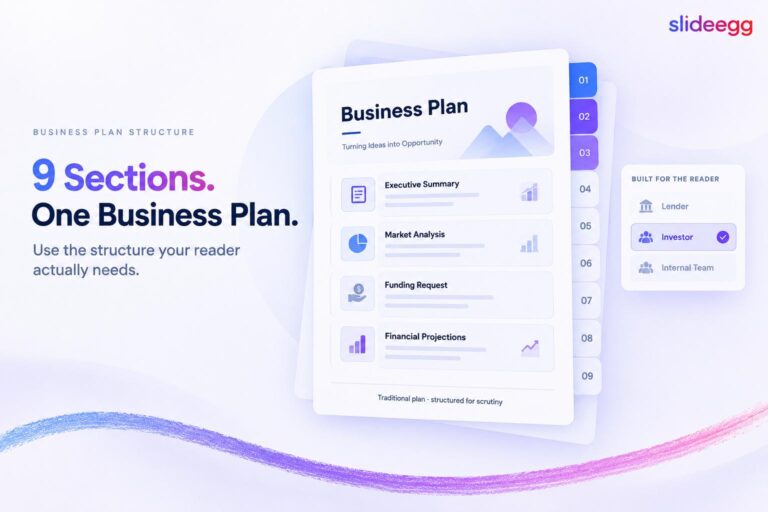
- They cut sections that don’t serve the decision. None of these structures needs every standard business plan section. Each can drop two or three, because the reader doesn’t need them.
- They end on a specific ask. Approve the budget, fund the round, sign the lease, and extend the grant. Not “thank you”.
The mistakes that show up in weak plans
| Mistake | Why it fails |
|---|---|
| The company-first opening | Slide one describes the business, slide two the team, and slide three the product. By the time the reader learns what problem is being solved, they’ve already decided how interested they are. |
| Projections with no stated assumptions | A five-year revenue chart with no basis is worse than no chart. Anyone who reads plans regularly will ask what’s behind it, and “we modelled it” ends the conversation. |
| The document is in slide form | Paragraphs shrunk to fit. If a slide can’t be understood in ten seconds, it belongs in an appendix. |
| Generic market sizing | A headline market figure says nothing about the share this business can reach. Sizing has to narrow to something addressable. |
| No limit acknowledged anywhere | A plan with no stated risk reads as one that hasn’t looked. Naming the constraint and showing you’ve planned around it is more persuasive than pretending it isn’t there. |
FAQ
What makes a business plan presentation structure worth copying?
Check four things: what the opening slide claims, whether evidence comes before or after the ask, where the financials sit in the sequence, and whether the closing slide requests a specific decision. If a structure gets those right for your audience, it’s worth copying. Design is not the variable that matters.
Should I copy a structure exactly or adapt it?
Adapt it. Keep the sequence and the emphasis, those encode who it was built for. Replace every placeholder figure, cut sections your reader won’t need, and add anything specific to your market. A structure copied exactly with someone else’s proportions usually spends slides on the wrong things.
Do investors and lenders expect different structures?
Yes, and it’s the most common mismatch. A lender is assessing whether the business can service debt, so cash flow, cost structure, and repayment capacity carry the argument, and growth projections get read sceptically. An investor is buying a share of future value, so market opportunity, traction, and team carry it instead. The same underlying plan needs a different order for each. What a business plan template should include breaks the sections down in detail.
Where can I find complete decks rather than single slides?
Browse the business plan and strategy PowerPoint templates collection and check each product page before downloading, some products are single-slide graphics rather than full decks, and the product page states which.
Start from the structure that fits your reader
These ten aren’t ranked. They’re built for different people making different decisions, and the useful question isn’t which is best, it’s who you’re presenting to on the day. Once you’ve chosen a structure, how to create a business plan presentation covers turning it into something you can deliver.