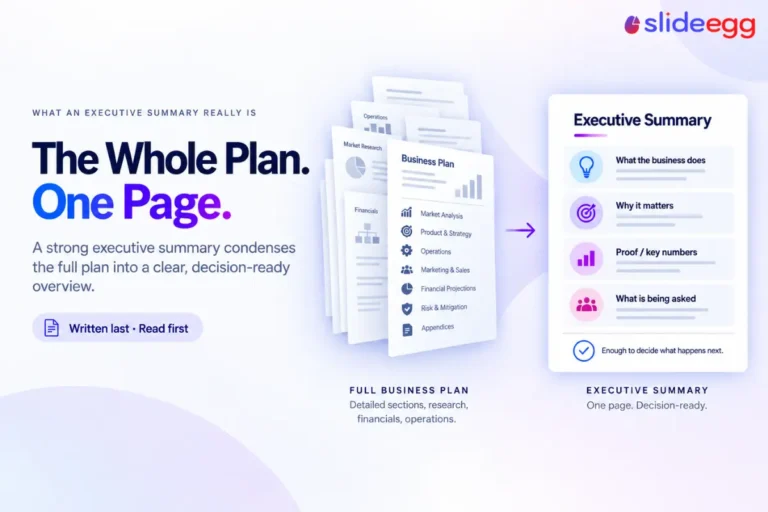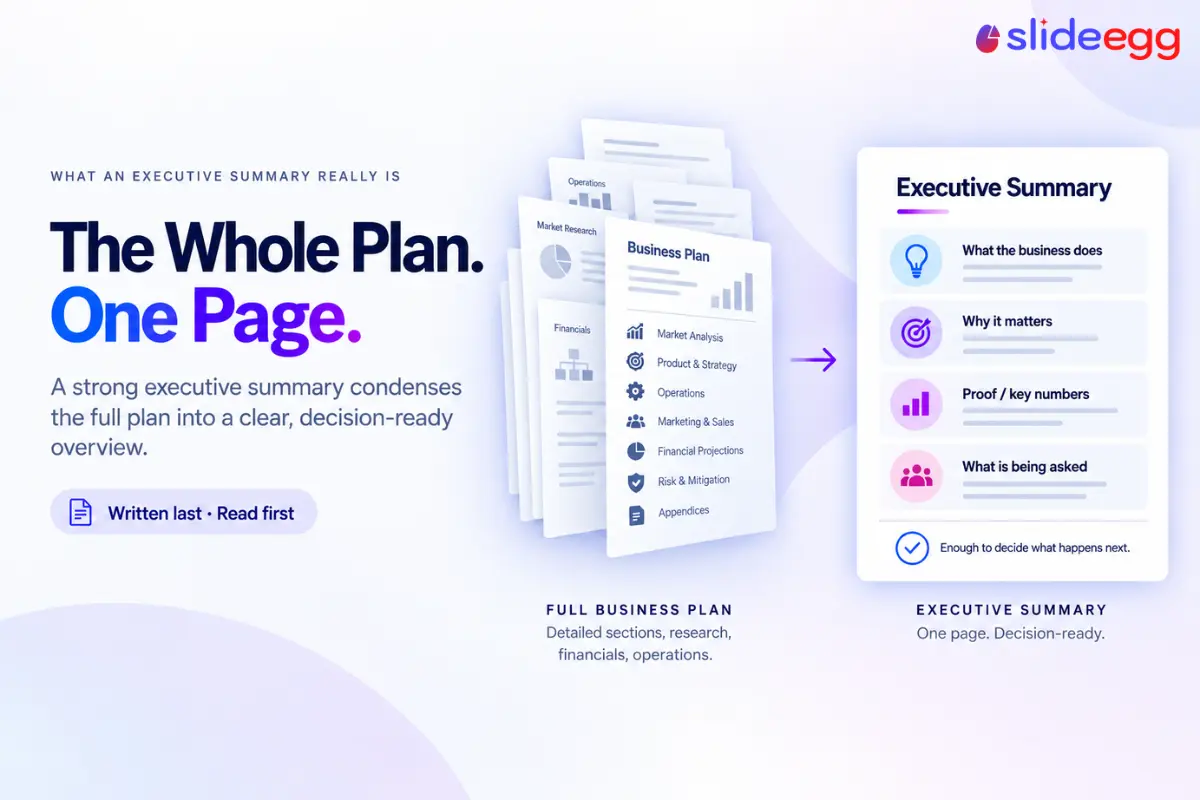
The executive summary is the section commonly written first and the one that should be written last. It is not an introduction to your business plan. It is the plan compressed into a page, and for many readers it is the only page they finish.
Here’s what belongs in it, how to write it once the rest of the plan exists, and how the emphasis shifts depending on who’s reading.
What is an executive summary in a business plan?

An executive summary is a one-page condensation of an entire business plan: what the business does, who it serves, how it makes money, what you’re asking for, and why the reader should believe you.
The distinction that matters is what it isn’t. An introduction sets up a document the reader is about to read. An executive summary replaces that document for a reader who may never get past page one. If someone read only your summary and nothing else, they should be able to reach a preliminary decision: fund it, don’t fund it, or ask for more.
That test is the whole job. Everything below serves it.
What goes in a business plan executive summary

The U.S. Small Business Administration’s guidance on writing a business plan describes the section like this:
“Briefly tell your reader what your company is and why it will be successful. Include your mission statement, your product or service, and basic information about your company’s leadership team, employees, and location. You should also include financial information and high-level growth plans if you plan to ask for financing.”
Read the last sentence again. The financial detail is conditional: it’s tied to whether you’re asking for money. That conditional is the first sign that a summary isn’t one fixed template, and it’s the idea the rest of this page builds on.
In practice, the section resolves into six components, in this order:
- The business in one sentence. What you sell and to whom. Not your mission, not your values, the transaction. If it takes two sentences, the business isn’t defined clearly enough yet.
- Problem and solution. Two or three sentences. What’s broken, and what do you do about it? This is where a reader decides whether to care, so it goes near the top and stays short.
- Market opportunity. The size of the addressable market and the slice you’re going after first. A headline industry figure proves nothing; the number that matters is the one you can realistically reach. Market sizing slides exist because “the market is huge” fails on contact with anyone who reads plans for a living.
- Traction or evidence. Revenue, users, signed contracts, pilots, letters of intent. If you have none, say what you’ve validated instead: customer interviews, a waitlist, a signed lease. “We have no revenue yet,” plus evidence of demand reads better than a projection with nothing behind it.
- The team. Why these specific people can execute this specific plan. Two lines, not biographies. The reader is checking for relevant scar tissue, not a CV.
- The ask. What you want, over what period, and what it buys. State the number. A summary that ends without a specific request leaves the reader with nothing to decide, and it’s also the component that disappears entirely when you aren’t seeking financing.
Not every plan needs all six at full weight. But the order holds, because it moves from what the business is to whether it can work to what happens next.
How to write it, step by step
- Write it last. You cannot compress a plan you haven’t finished. Drafting the summary first produces a statement of intentions, which is a different document and a weaker one. Finish the plan, then summarize it.
- Pull the numbers from the plan, don’t restate the narrative. A common failure is a summary that reads like a shortened company description. The numbers are what make it a summary: market size, revenue, runway, and the ask. Lift them directly so they match the detail sections exactly.
- Draft it long, then cut it in half. The first version is always about twice the length it should be. Cutting forces you to decide what the reader actually needs, which is the same decision the summary exists to make.
- Lead with whatever your reader doubts most. For an investor, that’s usually whether the market is real. For a lender, it’s whether you can repay. Opening with the company description answers a question nobody asked.
- End on the ask, stated specifically. Not “we look forward to discussing.” A number, a use, a timeline.
- Read it alone, cold. Print just that page and hand it to someone who hasn’t seen the plan. If they can’t tell you what the business does and what you want, it isn’t finished.
How long should an executive summary be?
One page is the working convention for a traditional business plan, and it’s a useful constraint rather than a rule: the discipline of fitting it on a page is what forces the edit.
A lean plan has no separate summary at all. Its one page is built from different components, so the opening line does the whole job. A plan read by a committee may run longer, but length should follow the reader’s decision, not a target. If your reader needs three pages to decide, the summary has stopped being a summary, and the plan structure is the problem.
How the same summary changes for each reader

The six components stay the same. What changes is what the opening line has to establish, where the space goes, and what you can safely compress to make room.
| Reader | The Opening Line Must Establish | Most of the Page Goes To | Safe to Compress |
|---|---|---|---|
| Investor | That the problem is real and large | Market opportunity and traction | Operating model, team history |
| Lender | That the business already generates cash | Trading history and repayment capacity | Growth narrative, market upside |
| Internal team | The decision being asked for | Owners, timelines, what changes Monday | Company description, market sizing |
| Grant committee | The need being addressed and who bears it | Impact, beneficiaries, sustainability after the grant | The profit argument |
The same underlying plan produces four different one-pagers. Writing one version and sending it to all four is a common reason a sound plan gets a lukewarm response: the reader can tell it wasn’t written for them.
This is about the summary’s internal balance. For which section of the whole plan each reader turns to first, what a business plan template should include covers that across all nine sections. For an investor audience, the summary usually becomes the opening slides of a deck rather than a page; investor pitch deck templates are built around that compressed sequence.
Common executive summary mistakes
- Written first. It summarizes what you intended to write rather than what you wrote, and the numbers drift from the detail sections.
- Reads as an introduction. Phrases like “this plan will outline” signal a preamble. The summary should contain the conclusions, not promise them.
- No numbers. A summary without figures is a description. The reader came for the size of the opportunity and the size of the ask.
- Numbers that don’t match the plan. If the summary says one revenue figure and the financial projections say another, every other number becomes suspect.
- No ask, when you’re asking. If you’re seeking financing and the page ends without a specific request, the reader finishes with nothing to decide.
- Three pages long. At that length, it competes with the plan instead of replacing it.
Turning the summary into an opening slide
Plans usually get read once and presented several times. Once the summary exists as a page, the next question is which parts survive the move to slides: usually the one-sentence business, the market number, the traction, and the ask, with everything else dropping into the body of the deck.
Our business plan and strategy PowerPoint templates are structured around the standard plan sections, so the mapping from document to deck is direct, and the executive summary templates collection covers the slide version specifically, including a full executive summary deck if you want the sequence already built.
For delivering it in the room, the business plan presentation section covers the presentation itself.
Frequently Asked Questions
Should the executive summary be written first or last?
Last. It condenses a finished plan, so writing it first produces a statement of intentions instead of a summary, and the figures in it tend to drift from the detail sections. Many people sketch a rough version early to clarify their own thinking, which is fine, but it should be rewritten from the completed plan before anyone else reads it.
What’s the difference between an executive summary and an elevator pitch?
An elevator pitch is spoken, runs about thirty seconds, and aims to earn a follow-up conversation. An executive summary is written, about a page long, and aims to let the reader make a preliminary decision without reading further. The pitch opens a door; the summary answers the questions behind it.
Do I need an executive summary in a one-page business plan?
Not as a separate section. The SBA describes lean startup plans as documents that “can take as little as one hour to make and are typically only one page,” but a lean plan isn’t a condensed traditional plan; it’s a different one-page format built from its own components, so there’s nothing left to summarize. What it still needs is a clear opening line stating what the business does and what you’re asking for, which is the summary’s job in a sentence.
How is an executive summary different in a pitch deck?
In a deck, the summary becomes the opening slides rather than a page of prose. The same six components appear, but they’re split across slides and carried by a single headline claim each, with the market and traction slides doing the work a paragraph does on paper. The written version is read at the reader’s pace; the deck version is delivered at yours.
Turn your summary into slides
Start from an executive summary template with the six components already laid out, then drop in your own numbers and the ask.