Someone asks you to “send the company deck,” but which one do they actually mean? Many businesses have multiple presentations, such as a company profile, a pitch deck, a sales deck, or a business proposal, and each serves a different purpose.
A company profile presentation introduces your business and builds trust. A pitch deck is designed to persuade investors or stakeholders to take action. Sending the wrong presentation can confuse your audience and weaken your message.
This guide compares company profiles and pitch decks by purpose, audience, content, evidence, and call to action so you can choose the right presentation for each business situation.
The Quick Answer: Which Presentation Do You Need?
Use a company profile presentation when your main goal is to introduce the business and establish credibility.
Use a pitch deck when you want a specific audience to invest, buy, approve, partner, fund, or take another defined action.
The simplest distinction is:
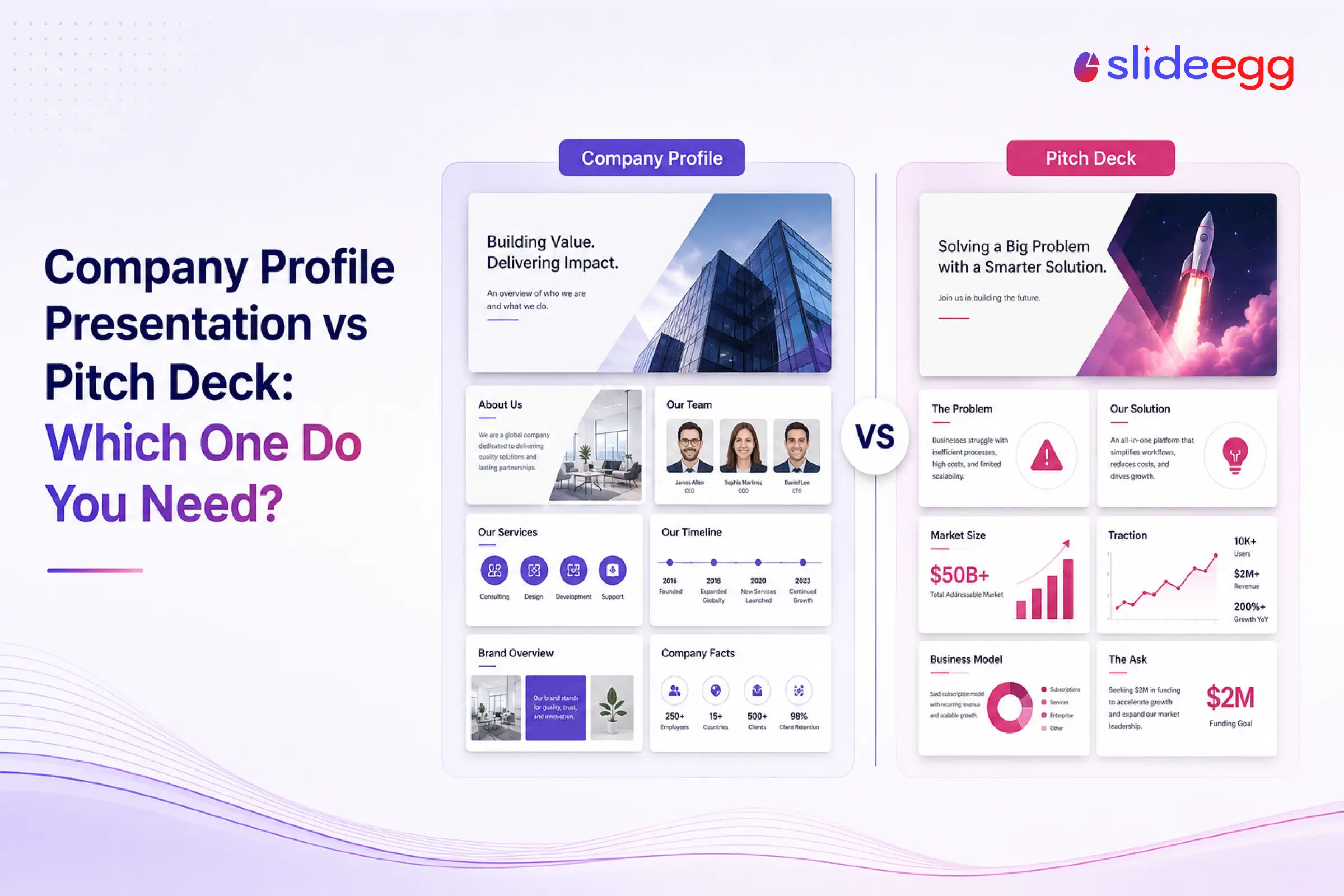
- Company profile: Who are we, what do we do, and why should you trust us?
- Pitch deck: What opportunity are we presenting, and why should you act?
A company profile explains the organisation. A pitch deck builds an argument around a decision.
Company Profile Presentation vs Pitch Deck at a Glance
| Factor | Company Profile Presentation | Pitch Deck |
|---|---|---|
| Main purpose | Introduce the company and build credibility | Persuade an audience to make a specific decision |
| Core question | Who are you, and why should we trust you? | Why should we act? |
| Typical audience | Clients, suppliers, partners, employees, and general stakeholders | Investors, prospective buyers, partners, executives, and approval stakeholders |
| Main goal | Understanding and trust | Commitment or a defined next step |
| Scope | The company as a whole | A specific problem, product, opportunity, or request |
| Opening | Company introduction or positioning statement | Problem, opportunity, or strong business insight |
| Common content | Company overview, services, capabilities, team, clients, history, and achievements | Problem, solution, market, traction, business model, financials, and ask |
| Financial information | Optional and usually limited | Often essential in investor pitches |
| Call to action | Contact us or continue the discussion | Invest, buy, approve, pilot, or partner |
| Design style | Brand-led and reusable | Audience-led and opportunity-specific |
| Reuse | Can be adapted for several general situations | Should be customised for each audience |
| Update frequency | Updated when company facts change | Updated whenever the audience, opportunity, or evidence changes |
There is no universal slide count for either presentation. The right length depends on the audience, meeting format, complexity of the business, and amount of evidence required. For pitch decks specifically, see our guide on 10-Slide Pitch Deck vs 22-Slide Pitch Deck: Which Should You Use?
What Is a Company Profile Presentation?
A company profile presentation is a structured introduction to a business.
It explains who the company is, what it offers, whom it serves, and what makes it credible. It is usually designed as a reusable corporate asset rather than a presentation created for one specific deal.
A company profile may be shared during:
- Client introductions
- Vendor registration
- Partnership discussions
- Trade shows
- Distributor meetings
- Employee onboarding
- Corporate events
- Capability presentations
- General business enquiries
What is its main purpose?
The main purpose is to build understanding and trust. The audience should finish the presentation knowing what the company does, which products or services it offers, and why it is capable of doing the work.
A company profile does not always need to persuade the audience to make an immediate purchase or investment. Its first job is to make the business clear and credible. For a complete slide-by-slide structure, see our guide on how to design a winning company profile presentation.
Who normally receives it?
A company profile may be useful for prospective clients, suppliers, distributors, strategic partners, and general stakeholders. Because these audiences have different interests, even a reusable profile should be adjusted before important meetings.
A distributor cares about capacity and locations, whereas a buyer looks for specific criteria. For example, understanding what B2B buyers look for in a logistics company profile reveals that they prioritize operational scale and historical reliability over high-level vision statements.
What action should it produce?
A company profile usually supports a low-pressure next step, such as:
- Request more information
- Arrange a meeting
- Explore the company’s services
- Consider the company as a vendor
- Begin a partnership discussion
- Contact the sales team
The next step is usually lower-commitment than the action requested in a pitch deck.
What Is a Pitch Deck?

A pitch deck is a focused business presentation designed to persuade a specific audience to support an opportunity, proposal, or request. In startup conversations, the term usually refers to an investor pitch deck, but the same principle can also apply to sales, partnership, and product pitches.
The audience is not only learning about the company. They are being asked to make a decision.
A pitch deck may be used to:
- Raise investment
- Sell a product or service
- Secure a partnership
- Win internal approval
- Launch a pilot project
- Apply to an accelerator
- Propose a new business initiative
- Request funding
What does “pitch deck” mean?
The term is often used to describe an investor presentation, especially in startup discussions. However, not every pitch deck is for investors.
Common types include:
- Investor pitch deck
- Sales pitch deck
- Partnership pitch deck
- Product pitch deck
The broader idea of pitching is not limited to fundraising. Guy Kawasaki’s 10/20/30 framework describes pitching as a way to reach agreement, including raising capital, making a sale, or forming a partnership.
What is its main purpose?
A pitch deck should move the audience toward a clear decision. The argument, evidence, and level of detail should change according to the audience and the decision being requested. For fundraising presentations, for example, a seed-stage deck and a Series A deck should not use the same evidence or emphasis.
What Content Usually Appears in a Company Profile?
A company profile normally gives the audience enough information to understand the business and judge its credibility. Common sections include:
- Company overview
- Mission and vision
- Products or services
- Company history and milestones
- Industries or customers served
- Capabilities
- Leadership
- Clients and case studies
- Certifications or achievements
- Locations
- Contact information
The exact sequence should depend on the audience. A distributor may need more operational information, while a potential client may care more about relevant services, experience, and results.
What Content Usually Appears in a Pitch Deck?
A pitch deck is structured around a specific argument rather than a complete description of the company. Depending on the type of pitch, it may include:
- Problem or opportunity
- Solution
- Product or service
- Target market
- Business model
- Competitive position
- Go-to-market strategy
- Traction or evidence
- Team
- Financial information
- Specific ask
- Next step
Investor, sales, partnership, and product pitches should not use exactly the same structure. The content should reflect the decision the audience is being asked to make.
For a complete slide-by-slide breakdown, see our guide on how to make a pitch deck.
How Should the Design Style Change?
Design should reflect the purpose of the presentation, not just the company’s visual identity.
Company profile design
A company profile is usually brand-led, reusable, consistent across sections, and broad enough to introduce the organisation. Company photography, capabilities, achievements, team information, and proof often play an important role.
Pitch deck design
A pitch deck is usually more tightly edited and audience-specific. The design should strengthen one argument, make evidence easy to understand, and keep the requested action obvious.
Good design cannot fix the wrong presentation
A polished company profile is still the wrong deck when an investor expects an investment case. Likewise, a highly persuasive pitch deck may be inappropriate when a supplier simply needs to verify your company’s capabilities and credentials.
Start with the audience and decision. Choose the design after that.
When Should You Use a Company Profile Presentation?
Choose a company profile when the audience mainly needs to understand the business.
Common situations include:
General business introduction
Use it when someone asks for an overview of the company before deciding whether to continue the conversation.
Vendor registration
Focus on legal information, capabilities, certifications, capacity, clients, and operational reliability.
Distributor meeting
Emphasise products, supply capacity, market presence, support, and distribution expectations.
Trade show
Use a shorter version that communicates the business quickly and supports follow-up conversations.
Employee onboarding
Adjust the profile to include history, mission, values, structure, major services, and culture.
Early partnership conversation
Use it to establish context before preparing a more specific partnership proposal.
A company profile may support a sales process, but it does not replace a tailored sales presentation or proposal.
When Should You Use a Pitch Deck?
Choose a pitch deck when the audience must evaluate a specific proposal.
Common situations include:
Fundraising
An investor needs to understand the opportunity, evidence, risks, potential growth, financial need, and use of funds.
Sales meeting
A buyer needs to see that you understand their problem and can produce a valuable outcome.
Partnership proposal
The audience needs to understand the shared opportunity, each party’s role, expected benefits, and next step.
Internal approval
Executives may need to approve a project, product, budget, expansion plan, or strategic initiative.
Pilot proposal
A client needs to understand the scope, timeline, cost, success criteria, and expected result.
The defining factor is not the age or size of the company. It is whether a specific decision is required.
5 Realistic Company Profile vs Pitch Deck Scenarios
Scenario 1: A startup meeting angel investors
A pre-seed software startup has developed a working prototype and completed customer interviews.
It needs a pitch deck.
The presentation should focus on:
- Customer problem
- Product insight
- Early validation
- Target market
- Business model
- Team
- Funding need
- Use of funds
The company history may require only one sentence. Investors do not need several slides about how the founders met.
Scenario 2: An established manufacturer meeting a distributor
A manufacturer with 20 years of experience wants to enter a new regional market.
It needs a company profile presentation.
The presentation should focus on:
- Product range
- Manufacturing facilities
- Production capacity
- Quality controls
- Certifications
- Current markets
- Logistics
- Existing customers
The distributor is evaluating credibility and operating capability, not a startup investment opportunity.
Scenario 3: A software company attending a sales meeting
A software company is meeting an enterprise buyer with a known operational problem.
It needs a sales pitch deck.
A few company profile slides may establish credibility, but most of the presentation should cover:
- The buyer’s problem
- Business impact
- Proposed solution
- Product workflow
- Integration
- Implementation
- Security
- Relevant customer proof
- Pricing or next step
Sending a generic company profile would force the buyer to work out how the software applies to their problem.
Scenario 4: A growing company meeting investors
An established company wants capital to open new locations.
It needs an investor pitch deck.
The company may already have a strong profile, but investors will still expect:
- Expansion opportunity
- Current performance
- Unit economics
- Market demand
- Financial projections
- Capital requirement
- Use of funds
- Expected milestones
The company profile may be supplied as background material. It cannot replace the investment case.
Scenario 5: An agency responding to a client brief
A marketing agency has been invited to present a proposal for a product launch.
It needs a client proposal or sales pitch.
Only a small part should describe the agency.
Useful company profile content includes:
- Relevant experience
- Selected team
- Similar work
- Client results
The rest should address:
- The client’s challenge
- Proposed strategy
- Deliverables
- Timeline
- Responsibilities
- Pricing
- Expected outcomes
For this situation, a business proposal presentation is more appropriate than a general company profile.
Can You Combine a Company Profile and a Pitch Deck?
Yes, but one purpose should remain dominant.
Company profiles and pitch decks can contain similar slides, such as team, achievements, customer proof, and company overview. The difference is not simply the slide title; it is why that information is being shown and what decision it supports.
Borrow slides, not structures. A sales or investor pitch can reuse selected company-profile material, such as a company overview, team, experience, or customer proof, without turning into a full corporate profile. The rest of the presentation should remain focused on the specific decision.
Company Profile or Pitch Deck? Use This 4-Question Framework
Before choosing a template, answer four questions.
1. Who is the audience?
Do not answer with “business people” or “stakeholders.”
Be specific:
- Angel investors
- Enterprise buyers
- Distributors
- Government procurement officers
- Potential employees
- Strategic partners
2. What do they already know?
A first-time visitor may need context. An existing client may not need another company introduction.
Remove information the audience already understands.
3. What decision must they make?
Examples:
- Should we trust this company?
- Should we invest?
- Should we purchase?
- Should we approve the project?
- Should we enter a partnership?
- Should we schedule another meeting?
4. What evidence will make the decision easier?
That evidence may include:
- Experience
- Results
- Market research
- Customer proof
- Financial data
- Certifications
- Product demonstrations
- Implementation plans
- Risk controls
Use the result:
- Use a company profile when the audience mainly needs to understand and evaluate the business.
- Use a pitch deck when the audience must make a specific decision.
- Combine them carefully when the audience needs brief company context before evaluating a specific proposal or opportunity.
A useful final test is to ask what is being evaluated. If the audience is mainly evaluating the company itself, start with a company profile. If they are evaluating a specific opportunity, proposal, investment, purchase, or approval request, use a pitch deck.
Frequently Asked Questions
1. Can a freelancer create a company profile presentation?
Yes. Replace corporate history and department slides with expertise, services, work process, selected clients, testimonials, and contact details.
2. Does a one-person startup need a team slide?
Yes, but present the situation honestly. Show the founder’s relevant experience and include genuine advisors, contractors, or planned hires only when appropriate.
3. Should prices appear in a company profile?
Only when the prices are standard and useful to the audience. Custom pricing normally belongs in a sales proposal, quotation, or client-specific pitch.
4. Should confidential financial information be included?
Not in a general company profile. Share detailed financial information only with an appropriate audience and at the correct stage of the discussion.
5. Which file format should I send by email?
PDF is usually the safest format for an emailed, read-only version because it preserves the presentation’s formatting and layout across devices. Keep the editable PowerPoint or Google Slides file for updates and live presentations.
6. Should the emailed deck and live deck be identical?
Not always. An emailed deck needs enough explanation to stand alone. A live deck can contain less text because the presenter supplies the context.
7. How often should a company profile be updated?
Review it whenever your leadership, services, locations, certifications, clients, or major achievements change. A formal review every six months prevents outdated information from remaining in circulation.
8. How often should a pitch deck be updated?
Update it whenever the audience, offer, metrics, financial assumptions, market evidence, or requested action changes.
9. Can I use the same slides in both presentations?
Yes, some slides can be reused, especially the company overview, team, customer proof, and selected achievements. However, the overall story should change. A pitch deck should include only the company information needed to support the specific decision.
10. Is a sales deck the same as a pitch deck?
A sales deck serves a similar persuasive purpose but is built specifically for prospective customers. It focuses on the buyer’s problem, proposed solution, proof, implementation, and next step rather than presenting the company as a whole.
Conclusion
A company profile and a pitch deck can share slides, branding, and company information, but they are built around different questions.
A company profile helps an audience evaluate the business: Who are you? What do you do? What experience, capabilities, and proof make you credible?
A pitch deck helps an audience evaluate a specific opportunity or proposal: What is the problem or opportunity? Why does your solution make sense? What evidence supports it? What should the audience do next?
Before opening a template, identify the audience, what they already know, the decision in front of them, and the evidence they need.
If the company itself is being evaluated, start with a company profile. If a specific investment, purchase, partnership, project, or approval is being evaluated, build a focused pitch deck.