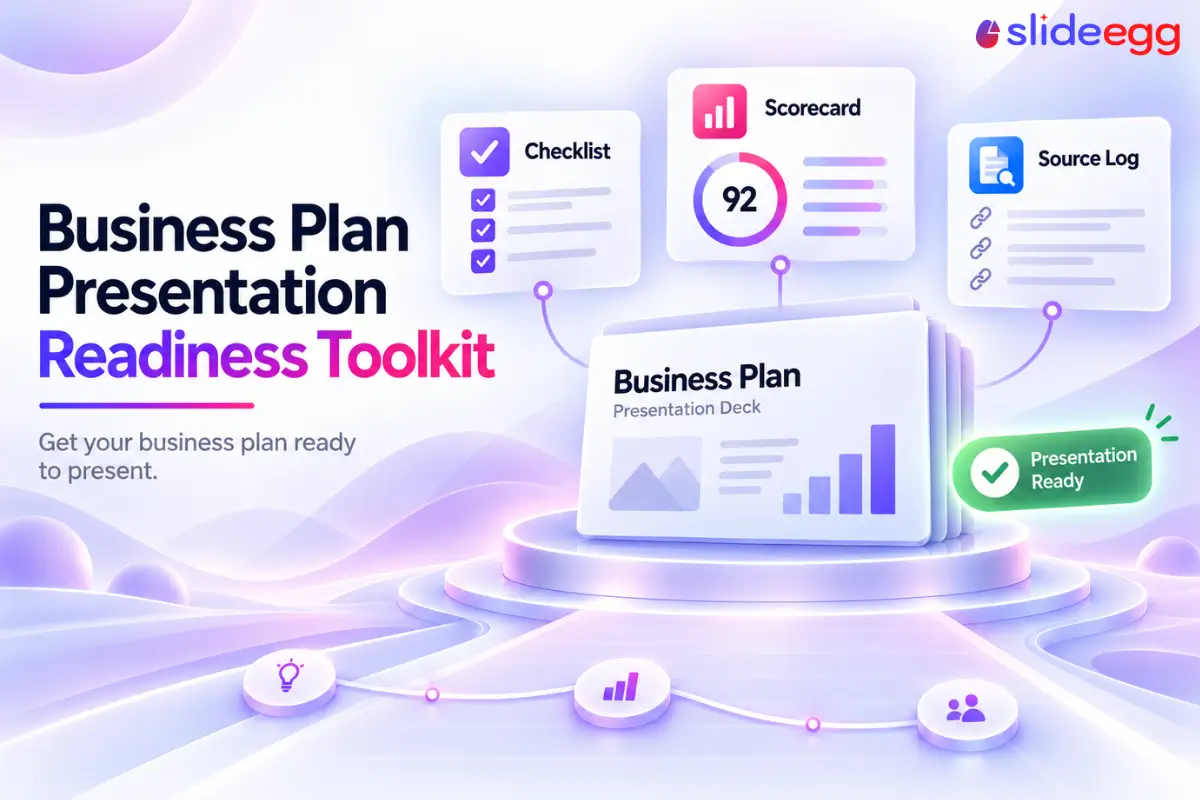
Most business plan presentations get proofread before they go out and almost never get checked for the things that actually sink a pitch: an unsupported claim, a slide nobody can explain the purpose of, a number with no source behind it. This toolkit, a checklist, a scorecard, and a source log, is built to catch exactly that, before you present, not after someone in the room asks a question you can’t answer.
Quick Answer
- Three parts: a checklist (is everything here), a scorecard (how strong is each section), and a source log (where did the evidence come from).
- Run the checklist first, it’s the fastest and catches outright gaps.
- Use the scorecard to decide which sections need another editing pass before the room sees the deck.
- Keep the source log as a working document, not a slide, pull it up if someone asks where a number came from.
- Tight deadline? run the checklist at minimum; add the other two for anything going in front of investors or lenders.
Why a toolkit, not just a checklist
A checklist alone tells you whether something is missing. It doesn’t tell you whether what’s there is any good, or whether you could actually defend it if someone pushed back. A business plan presentation, especially one going to investors, lenders, or a review board, gets challenged in ways a normal internal deck doesn’t. Three failure modes show up over and over: a slide exists but its purpose is unclear even to the presenter, a claim sounds confident but has no evidence behind it, and a number gets used without anyone able to say where it came from or how current it is.
Each part of the toolkit targets one failure mode directly. The checklist catches missing pieces. The scorecard catches weak-but-present sections. The source log catches unsupported claims. Running all three before you present is what separates a deck that merely looks finished from one that can survive being questioned.
Part 1: The readiness checklist
This is a yes/no pass through the deck, section by section. The goal isn’t depth, it’s coverage: does every piece that needs to be here actually exist.
- Does every slide have a single, statable purpose, one sentence explaining why it’s in the deck?
- Is the ask (funding amount, decision needed, next step) stated explicitly, not left implied?
- Does the market or opportunity section include at least one externally sourced figure?
- Is there a slide addressing the most obvious objection a skeptical reader would raise?
- Does the deck match the slide count and structure appropriate for its audience?
- Is the financial section internally consistent (summary slide matches detail slides)?
If you’re not sure what the full expected slide list looks like before running this pass, check what slides a business plan presentation should include first, since the checklist assumes you already know what’s supposed to be there.

Built for exactly the yes/no pass above, this holds the checklist items in one scannable view rather than a loose document you have to reformat.
Part 2: The scorecard
Once you know nothing’s missing, the scorecard asks a harder question: how strong is each section, really. Score each area from 1 (weak or missing) to 5 (would hold up under questioning), rather than treating the deck as pass or fail as a whole.
| Section | What “5” looks like | What “1” looks like |
|---|---|---|
| Problem & opportunity | Backed by an external data point with a source and date | Asserted with no evidence |
| Market size | Sourced, dated, and the method (TAM/SAM/SOM) is clear | A single unsourced number |
| Financial projections | Assumptions are stated explicitly and are defensible | Numbers appear with no stated assumptions |
| Competitive positioning | Names real competitors and states a specific differentiator | Vague claim of being “different” or “better” |
| The ask | Specific amount or decision, tied to a stated use | Implied but never stated outright |
Sections scoring 3 or below are the ones worth another editing pass before anyone outside your team sees the deck. This works especially well alongside business plan presentation examples by audience, since what counts as a “5” on the ask or the market section shifts depending on your reader.

A natural home for this scorecard, structured for rating sections against criteria rather than just listing them.
Part 3: The source log
Every external number in the deck goes in this log, kept separately from the presentation itself: the figure, where it came from, the date it was published, and the date you pulled it. This formalizes the same two-layer discipline covered elsewhere, a short credit on the slide, the full detail in a backup document, into something you fill in as you build the deck rather than reconstruct under time pressure.
Market size: $4.2B | Source: IBISWorld, Global Widget Market Report | Published: March 2026 | Pulled: today’s date
That’s the whole format: figure, source, publication date, pull date. A shared spreadsheet with those four columns covers every number in the deck. For wording the source line itself, see how to cite market research and statistics in a business plan.

The same backup slide the citation article describes, kept out of the main deck but ready the moment someone asks where a figure came from.
Turning findings into action
A checklist with gaps and a scorecard with low scores are only useful if they turn into a concrete next step. For each item that fails or scores 3 or below, write down what specifically needs to happen: which slide gets rebuilt, which number needs a source, which assumption needs to be stated out loud. Assign it an owner and a deadline, even if that owner is just you. That’s what actually gets fixes made instead of noted and forgotten, and where a deck earns real credibility: not from looking polished, but from every claim having an owner who can defend it.

Holds the punch list above, with room for an owner and a deadline next to each fix instead of a plain bullet list.
How to run the full pass
- Run the checklist first. Flag anything missing outright.
- Score the sections that pass the checklist using the scorecard.
- Pull every external number into the source log, checking each one has a source and a date.
- Turn every checklist gap and low score into a specific, owned action item.
- Fix what you can before the presentation date; for anything you can’t, have the honest answer ready if it comes up.
What this catches that proofreading doesn’t
| What proofreading checks | What the readiness toolkit checks |
|---|---|
| Spelling, grammar, formatting consistency | Whether every slide has a stated purpose |
| Whether slides look visually polished | Whether claims have evidence behind them |
| Whether the deck reads smoothly start to finish | Whether numbers are sourced and dated |
| Whether text fits the slide | Whether the ask is stated explicitly, not implied |
A deck can pass every proofreading check and still fail this toolkit entirely. The two check for different things, and skipping the second because the first is done is how decks that look ready turn out not to be.
FAQ
What’s the difference between this toolkit and a normal proofreading pass?
Proofreading catches typos and formatting. This toolkit checks substance: whether every claim has evidence behind it, whether the numbers are sourced and dated, whether each slide has a clear purpose, and whether you know what you’re asking for at the end. A deck can be typo-free and still fail all four.
Do I need all three pieces, or can I just use the checklist?
The checklist alone catches missing pieces. The scorecard adds a sense of how strong each section is, not just whether it exists. The source log matters most for anything citing outside data. If you’re on a tight deadline, run the checklist at minimum; add the other two for anything going in front of investors or lenders.
How long does a full readiness pass take?
For a deck you already know well, 20 to 30 minutes covers the checklist and scorecard together. The source log takes longer the first time, since you’re pulling together citations you may not have tracked as you built the deck, but it gets faster on the next presentation once you’re in the habit.
Should the scorecard scores actually go in the presentation?
No. The scorecard is a working document for you or your team, not audience-facing. Its job is to flag which sections need another pass before the room sees the deck, not to show up as a slide.
Does this replace getting feedback from another person?
No. It catches structural and evidence gaps you can check on your own, but it won’t tell you if your argument is actually convincing to a skeptical reader. Running the toolkit first means the feedback you get from someone else is about substance, not about things this checklist would have caught anyway.
The Bottom Line
None of the three parts here are complicated on their own, a checklist, a scorecard, and a log of sources. What makes them useful is running all three before you present instead of finding the gaps in the room. Once the deck passes its own readiness check, the template itself is worth a second look too. See how to choose the right business plan presentation template for picking a layout that already has room for the sourcing and structure this toolkit checks for.
Check readiness before the room does
A checklist for gaps, a scorecard for weak spots, a source log for evidence. Run all three, and start from a layout that already has room for the checking and sourcing this toolkit calls for.