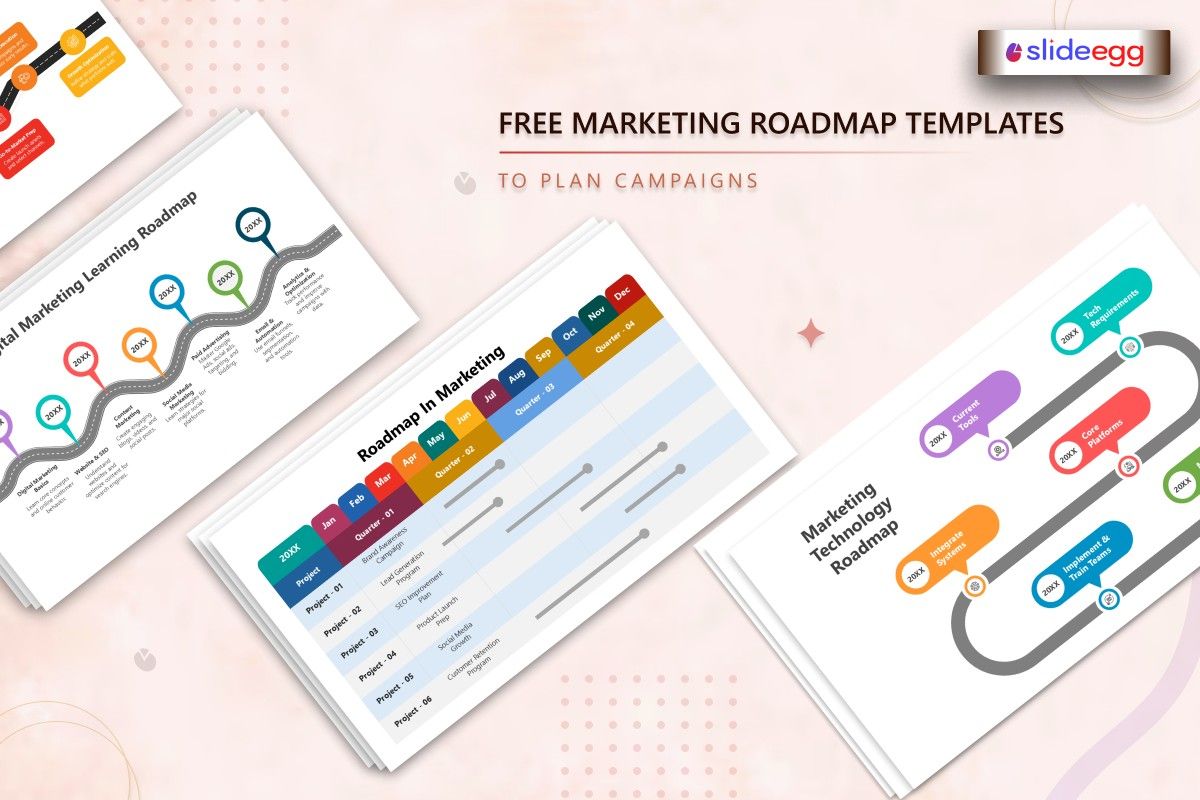
A marketing roadmap is the strategic backbone of every high-performing marketing team. It shows leadership where marketing is headed, gives the team a shared execution plan, and helps every campaign, content piece, and channel initiative connect back to a business goal. This guide covers how to build one — and where to get a free, ready-made template.
Marketing teams are constantly juggling a dozen competing priorities — content calendars, paid campaigns, events, product launches, SEO projects, and brand initiatives — all at the same time. Without a visual roadmap, the strategy lives in spreadsheets, email threads, and individual heads. That’s a recipe for missed deadlines, duplicated effort, and leadership confusion.
A free marketing roadmap template from SlideEgg gives your team a single source of truth — a clear, shareable view of what’s planned, when, and why.
What Is a Marketing Roadmap?
A marketing roadmap is a visual strategic plan that maps out all major marketing initiatives across a defined time period — typically a quarter, half-year, or full year. It shows which campaigns and projects are planned, when they launch, what channels they use, and how they connect to business goals.
It is different from a marketing calendar (which is a detailed schedule of individual content pieces and posts) and different from a marketing strategy document (which is a written plan). The roadmap is the bridge between strategy and execution — high-level enough for leadership, specific enough for the team.
Types of Marketing Roadmaps
Campaign Roadmap
Shows all planned marketing campaigns across the year — by channel (paid, organic, social, email, events) and by quarter. The most common type for marketing managers presenting to CMOs or CEOs.
Content Marketing Roadmap
Plans the content strategy — blog posts, videos, whitepapers, case studies, and podcasts — mapped against audience segments and funnel stages. Commonly used by content marketing teams and SEO leads.
Product Launch Roadmap
A go-to-market roadmap specifically for launching a new product, feature, or market segment. Shows pre-launch, launch, and post-launch marketing phases, with channel-specific activities in each phase.
Digital Marketing Roadmap
Covers the evolution of digital marketing channels and capabilities — SEO, paid search, social, email, and marketing automation — often used when planning a digital marketing transformation or tooling upgrade.
Key Components of a Marketing Roadmap
- Marketing channels or themes: Rows representing the main areas — Demand Generation, Content, SEO, Paid Media, Events, Brand, and CRM/Email.
- Time horizon: Quarterly or monthly columns across the top. Annual roadmaps typically use quarters; quarterly planning sessions use months.
- Campaign and initiative names: Named bars or boxes in each channel lane, placed in the appropriate time column.
- Business goals link: A header or colour legend linking each lane to a business priority (e.g., awareness, lead generation, retention).
- Key launch dates: Product launches, events, or campaign go-live dates marked as milestone diamonds on the timeline.
How to Create a Marketing Roadmap in PowerPoint
1. Download a Multi-Lane Roadmap Template
Choose a template from SlideEgg with multiple horizontal lanes and a quarterly timeline. The Strategic Planning Roadmap template works well as a base — it has the lane-and-timeline structure that a marketing roadmap needs, ready to customize.
2. Define Your Marketing Channels as Lanes
Replace the default row labels with your key marketing channels. A typical set: Paid Media, Organic/SEO, Content Marketing, Email & CRM, Events & Webinars, Social Media, Partnerships. You do not need all channels — only include the ones active in your plan.
3. Plot Campaigns and Projects in Each Lane
Add each campaign or marketing initiative as a labelled bar in the relevant lane and time period. Use a colour per funnel stage: blue for awareness, orange for consideration, green for conversion, purple for retention. Keep names short: “Q2 Brand Campaign,” “April Product Launch,” “SEO Content Sprint.”
4. Add Key Launch Milestones
Mark critical dates — product launches, major events, campaign go-lives, and end-of-quarter reviews — as milestone diamonds above or between the lanes. These are the “anchor points” that the whole marketing calendar aligns to.
5. Link to Business Goals at the Top
Add a row at the top (or a legend) showing the 3–5 business goals driving the roadmap: e.g., “Grow pipeline by 30%,” “Increase brand awareness in APAC,” “Reduce churn by 15%.” This grounds every campaign in a business outcome — essential for CMO and board presentations.
Build your marketing roadmap before campaign-level planning begins. The roadmap is your commitment to leadership; the campaign briefs are your execution plans. Getting leadership sign-off on the roadmap first prevents scope creep and last-minute budget cuts mid-campaign.
Free Marketing Roadmap Templates from SlideEgg
Strategic Planning Roadmap PowerPoint Template
Multi-lane roadmap ideal for plotting marketing channels and quarterly campaigns. 14 slides, fully editable.
Sales Strategy Roadmap PowerPoint Template
Phased sales and marketing strategy roadmap covering market analysis, planning, execution, and optimisation.
Product Development Roadmap PowerPoint Template
Go-to-market roadmap covering concept, design, testing, and launch phases. Ideal for product launch marketing plans.
Roadmap Communication Strategy PowerPoint Template
A roadmap designed for presenting marketing communication plans to stakeholders across channels and quarters.
How to Present a Marketing Roadmap to Leadership
Leadership audiences — CMOs, CEOs, and boards — are not interested in the individual campaigns. They want to see the strategic narrative: how the marketing plan connects to revenue goals. Structure your roadmap presentation around this framework:
- Open with the business goals: Before showing the roadmap, state the 2–3 growth targets the marketing plan is designed to deliver against.
- Walk the lanes, not the bars: Explain each channel lane and its role in the funnel — not each individual campaign.
- Highlight the inflection points: Focus on 2–3 key moments in the roadmap where marketing investment peaks — typically major campaign launches or product launch moments.
- Close with ROI expectations: What revenue, pipeline, or brand lift does this roadmap deliver? Always end with a number.
Plan your marketing year with clarity. Download a free roadmap template — editable in PowerPoint, Google Slides, and Canva — and get your team aligned around a single strategic view.
Frequently Asked Questions
What is the difference between a marketing roadmap and a marketing calendar?
A marketing calendar shows the day-by-day or week-by-week schedule of specific content and activities — blog posts, social posts, email sends, and ad launches. A marketing roadmap is higher-level: it shows the strategic initiatives, campaigns, and channel priorities across quarters. The roadmap drives the calendar, not the other way around.
How many lanes should a marketing roadmap have?
Four to six lanes covers most marketing teams effectively. A typical set: Paid Media, Content/SEO, Email & CRM, Events, Social, and Partnerships. If your team is smaller, collapse related channels into broader lanes (e.g., “Digital Paid” covers all paid channels; “Organic” covers SEO and content).
Should a marketing roadmap include specific campaign budgets?
For a leadership presentation, include order-of-magnitude budget allocations per lane or quarter (e.g., “Q2 Paid Media: ~$120K”). Exact budget line items belong in a separate budget document. The roadmap is a strategic communication tool — it should tell the story of priorities, not function as a finance spreadsheet.
How far ahead should a marketing roadmap plan be?
One year is the most common planning horizon for marketing roadmaps, with the roadmap divided into four quarters. Q1 should have detailed, confirmed activities; Q2–Q3 should have planned initiatives; Q4 can be directional. Many teams run a rolling quarterly planning process that refreshes the roadmap every 90 days.