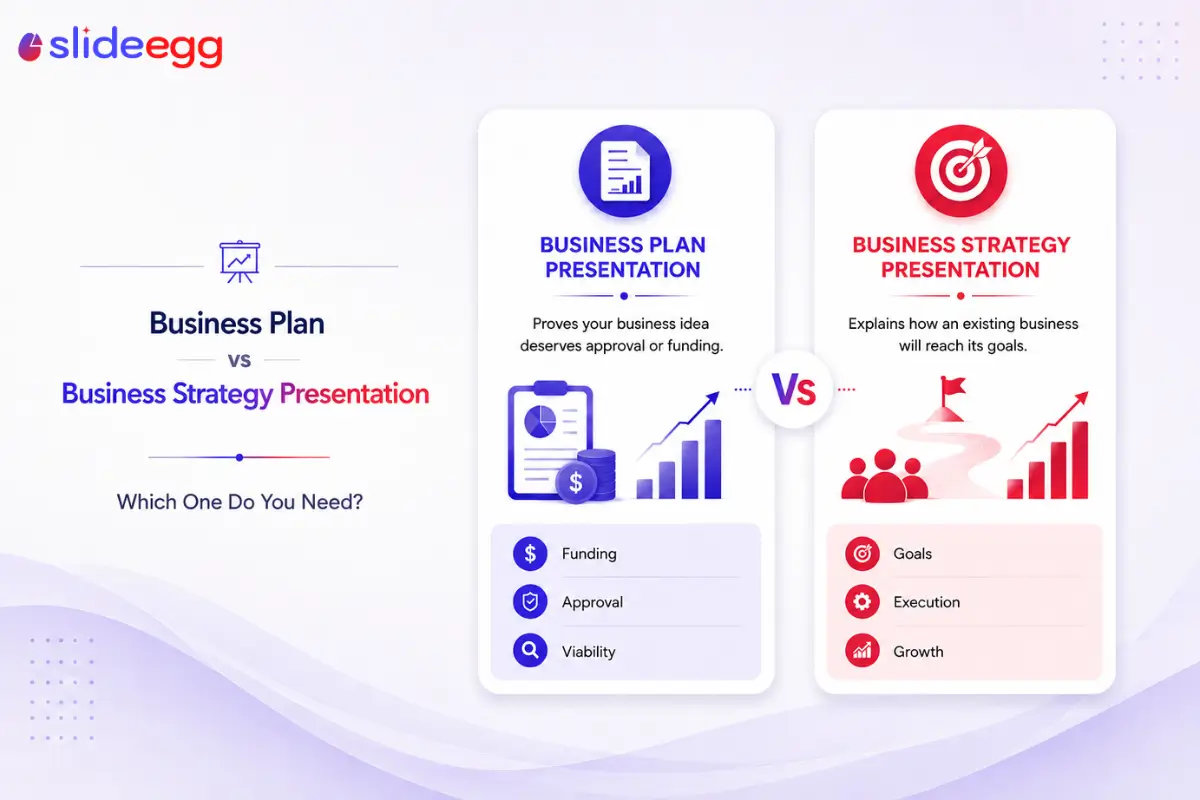
Someone asks you to “put together a business plan presentation,” and what you actually build is a slide deck about this quarter’s growth initiatives. It won’t hold up, the first question from the room will be about funding or financial projections, and that deck doesn’t have them.
A business plan presentation and a business strategy presentation get treated as the same request more often than they should be. They’re not. One argues that a business should exist and get funded. The other assumes the business already exists and explains how it’s going to hit its next goal. Confusing them wastes prep time and, worse, tells the room you didn’t know why you were asked to present.
Search for a business plan and strategy template and you’ll get both types mixed into the same results, which is exactly how this mix-up starts.
The Short Answer
If you’re trying to prove a business, or a new part of one, deserves funding, a loan, or approval, build a business plan presentation. If the business already exists and you’re explaining how it will reach a specific goal, build a business strategy presentation. The test: does the thing you’re presenting already have a green light, or are you trying to get one?
The Business Plan Presentation
A business plan presentation is the slide version of a business plan, built to convince someone who wasn’t involved in developing the idea that it’s viable. It exists because the business, or the part of it being pitched, hasn’t launched, been funded, or been approved yet.
It’s read by people who need to decide whether to say yes: investors, lenders, accelerator judges, or an internal committee weighing whether to fund a new venture.
What it typically includes:
- Executive summary
- The problem and the opportunity
- Product or service
- Market size and target customer
- Business model, how it makes money
- Go-to-market plan
- Competitive landscape
- Financial projections
- Team
- The ask, funding, a loan, or internal approval
You need this deck when you’re starting a business, raising a round, applying for a business loan, entering a pitch competition, or asking leadership to fund something that doesn’t exist yet.
If you’re converting an existing written plan into slides, our guide on turning a written business plan into a presentation covers what to keep, cut, and visualize.
The Business Strategy Presentation
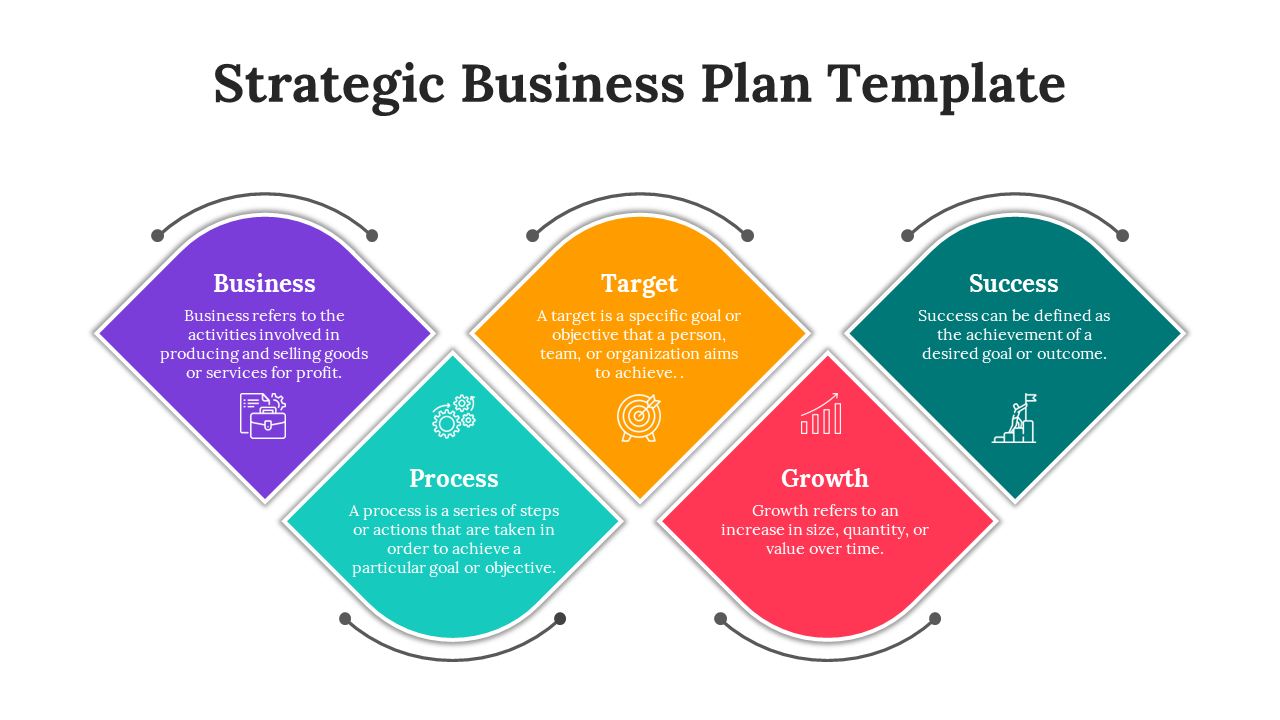
A business strategy presentation is built for a business that’s already operating. It doesn’t try to prove the business should exist, it explains how the business, or a team, product line, or region inside it, will get from where it is to a specific goal, over a defined period. It’s about execution, not viability.
It’s read by people who already work there or govern it: the leadership team, the board, department heads, or staff who need to align around the plan.
What it typically includes:
- Current position, market context, internal strengths and gaps
- Strategic goals and priorities
- Key initiatives tied to those goals
- Owners, timelines, and KPIs for each initiative
- Resource allocation
- Risks and how they’ll be handled
You need this deck for annual or quarterly planning, entering a new market, launching a product line inside an existing business, restructuring a team, or presenting direction to a board or staff.
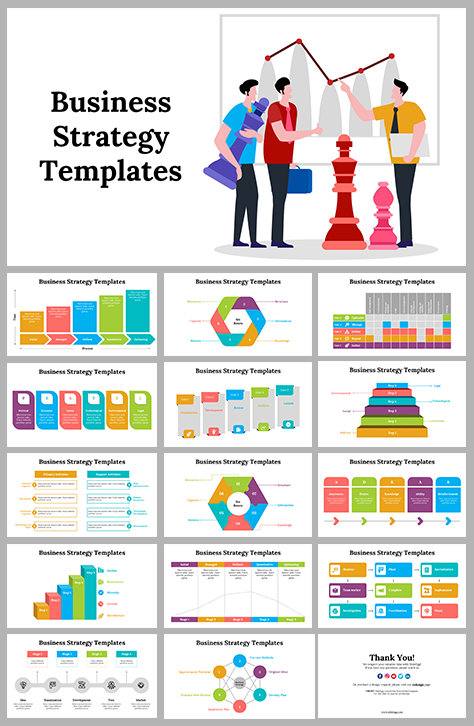
SlideEgg’s Business Strategy template is structured around goals, initiatives, and owners rather than a funding ask, worth checking if this is the one you actually need.
Side by Side
| Business Plan Presentation | Business Strategy Presentation | |
|---|---|---|
| Core question | Should this exist, and is it viable? | How will this reach its next goal? |
| Business stage | Pre-launch, pre-funding, or a new venture | Already operating |
| Primary audience | Investors, lenders, judges, approval committees | Leadership, board, internal teams |
| Time horizon | Often 3–5 years forward, from zero | Usually one planning cycle (often a year) |
| Centerpiece slide | Financial projections and the ask | Initiatives, owners, and KPIs |
| Tone | Persuasive, proving viability | Directive, aligning execution |
Neither is the “bigger” document. They’re built for different rooms, and putting the wrong one in front of the wrong room is the actual failure, not the content of either deck.
Choosing Between Them
Choose a business plan presentation if:
|
Choose a business strategy presentation if:
|
When You Need Both
These aren’t mutually exclusive, and two common situations call for both, just not in the same deck:
A funded startup builds a business plan presentation to raise its round, then builds a separate business strategy presentation once the money lands, to show the team how it’ll actually be spent that year.
An established company launching a new product line may need a business plan presentation to get internal budget approval for the new line, then a business strategy presentation for how that line fits the company’s broader direction once it’s greenlit.
If you’re in either situation, treat these as two separate deliverables for two separate audiences. Compressing both into one deck because the topics overlap is exactly the mistake below.
Mistakes That Come From Picking Wrong
Bringing a funding ask to an internal strategy review
Boards and leadership already know the business exists, a slide asking them to approve it as if it doesn’t reads as a miscalibrated pitch, not a strategy update.
Bringing goals and KPIs to investors with no viability case
Early-stage investors want to know the business is worth funding first. A deck that opens with initiatives and no market size or financial projection skips the question they came to ask.
Merging both into a single deck
It usually weakens both halves, the viability case gets rushed to make room for initiatives, and the initiatives get rushed to make room for the ask.
A Quick Gut-Check
Ask one question first: does this already have a green light, or are you trying to get one?
- Trying to get something funded, launched, or approved → business plan presentation
- Already funded or operating, explaining how you’ll hit a goal → business strategy presentation
- Not sure, or it touches both → build for whichever question your immediate audience is actually asking, and treat the other as a separate deck later
Common Questions
FAQ
Can one presentation combine a business plan and a business strategy?
It can, but it usually weakens both halves. Investors reviewing viability want the ask and the numbers up front; a board reviewing strategy wants initiatives and owners up front. Combining them forces one to get cut short. Build them as separate decks.
Do investors ever ask for a strategy presentation instead of a business plan?
Early-stage investors almost always want a business plan first, the business’s viability hasn’t been established yet. Investors already in a company they’ve funded may ask for a strategy update instead, since at that point the business’s existence isn’t the question, its execution is.
What’s the actual difference between a business plan and a strategic plan, not just the presentations?
That’s a document-level question, not a presentation one. A business plan is a written document arguing that a business should exist and get funded, it covers the idea, the market, the financials, and the ask, usually looking 3–5 years ahead from a standing start. A strategic plan assumes the business already exists and maps out how it will reach specific goals over a shorter, defined period, usually one planning cycle.
How many slides should each type run?
There’s no fixed rule, but a business plan presentation for investors typically runs 10–15 slides. A business strategy presentation varies more by scope; a single-team strategy might run 8–10 slides, a company-wide one considerably more.
I already have a written business plan, do I still need a separate strategy deck later?
Usually yes, once the business is funded or approved. The written plan and its presentation argue you should exist; a strategy deck comes after, once you’re operating, to align the team on execution.
Pick the Deck the Room Actually Needs
The confusion between these two decks comes from the words, not the work. “Business plan” and “business strategy” get used loosely in conversation, but the presentations answer different questions for different audiences at different points in a business’s life.
Once you know which question the room in front of you is actually asking, the rest of the deck follows, the right section order, the right centerpiece slide, and a template built for that structure. Get that one call right first, and everything downstream has somewhere to go.
Made the call and ready to build?
Browse Business Plan & Strategy Templates →