You have a business idea that keeps you up at night. You have done the research, run the numbers, and now someone tells you they want to see your “business plan.” So you open a blank document and start typing — but a nagging question follows: should this be a 40-page report or a 15-slide deck?
That confusion is more common than you think, and it costs founders time and opportunities. In this guide, we break down exactly what each format is, when you need which one, and how to move between them without losing your message.
First, Understand Why Both Formats Exist
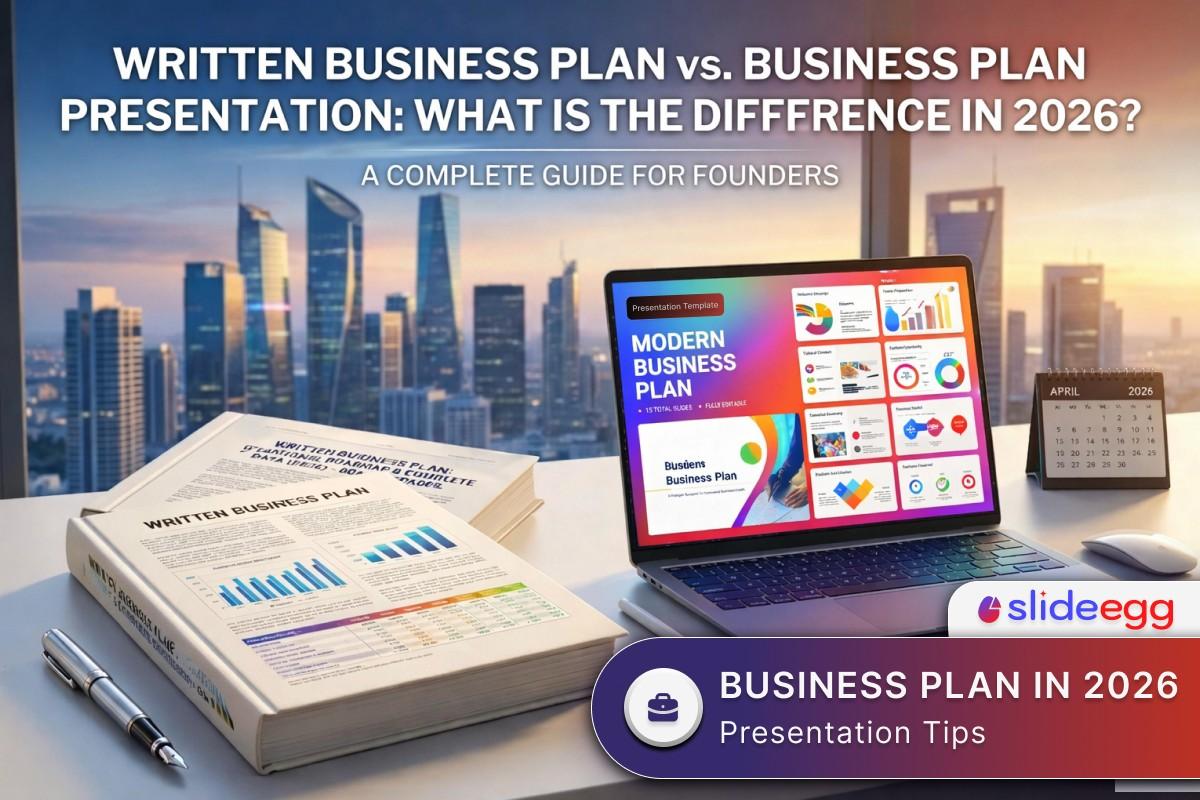
A written business plan and a business plan presentation are not competing formats. They serve completely different jobs. One is a working document. The other is a communication tool.
Think of it this way: your written plan is what you would hand to a bank manager or a new operations hire. Your presentation is what you would show in a 10-minute pitch meeting with a VC partner. Same business. Completely different format, tone, and depth.
“The goal of a pitch deck is not to close the deal. It is to get the next meeting.”
What Is a Written Business Plan?
A written business plan is a comprehensive, structured document — typically 20 to 60 pages — that covers every dimension of your business in detail. It is designed to be read, not watched.
It usually includes:
• Executive summary
• Company overview and mission
• Market research and competitive analysis
• Product or service description
• Go-to-market and sales strategy
• Operations and team structure
• Full financial projections (3 to 5 years)
• Funding requirements and use of funds
• Appendices with supporting data
What Is a Business Plan Presentation?
A business plan presentation — commonly called a pitch deck — is a visual, story-driven slide deck of typically 10 to 20 slides. It is designed to communicate the most compelling parts of your business quickly.
A strong business plan presentation template typically covers:
• The problem you are solving
• Your solution and product
• Market size and opportunity
• Business model (how you make money)
• Traction and key milestones
• Team and why you are the right people
• Financial highlights
• The ask (how much, for what)
“People do not buy into a business plan. They buy into a founder who clearly understands the problem and has a believable path to solving it.”

Side-by-Side Comparison
Here is a quick reference to help you decide which format you need at any point in your journey:
| Feature | Written Business Plan | Business Plan Presentation |
| Length | 20–60+ pages | 10–20 slides |
| Audience | Banks, internal teams, partners | Investors, accelerators, pitch events |
| Tone | Formal, analytical | Persuasive, visual, story-driven |
| Data depth | Full financial models + appendix | Key metrics and highlights only |
| Purpose | Operations roadmap + funding docs | Secure interest and open conversations |
| Format | Word / PDF | PowerPoint / Google Slides / Canva |
| When to use | Loan applications, strategic planning | Investor pitch, demo day, board meeting |
When to Use Each Format
Use a written business plan when:
• Applying for a bank loan or SBA funding
• Bringing on a co-founder or key executive hire
• Entering a formal business plan competition
• Setting annual strategy with your leadership team
• Presenting to a government or grant body
Use a business plan presentation when:
• Pitching to angel investors or venture capitalists
• Presenting at a demo day or startup accelerator
• Meeting with a potential strategic partner or acquirer
• Running an internal “strategy day” with your team
• Applying to startup incubators or competitions with pitch rounds
The Overlap: What Both Formats Share
Even though the format differs completely, the foundation is the same. Both a written plan and a presentation must be grounded in:
• Real market research, not assumptions
• Honest financial projections with clear assumptions
• A clear explanation of your competitive advantage
• A specific, defensible ask or objective
If your written plan has shaky numbers, your presentation will fall apart under questioning. The two formats reinforce each other. Build your written plan first — then distill it into your presentation.
A Practical Workflow for 2026 Founders
Here is the honest sequence most successful early-stage founders follow:
• Start with a lean written plan to pressure-test your thinking. Check out the best business plan templates for 10 different industries to get a head start.
• Build your pitch deck next using a clean business plan presentation template. Keep it under 15 slides.
• Expand your written plan once you have investor interest. That is when the full 30-page document becomes necessary for due diligence.
Starting with a free PowerPoint template is completely reasonable in the early stage — especially if you are pre-revenue. Spend your limited time on the content and the story, not on perfecting slide aesthetics from scratch. You can also browse best sellers to find a proven design instantly.
A Note on Format in 2026
The way investors consume pitches has changed. Remote-first fundraising, async pitch reviews, and AI-assisted due diligence mean your documents need to work without you in the room. Your written plan should be a clean PDF that reads well on screen. Your presentation should use a professional PowerPoint template that looks sharp on a shared screen or a recorded Loom.
In 2026, interactive presentation tools that allow live audience participation, embedded Q&A, or real-time data overlays are increasingly used in later-stage pitch environments and board settings. Worth knowing about as you grow. If you want to understand why so many technology pitches still fall flat, read why technology presentations fail and how to fix them.
The Bottom Line
There is no competition between a written business plan and a business plan presentation. They are tools for different moments in your journey as a founder.
Your written plan keeps you honest and aligned with your team. Your pitch deck opens doors. Build both with intention — and remember that the story you tell in those 12 slides is only as strong as the research behind it.
“The best pitch deck I ever saw was backed by the most boring, thoroughly written plan you can imagine. That is not a coincidence.”
Frequently Asked Questions
Do I need both a written plan and a presentation?
Yes—your written plan guides your strategy, while your presentation helps you communicate and win investor interest.
Why do investors prefer business plan presentations?
Investors prefer presentations because they are quick, visually engaging, and help them understand the business idea, value proposition, and potential returns in a short time.
Can you convert a written business plan into a presentation?
Yes, you can convert a written business plan into a presentation by summarizing key sections like problem, solution, market size, business model, and financials into clear, visual slides.
Is a business plan presentation enough to get funding?
No, it creates interest, but investors will always expect detailed documents before making decisions.
What makes a professional PowerPoint template different from a regular one?
A professional template ensures your slides look consistent, clear, and trustworthy without extra effort