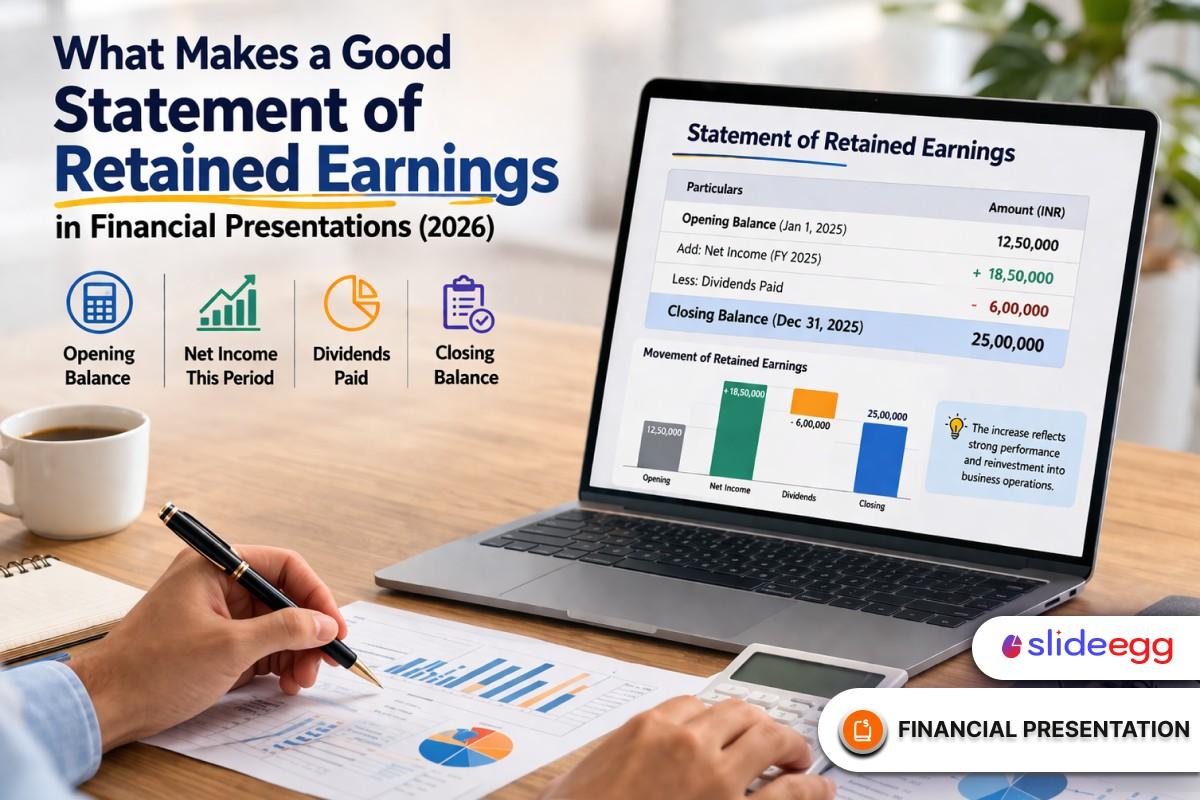
Most financial presentations treat the Statement of Retained Earnings as a formality. A single line. A throwaway slide tucked between the income statement and the balance sheet. But here is the truth: when this statement is built and presented well, it tells the clearest story about where a business stands and where it is heading.
This guide breaks down exactly what makes a retained earnings statement effective in 2026, whether you are preparing a board deck, an investor presentation, or an annual report. No theory. Just what works in practice.
Start With What Retained Earnings Actually Represents
Before you design a single slide, make sure you are clear on what this number is.
Retained earnings are the total profit your company has accumulated over its lifetime, after paying out dividends. It is not a cash balance. It is not how much money is in the bank. It is a running record of financial decisions made over the years.
Retained Earnings = Opening Balance + Net Income This Period – Dividends Paid This Period
That formula looks simple. But what it reflects is complex: every profitable quarter, every loss year, every dividend paid to shareholders, every reinvestment decision. That context is what your statement needs to carry.
The Core Components That Cannot Be Missing
A retained earnings statement in a financial presentation needs four things to be complete and credible:
1. Opening Balance With a Reference Period
Never show a closing balance without the opening. The change between the two is where the conversation starts. Always label the period clearly: beginning of fiscal year, end of Q3, as of December 31, 2025. Ambiguous dates create doubt in boardrooms.
2. Net Income (or Net Loss) for the Period
This number comes directly from your income statement. If there was a loss, show it clearly. Hiding a loss year inside a multi-year average is a red flag to any experienced analyst. Own the numbers.
3. Dividends Declared
Show dividends separately from everything else. Combining or netting them destroys visibility. Investors specifically look at dividend history to assess payout policy. If no dividends were paid, state that explicitly. It is information too.
4. Closing Balance
The ending retained earnings number should tie directly to the shareholders’ equity section of your balance sheet. If it does not, something is wrong, and reviewers will find it.
What a Good vs. Weak Statement Looks Like Side by Side
The difference is often not in the numbers. It is in how those numbers are presented.
| Element | Weak Presentation | Strong Presentation |
| Period Label | “FY25 Retained Earnings” | “January 1, 2025 to December 31, 2025” |
| Opening Balance | Missing or buried in notes | Shown prominently as the first line item |
| Net Income Line | Merged with other adjustments | Separate line, ties to the income statement |
| Dividends | Shown as a lump “distributions” line | Split by type: cash dividends, special dividends |
| Closing Balance | No tie to the balance sheet | Cross-referenced to the equity section |
| Context | Numbers only | Brief annotation: “reflects expansion into new warehouse.” |
How to Present It in a Slide Deck Without Losing the Reader
This is where most presentations fall apart. The statement is technically correct but visually impossible to read. Here is what works:
Use a Waterfall or Bridge Chart
Instead of a plain table, a waterfall chart shows the opening balance, adds net income, subtracts dividends, and lands on the closing balance. This visual makes the movement intuitive. Your audience does not have to do mental math.
Anchor It to the Income Statement
On the same slide or the next one, show where the net income figure came from. A simple line: “Net income of 18,50,000 per income statement, page 4” removes any ambiguity and builds trust.
Add One Line of Business Context
Numbers without context are noise. Add one sentence: “The increase in retained earnings reflects strong Q3 performance driven by a new warehousing contract and controlled overhead.” This one line changes how the number lands.
Retained Earnings in Your Own Business: How Much Is Actually Yours?
This is a question many small business owners and founders never think to ask. And it matters.
Say your business earned a total profit of 20,00,000 this year. You paid yourself a salary of 8,00,000 already included in expenses. After taxes of 3,00,000 and dividends of 2,00,000 taken out, your retained earnings for the year is 7,00,000.
That 7,00,000 belongs to the business. Not to you personally. It stays inside the company to fund operations, pay off loans, or invest in growth.
| Flow of Profit | Amount (INR) | Where It Goes |
| Total Revenue | 80,00,000 | Gross income |
| Operating Expenses (incl. salary) | 55,00,000 | Costs to run the business |
| Net Profit Before Tax | 25,00,000 | Earned profit |
| Tax Paid | 5,00,000 | To government |
| Net Profit After Tax | 20,00,000 | Available for use |
| Dividends / Owner Withdrawal | 8,00,000 | Your personal income from the business |
| Retained Earnings (stays in business) | 12,00,000 | Reinvested into the company |
Of the 12,00,000 retained inside the business, how much is yours? Technically, all of it, since you are the owner. But you cannot spend it directly. It is tied up in assets, equipment, stock, or working capital. This is why founders sometimes feel cash-poor even when the balance sheet looks healthy.
A high retained earnings balance is a sign of reinvestment, not personal wealth. Know the difference before you plan your next financial year.
The Statement That Earns Trust
A retained earnings statement that is complete, clearly labeled, visually readable, and tied to the rest of the financial picture does something that spreadsheets alone cannot: it builds confidence.
Whether you are presenting to a bank for a loan or using professional business PowerPoint templates to pitch to a board for approval, the way you present this number tells people how seriously you take your own financials.
Get the structure right. Add real context. Use presentation tools built for financial data, like our 10 best professional financial PowerPoint templates for 2026. And let the numbers tell the honest story they were always meant to tell.
Ready to start building? Download from our massive library of free PowerPoint templates today to present your financials with confidence.
FAQ
1. When should a company show a Statement of Retained Earnings in a presentation?
It is usually included when companies present financial results to investors, lenders, or board members. It helps explain how profits are being used inside the business.
2. How often should retained earnings be reported?
Retained earnings are updated at the end of each financial period, such as quarterly or annually. This helps track how profits grow or change over time.
3. Can retained earnings ever become negative?
Yes, it can become negative if a company has continuous losses or pays more dividends than it earns. This situation is commonly called an accumulated deficit.
4. Are retained earnings the same as cash in the bank?
No, retained earnings are accounting profits kept in the business. The money may already be invested in assets, inventory, or operations.
5. Why do investors pay attention to retained earnings?
Investors use it to understand how a company manages and reinvests its profits. It shows whether the business is focusing on growth or paying returns to shareholders.