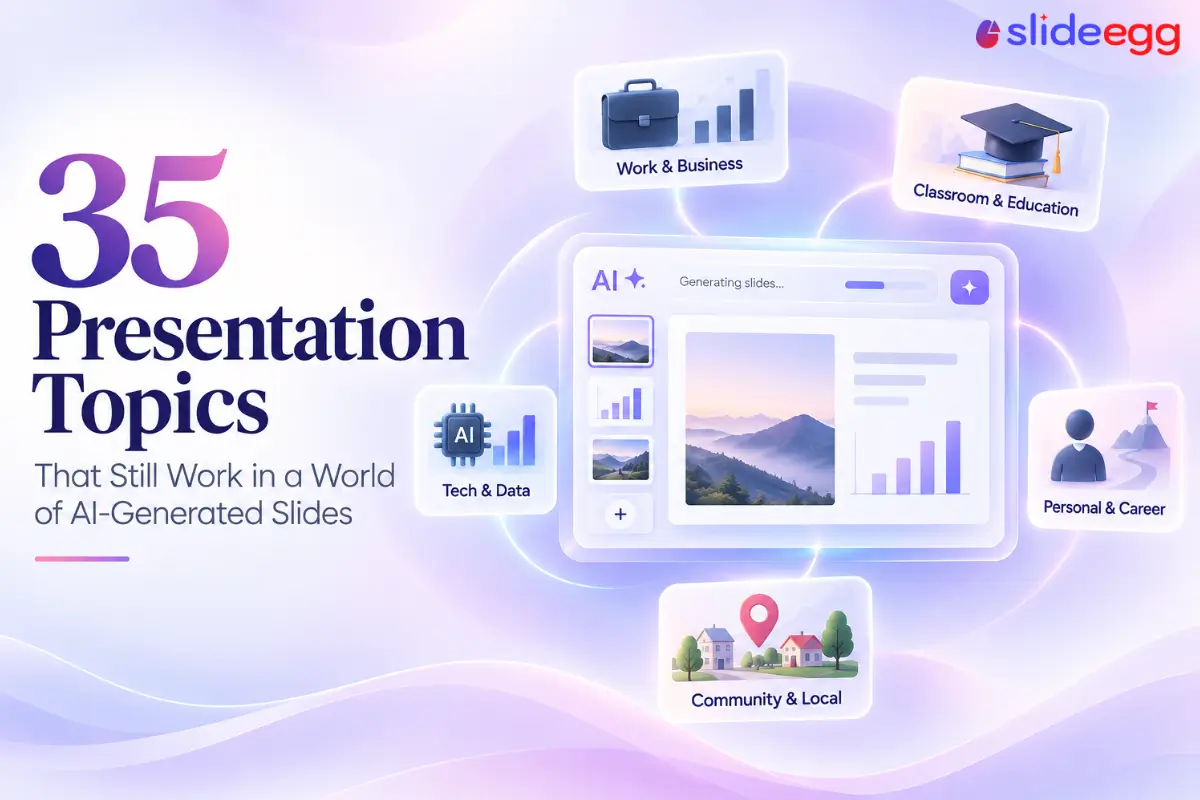
Open any AI presentation tool, type one sentence, and under a minute later you have a finished deck: title slide, section breaks, a matching palette. What it still can’t do is know what’s actually worth someone’s attention, that part is still yours. These 35 presentation topic ideas are grouped into five settings, and every one gives an AI tool something worth building around: your data, your mistake, your neighborhood, your actual opinion.
Quick Answer
- AI can build the slides fast and well; these 35 topics are what to feed it so the finished deck actually says something.
- Grouped into five settings: work, classroom, tech and data, personal and career, and community and local.
- Every topic routes through something specific to you or your group: a real mistake, a real number, a real disagreement.
- Pick the topic where you already have a specific angle, number, or story only you could bring to it.
- Once picked, an AI presentation tool is genuinely the fastest way to build the deck around it.
Why the topic still matters more than the tool
Ask an AI tool for “a presentation about improving team communication” and it will produce something clear and well-organized, built from the best of what’s worked across thousands of similar requests. What it can’t pull from is material specific to you: a number only your team has, a decision your team actually made, a street only your neighborhood has, an opinion you’re willing to defend. Pair a strong AI-built deck with that layer and the result stands out; the list below is organized around supplying it.
Work and business presentation topics
These work because they pull from something specific to your team, not a category. A generic prompt about “sales strategy” produces a generic slide about sales strategy, whoever or whatever builds it; a real number from last quarter’s pipeline turns it into a conversation.
- Why our last project actually missed its target, told as a postmortem rather than a highlight reel, with the one decision you’d make differently.
- What a specific competitor is doing better than us right now, based on something you’ve actually used or tested, not a category comparison.
- The one complaint customers keep repeating, and what’s actually being done about it this quarter.
- A skill the team is missing for the next 12 months, and a realistic plan for closing that gap.
- What changed in the industry this year that nobody’s discussed internally, and what it means for how the team works.
- A tradeoff the team made and whether it paid off, with the actual numbers or feedback that came out of it.
- Where the budget is really going versus where it was planned to go, and the one line item worth a second look.

A structure like this one works for any of the seven topics above, swap the placeholder sections for the real numbers and decisions your team actually made.
Classroom and education presentation topics
Students and teachers get the most out of a topic that can’t be fully answered by searching, because it asks for a source, an opinion, or a piece of local knowledge the room doesn’t already have.
For more options built specifically around a classroom audience, check this roundup of education presentation ideas alongside the seven below.
- A piece of local history nobody in class has heard of, pulled from a source closer to home than a textbook.
- How something in this week’s news connects to what the class is studying, argued with a specific, current example.
- A skill learned outside of school and how it was actually picked up, step by step, not in theory.
- Two experts who disagree on the same question, presented fairly, with the class left to weigh the evidence.
- What a primary source reveals that the textbook version smooths over, using the actual document or account.
- A real problem in the community and three specific ways to address it, not a generic policy idea.
- The biggest misconception held before researching this topic, and the moment that changed it.

A layout built for a classroom audience already has room for sources and discussion prompts, which most of these seven topics need.
Tech, data, and the AI era
This group turns the AI conversation itself into material, a subject worth exploring in its own right, not just a tool for building the deck.
- Where an AI tool nailed this exact topic and where your own expertise still added something it couldn’t, shown side by side.
- A dataset from your own work and what it really shows, once you look past the summary numbers.
- A rule of thumb in the field that quietly stopped being true, and what replaced it.
- A tool used every day and what happens when it fails, including the workaround nobody’s documented yet.
- What automating a task actually cost that wasn’t in the original estimate, in time, quality, or trust.
- The ethical tradeoff a project proposal left out, stated plainly instead of buried in a footnote.
- A five-year-old prediction about technology that didn’t come true, and what actually happened instead.

Topics like a dataset walkthrough or a prediction check hold up better with real charts on screen instead of bullet points describing what the data showed.
Personal, career, and creative topics
These work in settings where the audience already knows you, a talk series, a team offsite, a personal blog turned into slides, because the value is in the specific, not the universal advice.
- A mistake early in a career and what it actually taught, past the tidy lesson most people stop at.
- The book, show, or trip that changed how you think about your work, and the specific idea that carried over.
- A skill you’re deliberately bad at because something else mattered more, and what that tradeoff bought you.
- What you’d tell yourself on day one of your current job, if you could go back with what you know now.
- A hobby that made you better at your job in a way nobody would guess, with the actual mechanism, not just the claim.
- Advice you ignored, and whether that turned out to be the right call, told honestly either way.
- A goal you quietly gave up on that wasn’t actually a failure, and what it freed you up to do instead.

A career-shaped layout like this one gives a personal topic somewhere to put the timeline or turning point without it looking like a corporate case study.
Community and local topics
Local material is the hardest to fake with something generic, since the specifics only exist for people who’ve spent time in that exact place.
- A local business or landmark with a history worth knowing, told through people who were actually there.
- How the neighborhood has changed over the last decade, backed by both data and the stories behind it.
- A local tradition worth explaining to someone new to the area, including the part outsiders usually miss.
- What a local statistic actually means for the people behind it, translated out of the abstract.
- A volunteer effort that’s working and how to get involved, with a specific next step, not just an appeal.
- Two sides of a real local debate, presented fairly, letting the audience land on their own conclusion.
- Something small that made a noticeably big difference locally, and why it worked when bigger efforts hadn’t.

A mission-and-impact layout like this fits a volunteer effort or local debate topic that needs to build a case, not just report facts.
From topic to deck, fast
Picking the topic is still on you. Building the deck isn’t. Once you’ve got your angle, describe it to AI Presentation Maker along with a slide count and style, and get a first draft in a few minutes, then edit it until it sounds like you. For settings and prompt tips beyond the basics, check this guide to getting the most out of the AI tool. And if the topic leans more visual, comparisons, timelines, data walkthroughs, skip straight to free PowerPoint templates instead; adapting a layout already built for that structure is usually quicker than describing one from scratch.
What makes a topic fall flat
| Sign the topic is too generic | What to do instead |
|---|---|
| You can guess what an AI tool would say about it before asking | Add the specific number, mistake, or local detail that would make your version different from its general one |
| It’s phrased as a category (“marketing trends”) rather than a claim | Turn it into an argument or a finding the audience could push back on |
| Nothing in it depends on where or who you are | Swap in the version only your team, class, or neighborhood could tell |
| It could be presented word-for-word by someone with no connection to the subject | Keep only the parts that require your actual experience or data |
FAQ
Can’t I just ask an AI tool for a presentation topic?
You can, and it’s a genuinely good way to get a fast, well-structured starting point. AI tools are excellent at generating a broad answer built from what’s worked for thousands of similar requests before. What makes a topic really land is pairing that speed with something only you have: your actual data, your specific experience, your neighborhood, your opinion. The 35 topics on this list are built around that pairing.
Does having a good topic still matter if AI can design the slides?
More than before, not less. When the design and formatting work took real effort, a mediocre topic could still hold attention because people were impressed by the craft. Once anyone can generate a polished deck in a minute, the deck itself stops being the differentiator. What’s left standing out is whether you had something worth saying in the first place.
How do I pick one of these topics if several apply to me?
Pick the one where you already have something specific to add beyond a solid, general starting point. If you can picture the exact number, story, or detail that would make the topic sharper than a broad overview, that’s the one with something real underneath it.
Are these topics only for business presentations?
No. They’re grouped into five settings: work, classroom, tech and data, personal and career, and community and local, so there’s a workable option whether you’re presenting to a team, a class, or a local group. The common thread across all five groups is a topic that depends on something only you or your group actually knows.
Once I’ve picked a topic, what’s the fastest way to build the deck?
Describe the topic and your angle on it, choose a slide count and style, and let an AI presentation tool generate a first draft you then edit for accuracy and voice. That’s the right order: decide what you’re actually saying first, then let AI handle the layout, not the other way around.
Conclusion
None of these 35 ideas are hard to execute once the topic is chosen, and that’s the point. The design, the formatting, the transitions, all of that is a solved problem now, handled in minutes by tools built for exactly that. What still separates a presentation worth sitting through from one that’s already forgotten is whether the person presenting had something specific to say. Pick a topic from the list above, or use the pattern behind it, something only you, your team, or your neighborhood actually knows, and build from there.
Have a topic but not a starting layout?
A template library covering almost any subject and an AI tool that builds a first draft from a short description are both a click away, whichever fits how the topic you picked is shaped.