Quick Answer
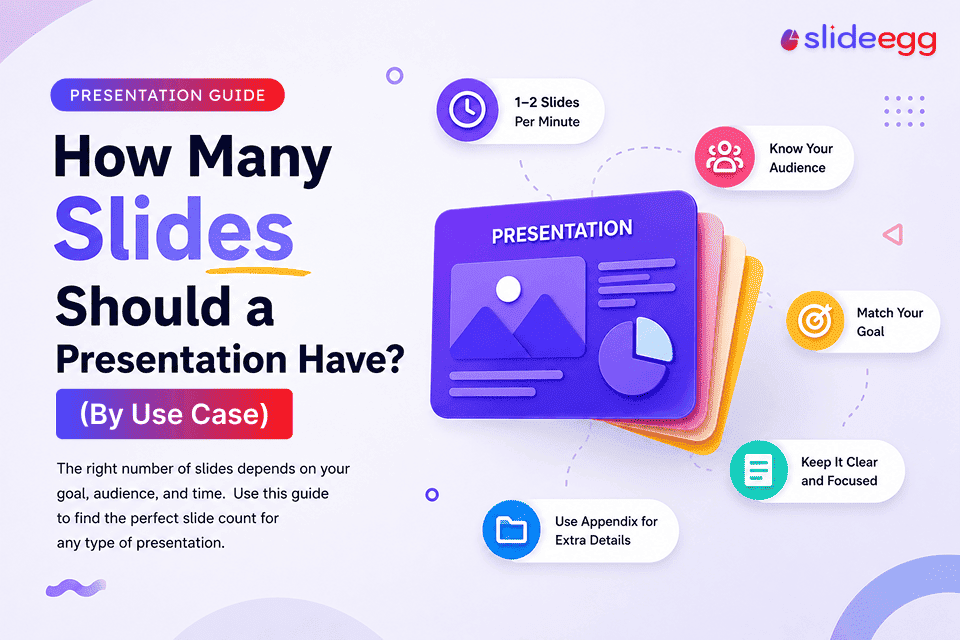
Use 1 to 2 slides per minute of speaking time.
There is no single “right” number. The best slide count depends on your topic, your audience, and how long you have to speak. But this rule gives you a solid starting point:
- 10-minute presentation → 10–15 slides
- 20-minute presentation → 20–30 slides
- 60-minute presentation → 40–60 slides
Keep reading to find the exact count for your specific use case.
In This Guide:
- Why slide count matters
- Business Pitch / Investor Presentation — 10–15 slides
- Sales / Client Proposal — 12–20 slides
- Corporate / Internal Presentation — 15–30 slides
- Conference Talk / Keynote — 1 per minute
- Classroom / Academic Lecture — 20–45 slides
- Training / Workshop — 40–80 slides
- Webinar / Online Presentation — 30–55 slides
- Job Interview Presentation — 8–15 slides
- Student / Class Presentation — 6–15 slides
- Product Demo Presentation — 5–10 slides
- Wedding / Event / Personal Slideshow — 15–40 slides
- Factors that change the right number
- Warning signs: too many or too few
- The appendix: your backup slide section
- Quick-reference table
- Frequently asked questions
Why Slide Count Matters
Slide count affects more than just how long you speak. It shapes the whole experience for your audience.
- Pacing: Too many slides and you rush. Too few and you drag. Either way, the audience notices.
- Attention: Most people start to lose focus after 10 to 15 minutes without a change in format. Moving through slides at the right pace helps them stay engaged.
- Readability: Cramming content to save slide count creates cluttered slides. Spreading thin content across too many slides wastes the audience’s time.
- Credibility: A 5-slide deck for a 30-minute board meeting looks underprepared. A 60-slide deck for a 5-minute pitch shows poor judgment. Both hurt your image.
Getting the number right is a sign that you respect your audience’s time.
Slide Count by Use Case
1. Business Pitch / Investor Presentation
Slides: 10–15, Duration: 10–20 minutes
Investor presentations are one of the most slide-limited formats in business. Guy Kawasaki’s famous 10/20/30 rule says : 10 slides, 20 minutes, 30pt font. The 10-slide limit holds up because investors make quick decisions. Every extra slide gives them more reasons to tune out.
A strong investor pitch covers these 10 topics:
- Title and company overview
- The problem you solve
- Your solution
- Product — screenshot or live demo
- Market size
- Business model
- Traction and milestones
- Competitive landscape
- Team
- The ask — funding amount and use of funds
If you need more than 15 slides to tell this story, the problem is usually unclear thinking — not too little content.
Save time: Use ready-made pitch deck templates from SlideEgg to start with a clean, professional structure.
2. Sales Presentation / Client Proposal
Slides: 12–20, Duration: 15–30 minutes
A sales deck needs enough slides to build trust and walk through the offer. But it should not feel like a lecture. The goal is a conversation, not a one-way talk.
A clear client proposal covers:
- The client’s problem (2–3 slides)
- Your proposed solution (3–4 slides)
- Proof — case studies, data, or reviews (2–3 slides)
- Pricing or engagement options (1–2 slides)
- Next steps (1 slide)
Watch out for this: Most sales decks have too many feature slides and too few slides about the client’s problem. Buyers care about their results — not your product list.
Need a head start? Browse SlideEgg’s business proposal templates — fully editable in PowerPoint, Google Slides, and Canva.
3. Business / Corporate Internal Presentation
Slides: 15–30, Duration: 20–45 minutes
Internal presentations — like quarterly reviews, project updates, and strategy sessions — usually run longer. Your audience already knows the company context, so they can take in more detail than an outside audience can.
That said, longer does not mean better. A 30-slide deck with three clear decisions to make is more useful than a 60-slide one where everything feels equally important.
Use appendix slides for supporting data, full tables, or backup charts. They sit after your last slide and are only shown if someone asks. They don’t count toward your main slide total.
4. Conference Talk / Keynote
Slides: 1 per minute (strict), Duration: 20–60 minutes
Conference talks have hard time limits. Running over is unprofessional and cuts into Q&A time. Use exactly one slide per minute as your ceiling.
- 30-minute talk → 30 slides max
- 45-minute keynote → 45 slides max
Conference slides tend to be more visual — big photos, bold one-liners, charts. That style naturally limits how much fits on each slide, which is a good thing.
Never build a slide you plan to skip. If you’re thinking “I’ll skip this one if I’m short on time,” remove it now.
5. Classroom / Academic Lecture
Slides: 1 per 2–3 minutes, Duration: 45–90 minutes
Lectures move at a slower pace than business presentations. Instructors pause, take questions, and work through examples. Slides act as anchors — not the main event.
- 60-minute lecture → 20–30 slides
- 90-minute lecture → 30–45 slides
Academic slides often carry more text than business slides. Definitions, formulas, and frameworks need space. Students take notes, so each slide can hold a little more.
Students: For a 5 to 10-minute class presentation, aim for 6 to 12 slides. Check your course guidelines first — some instructors set a fixed limit.
Teaching a class? SlideEgg has education templates built for clarity and easy customization.
6. Training / Workshop Presentation
Slides: 1 per 3–5 minutes, Duration: 1–4 hours
Training sessions include group activities, discussions, and exercises that don’t show up on slides. A 3-hour workshop might have 40 to 60 slides, but those slides only cover about a third of the total session time.
Slide types that work well in training decks:
- Section divider slides — signal topic changes
- Step-by-step process slides
- Before-and-after comparison slides
- Discussion prompt slides — one question per slide
- Summary slides at the end of each section
Don’t fill training slides with text that repeats what you’re saying out loud. If the slide and your words say the same thing, one of them is not needed.
7. Webinar / Online Presentation
Slides: 1–1.5 per minute, Duration: 30–60 minutes
Online audiences lose focus faster than in-person ones. There’s no eye contact, no physical presence to keep them engaged, and switching tabs takes one second. Moving through slides a little faster — about one per minute — helps them stay with you.
- 30-minute webinar → 30–40 slides
- 45-minute webinar → 40–55 slides
Use slide transitions actively. Every time you advance a slide, it signals to viewers that the content is moving forward. That moment of visual change re-engages attention that has drifted.
8. Job Interview Presentation (30-60-90 Day Plan)
Slides: 8–15, Duration: 10–20 minutes
Many employers ask candidates to present a plan or case study. These are judged as much on how you communicate as on what you say. A clear, concise deck shows editing skills — which most hiring managers value highly.
A well-structured 30-60-90 day plan covers:
- Title slide — role title and your name
- Your understanding of the role and company (1–2 slides)
- First 30 days — learning goals
- Days 31–60 — early contributions
- Days 61–90 — measurable outcomes
- Key assumptions you’ve made
- Questions for the panel
Stay under 15 slides. Going over suggests you can’t edit your own thinking — which is a red flag for most managers.
9. School / Student Presentation
Slides: 6–15, Duration: 5–15 minutes
Always check your course guidelines first. Some instructors set a fixed slide count. When there are no rules, use 1 to 1.5 slides per minute.
- 5-minute presentation → 6–8 slides
- 10-minute presentation → 10–12 slides
Common student mistake: One slide per fact. This turns your presentation into a long list of bullet points. Group related points on the same slide instead, and only change slides when you move to a new topic.
10. Product Demo Presentation
Slides: 5–10 + live demo, Duration: 15–30 minutes
Product demos are about showing — not talking. Slides set the context before the demo and recap the key points after it. The demo itself needs no slides at all.
A clean product demo flow looks like this:
- The problem you solve (1–2 slides)
- What you’ll show today (1 slide)
- Live demo — no slides needed here
- Key features and benefits recap (2–3 slides)
- Pricing or next steps (1–2 slides)
If your demo relies more on slides than on the actual product, that’s a sign the product isn’t ready to be shown live — or that the demo needs more work.
11. Wedding / Event / Personal Slideshow
Slides: 15–40, Duration: 5–15 minutes
Personal slideshows follow different rules. The right number of slides is simply the number of meaningful moments you want to share — with enough time on each slide for the audience to feel it.
- 10-minute photo tribute set to music → 20–40 slides (10–15 seconds per slide)
- Wedding speech with slides → under 10 slides, under 5 minutes
For a wedding speech, your words carry the moment. Keep slides minimal so the audience listens to you — not reads your deck.
Factors That Change the Right Number
Beyond the use case, four things determine whether your slide count is right for your specific presentation.
How much you say per slide
A one-data-point slide takes 30 seconds. A case study slide might take 3 minutes. Know your average before you lock in a count.
Whether slides lead or support
If slides are your notes and you read from them, you’ll spend longer on each one. If they support a confident verbal delivery, you can advance more often.
Amount of audience interaction
Q&A, polls, and group activities fill time without slides. A 60-minute workshop with 20 minutes of group work only needs 40 minutes of slide content.
How data-heavy the content is
A financial review with 10 complex charts needs more time per slide than a brand strategy deck with 20 single-idea slides.
Warning Signs: Too Many or Too Few Slides
⚠ Signs you have too many slides
- You say “I’ll skip this one” more than once
- You rush to stay within time
- Two or more slides in a row say the same thing
- Your slide count is more than 2× your speaking time in minutes
- You added slides to look thorough — not because they add value
↓ Signs you have too few slides
- You stay on one slide for more than 5 minutes
- Your audience looks confused — context is missing
- Slides are so text-heavy they look like Word documents
- You repeat the same verbal points because there’s no visual anchor
- You run out of content well before time is up
The Appendix: Your Backup Slide Section
Not sure whether to include a slide? Put it in the appendix instead of cutting it or forcing it into the main deck.
Appendix slides go after your closing slide. They don’t count toward your main flow. But they’re ready if someone asks a question you planned for.
Label them clearly — use a header slide that says “Appendix” or “Supporting Data.” That way, you can jump to them fast during Q&A without hunting through your whole deck.
Quick-Reference Table: Slides by Use Case
| Presentation Type | Typical Duration | Recommended Slides |
|---|---|---|
| Investor / Startup Pitch | 10–20 min | 10–15 |
| Sales / Client Proposal | 15–30 min | 12–20 |
| Corporate / Internal Update | 20–45 min | 15–30 |
| Conference Talk / Keynote | 20–60 min | 1 per minute |
| Academic Lecture | 45–90 min | 20–45 |
| Training / Workshop | 1–4 hours | 40–80 |
| Webinar / Online Presentation | 30–60 min | 30–55 |
| Job Interview (30-60-90 Plan) | 10–20 min | 8–15 |
| Student / Class Presentation | 5–15 min | 6–15 |
| Product Demo + Live Demo | 15–30 min | 5–10 |
| Personal / Event Slideshow | 5–15 min | 15–40 |
Frequently Asked Questions
How many slides for a 10-minute presentation?
Aim for 10 to 15 slides. That follows the standard 1 to 2 slides per minute rule. If your slides carry a lot of data, stay closer to 10. If they’re mostly visual, you can go up to 15.
How many slides for a 30-minute presentation?
For a 30-minute presentation, 25 to 40 slides is a solid range. Adjust based on how complex each slide is and how much audience interaction you plan.
Is there a minimum number of slides?
No. A 5-minute presentation can work with 5 slides or 8, depending on how much you say per slide. The minimum is set by your content — not any rule.
Should title and closing slides count toward my total?
Yes. They take real time — usually 30 to 90 seconds each. Include them in your count so you don’t run short on content or over on time.
Is it better to have more slides with less text, or fewer slides with more text?
More slides with less text almost always works better for live presentations. It keeps the audience engaged, gives your eyes variety, and stops slides from turning into documents people read instead of listen to.
What if my content doesn’t fit in the recommended slide count?
Cut content — don’t add slides. Not everything you know needs to be in one presentation. Decide what the audience needs to leave with, and build to that goal. Everything else goes in the appendix or a follow-up document.
Do slide count rules change for virtual presentations?
Yes. Virtual audiences lose focus faster. Advance slides more often — about once per minute — to maintain momentum and keep attention. In person, your physical presence holds attention even when a slide stays up longer.
Related Guides From SlideEgg
Design: How to Design a PowerPoint Presentation: A Beginner’s Guide
Templates: Free & Premium PowerPoint Templates for Every Presentation Type
The Bottom Line
The right number of slides is the number that fills your time without rushing or padding — and covers your content without crowding the audience.
Start with the 1 to 2 slides per minute baseline. Then adjust based on your use case, how dense your content is, and how much of your time involves audience interaction. After that, cut any slide that doesn’t earn its place.
A presentation with 12 well-built slides will nearly always outperform one with 35 mediocre ones.
Need a starting point? Browse SlideEgg’s free and premium PowerPoint templates — organized by use case so you can pick the right layout from the start.