Free - Lean Supply Chain Management PowerPoint And Google Slides
Free

 Canva
Canva
Lean Supply Chain Management Presentation Template
Teams often struggle to explain where waste exists, how flow breaks, and what actions improve performance. Conversations stay high-level. Decisions get delayed because the process is not visible.
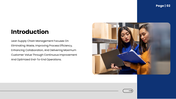
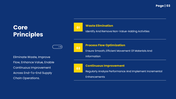
This deck structures the discussion in a direct way. It starts with the core idea: removing waste, improving flow, and increasing customer value. It then moves into three clear principles: waste elimination, process flow optimization, and continuous improvement. This sets the operational mindset.
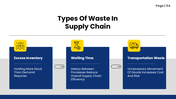
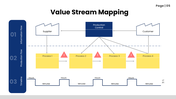
The next section breaks waste into specific types: excess inventory, waiting time, and transportation waste. This helps teams point to real inefficiencies instead of general issues. The value stream mapping slide shows how materials and information move across processes, including delays and gaps.
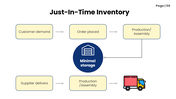
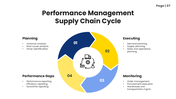
Execution is made clear with the just-in-time flow. It connects demand, order, production, and delivery with minimal storage. The performance management cycle adds structure with planning, execution, monitoring, and gap analysis.
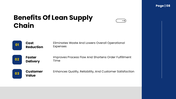
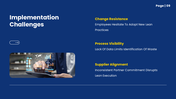
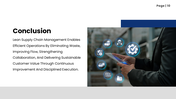
The deck also addresses real concerns: resistance to change, lack of visibility, and supplier misalignment. It then closes with measurable outcomes: cost reduction, faster delivery, and improved customer value.
The layout uses a strong blue contrast with yellow highlights for key actions. Icons guide attention without distraction. Use this deck when you need to show exactly where waste sits and how to remove it.
Features of this template:
- Update text, colors, and elements to match your operations and process flow
- Use seamlessly in PowerPoint, Google Slides, and Canva
- Present in both widescreen (16:9) and standard (4:3) formats
- Waste classification slide covering inventory, waiting time, and transportation inefficiencies
- Value stream mapping layout showing supplier, process stages, and timeline delays
- Just-in-time workflow linking demand, production, delivery, and minimal storage
- Performance cycle model with planning, execution, monitoring, and gap analysis
- Implementation challenge framework covering change resistance, visibility gaps, and supplier alignment
You May Also Like These PowerPoint Templates
Showing36 of69,218 templates