Free - Informative Dacryocystitis PowerPoint And Google Slides





 Canva
Canva
Dacryocystitis PowerPoint, Google Slides, and Canva Template
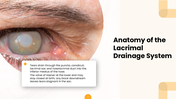
Tears that can't drain end up somewhere — and in dacryocystitis, that somewhere is the lacrimal sac, where stagnant fluid turns an anatomical blockage into an active infection. This template starts with the anatomy that makes the whole condition make sense: tears normally travel through the puncta, canaliculi, lacrimal sac, and nasolacrimal duct into the nose, and a closed valve of Hasner or any downstream blockage leaves that fluid with nowhere to go.
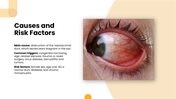
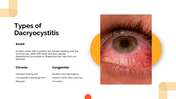
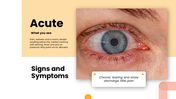
The causes-and-risk-factors slide gets specific rather than generic — congenital narrowing, age-related stenosis, trauma, sinus disease, and dacryoliths as common triggers, with female sex, age over 40, diabetes, and chronic rhinosinusitis named as actual risk factors. A types slide separates acute presentation — sudden, painful, tender swelling with fever and possible abscess formation, usually from Staph aureus or Streptococcus — from chronic cases with persistent tearing and mucopurulent discharge but little pain, and congenital blockage at Hasner's valve that typically clears by 12 months.
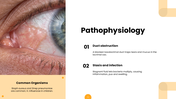
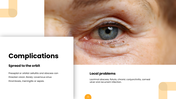
A pathophysiology slide walks through the actual mechanism: duct obstruction traps tears and mucus, stasis lets bacteria multiply, and specific organisms get named by age group, including H. influenzae in children. The diagnosis slide covers real bedside clinical practice — pressure on the sac producing purulent reflux at the punctum, the dye disappearance test, syringing to localize the blockage, and CT or DCG imaging reserved for suspected mass or trauma. A complications slide doesn't undersell the stakes, covering lacrimal abscess and fistula alongside the rarer but serious risk of orbital cellulitis, cavernous sinus thrombosis, or meningitis.
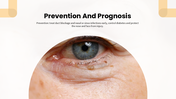
The treatment slide covers the actual clinical pathway: warm compresses and systemic antibiotics for acute cases, drainage if an abscess points, dacryocystorhinostomy (DCR) as the definitive fix once infection settles, and sac massage before probing for congenital cases still unresolved at 12 months.
Built for ophthalmology residents, ENT and general medicine educators, nursing programs, and clinical training departments who need this condition explained with real diagnostic and treatment accuracy. Every mechanism, organism, and treatment step is yours to edit.
Features of this template
- 100% customisable slides and easy to download.
- The slides contain 16:9 and 4:3 formats.
- Easy to change the colours quickly.
- Highly compatible with PowerPoint, Google Slides, and Canva templates.

You May Also Like These PowerPoint Templates













Showing20 of69,218 templates