Let’s be honest — most company profile presentations are forgettable. They’re either too long, too cluttered, or too generic to leave any real impression. And in 2026, when attention spans are shorter and competition is fiercer than ever, “forgettable” is the same as invisible.
The good news? Getting it right isn’t complicated. It just takes a clearer sense of what works, what doesn’t, and why it matters in the first place.
Whether you’re a startup founder pitching for your first big client, a marketing team refreshing your brand story, or a student building a business project, a well-crafted company profile presentation is one of the most powerful tools you can have in your corner. It’s your business on a stage. Make sure it deserves the spotlight.
Why your company profile presentation matters more now
Think of your company profile presentation like a firm handshake. Before a single word leaves your mouth, it tells the other person whether you’re serious, prepared, and worth their time. In virtual meetings, email pitches, and LinkedIn exchanges, that handshake happens through your slides.
In 2026, buyers are more informed and more skeptical. They’ve seen hundreds of decks. They scroll past generic ones in seconds. What stops them is something that feels real — a presentation that speaks directly to them, looks sharp, and communicates value without wasting their time.
The businesses winning new clients and partnerships aren’t necessarily the biggest or the oldest. They’re often the ones who show up best. And showing up best starts with how you present yourself.
The do’s and don’ts at a glance
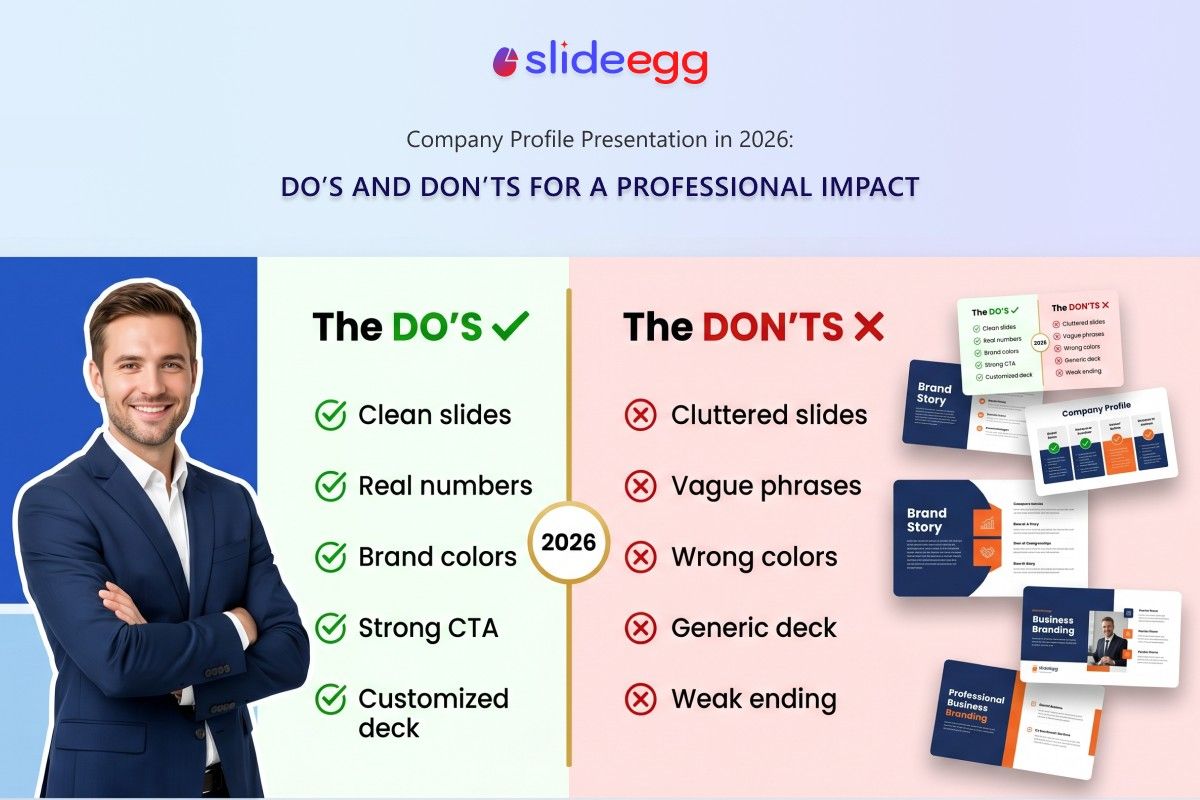
Before we go deeper, here’s a quick reference you can save and come back to every time you build or update your deck:
| The Do’s | The Don’ts |
| ✓ Keep slides clean and uncluttered | ✗ Cram every detail onto one slide |
| ✓ Use your actual brand colors and fonts | ✗ Pick random colors that clash with your logo |
| ✓ Include real numbers and client results | ✗ Use vague phrases like “extensive experience.” |
| ✓ Customize for each audience or purpose | ✗ Send the same deck to every prospect |
| ✓ Add a clear call to action at the end | ✗ End with a “Thank You” slide and nothing else |
The do’s — what actually works
Start with a story, not a list. The most effective company profiles don’t open with a bulleted history of the firm. They open with a problem — something the audience recognizes — and then position the company as the solution. That framing turns a passive viewer into an engaged one.
Use real proof. Numbers build trust faster than any adjective. “Helped 140 clients increase revenue by 30%” hits differently than “we deliver results.” Be specific. If you have case studies, client logos, or awards — use them.
Pick the right format and tool. In 2026, your audience might view your deck on a laptop, a phone, or a shared screen in a boardroom. A good company presentation template is already optimized for these scenarios — clean layouts that hold up across screen sizes, with enough white space to breathe.
Consider interactivity. A static deck is fine for most situations. But if you’re presenting virtually or want to stand out in a crowded inbox, an interactive presentation tool — one that lets you embed clickable sections, video clips, or live data — can make your company profile feel alive rather than flat.
End with purpose. Your last slide should tell the viewer exactly what to do next. Book a call. Visit your website. Reply to your email. Don’t leave them with a “Thank You” slide and a question mark.
The don’ts — mistakes that quietly kill your pitch
Don’t design by committee. When six people have opinions on every slide, you end up with a deck that pleases everyone and persuades no one. Assign one person to own the final design and messaging decisions.
Don’t use placeholder text in a live deck. It sounds obvious. But it happens more than you’d think — Lorem ipsum text, “insert client name here,” or last year’s revenue figures. Always do a final read-through before sharing.
Don’t ignore your audience. A pitch to an investor needs different slides than a proposal to a new vendor. Customize. It doesn’t have to be a full rebuild — even small adjustments to the opening slide and the “why us” section make a big difference.
Don’t skip a template just because it’s free. There’s a common assumption that paid always means better. That’s not true anymore. A well-designed free presentation template — from a platform that invests in design quality — can look just as sharp as anything custom-built. What matters is what you do with it.
Who this applies to — everyone, really
A company profile presentation isn’t just for Fortune 500 marketing departments. Here’s a look at how different people use it — and what they get out of it:
| Who You Are | Your Biggest Win from a Strong Profile Deck |
| Business owner (any size) | Walk into any meeting with confidence — your story is already told |
| Startup founder | Build instant credibility even when you don’t have years of history yet |
| Corporate executive | Align internal teams and external stakeholders with one clear narrative |
| Marketing/branding team | Turn brand guidelines into a living, shareable presentation asset |
| Consultant or freelancer | Position yourself as a serious professional, not just a gig worker |
| Presentation designer | Use it as a flagship portfolio piece to attract higher-paying clients |
| Student | Build a polished academic project that mirrors real-world business practice |
The 2026 shift: what’s different this year
Presentations haven’t changed fundamentally — storytelling still wins, clarity still matters, and trust is still built through proof. But the bar has risen. Audiences in 2026 have seen polished decks powered by AI design tools and interactive presentation platforms. A deck that would have impressed in 2020 might just look ordinary today.
That doesn’t mean you need to rebuild everything. It means you should ask a more honest question each time you share your deck: “Does this still represent us well?” If the answer is anything other than a clear yes, it’s time for an update.
Fortunately, the tools make it easier than ever. A good free presentation template gives you a professionally designed starting point. An interactive presentation tool gives you ways to engage audiences beyond static slides. And a clear sense of your own story gives you everything else.
Frequently asked questions
How many slides should a company profile presentation have in 2026?
Keep it between 12 and 16 slides for most situations. If you’re emailing it, 10–12 slides is enough. The goal is to stay short and clear, not to overload your audience.
Should I build my presentation from scratch or use a company presentation template?
Using a template is usually the smarter choice because the structure is already well-designed. You simply add your content and adjust it to match your brand instead of spending time on layout.
Are free presentation templates actually good enough for professional use?
Yes, many free templates today are high quality and look fully professional when used correctly. What really matters is how well you customize them with your own content and branding.
When does it make sense to use an interactive presentation tool?
Use it when you want your audience to engage more, especially in virtual meetings or digital sharing. Interactive features like clickable sections and videos make your presentation more memorable and engaging.
My company is a startup with no big client list yet — what do I put in the profile?
Focus on your story, your team’s skills, and the problem you are solving rather than big names. Even small early results matter if you explain them clearly and show your approach with confidence.
Final thoughts
A strong company profile presentation isn’t a luxury — it’s a basic requirement for any business that wants to be taken seriously. In 2026, the tools are accessible, the templates are better than ever, and the difference between a good deck and a forgettable one comes down to intention.
Know your audience. Tell a real story. Back it up with proof. Keep it visual, keep it concise, and make it easy for the other person to say yes.
Do those things and your company profile presentation won’t just inform people — it’ll move them.
Related articles
https://www.slideegg.com/blog/presentation-tips/how-to-design-a-winning-company-profile-presentation-in-2026/
https://www.slideegg.com/blog/presentation-tips/5-tips-to-create-a-powerful-business-company-profile-presentation-in-2026/