
If you search for an answer to this question, you will find numbers ranging from 5 to 30. That range is not wrong — it just lacks context. The right slide count depends on your stage, your audience, and the purpose of the meeting.
This guide gives you a clear, stage-by-stage answer. It also covers the 10 slides every investor deck needs, signals that your deck is too long or too short, and advice from investors and founders who have seen thousands of decks. If you’re starting from a blank file, pair it with our full walkthrough on how to make a pitch deck.
Quick Answer
Most startup pitch decks should have 10 to 15 slides. For early-stage investor meetings, 10 to 12 slides is the sweet spot. Demo day presentations run 5 to 7 slides. Series A decks can go up to 15 to 20 slides when the data justifies it.
Slide Count by Stage: At a Glance
Here is the recommended slide count for each stage and context. These are not strict rules. They are the ranges where most successful decks land.
| Pre-Seed / Angel SlideCount: 8–10 Idea + founding team focus |
| Seed Round SlideCount: 10–12 Sweet spot for most decks |
| Demo Day SlideCount: 5–7 Under 2 minutes to present |
| Series A SlideCount: 15–20 Data-first, proof-heavy |
| Board / Enterprise SlideCount: 20–30 Full review, no time limit |
Notice the pattern: slide count grows with the depth of the relationship. A first meeting needs a short deck. A due diligence review needs a long one.
Why Slide Count Actually Matters
DocSend’s pitch deck research shows investors now spend an average of under 2 minutes reviewing a seed deck — making every slide more time-pressured than ever. At that pace, roughly 10 seconds per slide in a 12-slide deck, every extra slide you add costs you time on every other slide.
When you go past 15 slides without a very good reason, you are asking investors to spend less time on the slides that matter most.
Common Mistake: A long deck does not signal thoroughness. To most investors, it signals that you have not yet figured out what matters most about your business.
Stage-by-Stage Breakdown
The right number of pitch deck slides depends entirely on your funding stage and audience.
Pre-Seed and Angel Rounds: 8–10 Slides

At the pre-seed stage, you probably do not have much traction. You may not even have a product yet. The deck is about the idea, the problem, and the team.
Eight to ten slides is enough. Trying to stretch to 15 slides at this stage forces you to pad with content you do not have. Investors at this stage are betting on the founders, not the spreadsheets.
Focus on: problem, solution, market size, business model, team, and your ask. That is six core slides. Add two to four more if you have early data or a compelling vision section.
Seed Round: 10–12 Slides

This is the most common pitch deck format. Seed-stage investors expect to see some traction — early users, waitlist signups, pilot revenue, or strong engagement metrics. Twelve slides gives you room to cover all the essentials and show early proof without overloading the deck.
The classic 10-slide format from Guy Kawasaki was designed for this stage. Most founders who follow it end up adding one or two slides and landing at 11 or 12.
Practical Tip: If you are unsure whether to include a slide, ask yourself: “Does this answer a question a seed investor would ask?” If it does not, cut it or move it to the appendix.
Demo Day: 5–7 Slides

Demo day formats — like Y Combinator’s — give you about two minutes to pitch. That is not a typo. Two minutes.
At that pace, you can present five to seven slides at most. The content needs to be ruthlessly simple: who you are, what you do, the size of the market, your traction, and what you are raising. That is it.
Demo day decks are not meant to close investors. They are meant to get meetings. Think of them as a trailer, not the full film.
Series A: 15–20 Slides

Series A investors are not asking whether your idea makes sense. They already know you have product-market fit or strong signals of it. They are asking whether the business can scale.
That question requires real data. Fifteen to twenty slides gives you room to show detailed traction, unit economics, go-to-market specifics, and a financial model with assumptions. Every slide in a Series A deck should contain data that would hold up in a due diligence conversation.
Going beyond 20 slides at this stage usually means you have not tightened the story yet. If you’re weighing how much the raise changes your deck, see the differences between a seed round vs Series A pitch deck.
Board Meetings and Enterprise Sales: 20–30 Slides
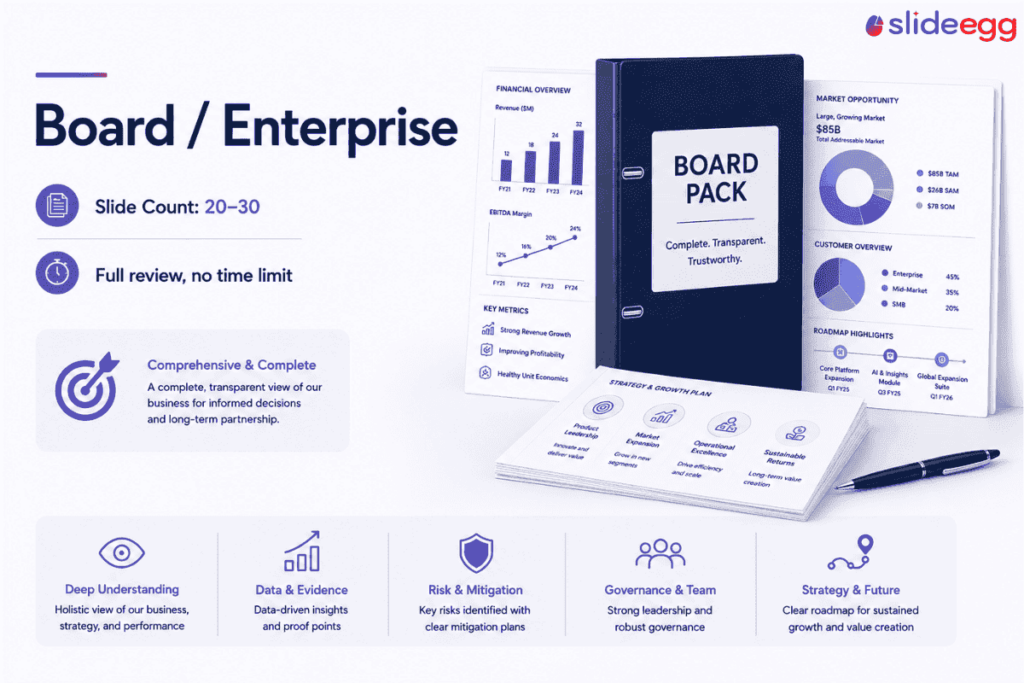
Board decks and enterprise sales decks live in a different category. These are not pitch decks in the fundraising sense. They are review documents.
Board members expect financial comparisons, operational metrics, strategic options, and milestone reviews. Enterprise buyers want case studies, compliance documentation, and implementation timelines. For these audiences, 20 to 30 slides is appropriate — as long as every slide carries weight.
The 10 Slides Every Investor Pitch Deck Needs
Whatever your slide count, these ten slides form the backbone of any investor-facing pitch deck. If any of these is missing or weak, the rest of the deck suffers.
- 1. Title / Company Overview — Your company name, one-line value proposition, and what stage you are at. Keep it clean and direct.
- 2. Problem — The specific pain point you are solving. Use data or a real customer story to make it tangible. Do not just describe the problem — show why it matters.
- 3. Solution — What you offer and how it fixes the problem. One clear paragraph or three bullet points. Avoid technical jargon here.
- 4. Market Opportunity — TAM, SAM, and SOM with credible sources. Show you understand the size and why a portion of it is actually reachable.
- 5. Business Model — How you make money. Revenue streams, pricing model, and any key assumptions behind your monetization strategy.
- 6. Traction — Metrics, growth rates, or early social proof. Even pre-revenue companies can show waitlists, pilot users, letters of intent, or strong engagement. Show the trend, not just a snapshot.
- 7. Go-to-Market Strategy — How you plan to acquire customers at scale. Which channels, what CAC assumptions, and how you will grow from where you are today.
- 8. Competition — The competitive landscape and where you fit. A simple matrix or positioning map works well. Be honest about who else is in the space.
- 9. Team — Key people, their relevant background, and why this team is right for this problem. Domain expertise, previous exits, and relevant operator experience all matter.
- 10. The Ask and Use of Funds — How much you are raising, what it will fund, and what milestone it enables. Be specific. “We are raising $2M to reach $1M ARR by Q4 2026” is better than “to grow the business.”
SlideEgg’s free pitch deck templates are pre-built with all 10 of these slides — structured for seed, demo day, and Series A.
What the Experts Say
“A pitch should contain no more than ten slides, last no more than twenty minutes, and contain no font smaller than thirty points.” – Guy Kawasaki — Author, VC, Former Apple Evangelist
Source: The 10/20/30 Rule — one of the most cited frameworks in startup fundraising · guykawasaki.com
“Keep your seed deck short and direct. The goal is to get a meeting, not to answer every question. Leave something to discuss.” – Y Combinator
Source: YC Startup Library — How to Design a Better Pitch Deck
“Twelve slides is a practical sweet spot. It forces you to prioritize — and prioritization is exactly what investors want to see from a founder.” – David S. Rose — Founder of Gust, Serial Investor
Source: What Belongs in a Startup’s Pitch Deck? — Gust Blog
Notice the pattern:
Each expert gives a slightly different number. Kawasaki says 10. Rose says 12. YC says “short.” They are all pointing at the same principle: fewer slides, done well, beats more slides done poorly.
Signs Your Deck Has Too Many Slides
More slides do not mean more information. They often mean less clarity. Here are the warning signs that your deck has grown too long. Still weighing a lean deck against a longer one? Compare the 10-slide vs 22-slide pitch deck.
🚩 Too Many Slides
- You have two or more slides covering the same theme
- You have a slide that exists only to explain another slide
- Your presentation runs past 25 minutes consistently
- Slides 11 and beyond contain no new core argument
- You added a slide because it “looked empty” without it
- The appendix has grown longer than the main deck
⚠️ Too Few Slides
- You skipped the problem slide entirely
- The business model is one sentence with no detail
- Market size has no source or methodology
- You did not include a specific funding ask
- Traction is absent or vague
- Investors keep asking the same follow-up questions
The Appendix Strategy
The best founders do not choose between a short deck and a thorough one. They build both.
How the Appendix Works
- Main deck: 10 to 12 slides for the live meeting — tight, focused, one core idea per slide
- Appendix: 5 to 15 backup slides for any question that comes up — financial model detail, technical architecture, case studies, patent information
- When to use it: Have the appendix ready but do not show it unless an investor asks a specific question it answers
- What goes in it: Unit economics detail, customer logos, competitor deep dives, team bios, reference data for market sizing
This approach lets you keep your main deck clean while never being caught without an answer. It also shows investors that you have thought deeply about the business — without making them sit through 25 slides to see it.
The Rule That Actually Matters
Every pitch deck guide eventually comes back to the same principle. Slide count is not the real question. The real question is whether each slide earns its place.
A slide earns its place when it answers a specific question an investor would ask. If you cannot name the question a slide answers, cut it or move it to the appendix.
Ask yourself three things about each slide:
| Test | What to Ask | If the Answer Is No |
|---|---|---|
| The Question Test | Does this slide answer a question an investor would ask? | Cut it or move it to the appendix |
| The 20-Second Test | Can a reader understand this slide in 20 seconds? | Simplify the content or split it into two slides |
| The Remove Test | If I removed this slide, would the deck still make sense? | If yes, the slide is probably redundant |
Frequently Asked Questions
How many slides should a pitch deck have?
Most startup pitch decks should have 10 to 12 slides for seed-stage investor meetings. Pre-seed decks can go as short as 8 slides. Series A decks can go up to 15 to 20 slides when the data supports it. Demo day presentations run 5 to 7 slides.
What is the ideal number of slides for a pitch deck?
The ideal number is 10 to 12 for most early-stage investor meetings. This range is backed by Guy Kawasaki’s 10-slide rule, David S. Rose’s recommendation of 12, and Y Combinator’s guidance to keep decks short and direct. Twelve slides gives you enough room to tell a complete story without losing investor attention.
Is 10 slides enough for a pitch deck?
Yes — for most early-stage meetings, 10 slides is enough and often ideal. Guy Kawasaki built his entire pitch deck framework around 10 slides. The goal of a first meeting is to create interest and get a second meeting, not to answer every possible question. If 10 strong slides do that, you do not need more.
How many slides should a demo day pitch have?
Demo day pitches should have 5 to 7 slides. Y Combinator demo day slots give founders around 2 minutes to present. At that pace, you have time for: who you are, what you do, market size, traction, and your ask. That is five slides at most, delivered clearly.
How many slides for a Series A pitch deck?
A Series A pitch deck typically runs 15 to 20 slides. At this stage, investors expect proof — detailed traction, unit economics, go-to-market specifics, and a financial model with assumptions. The extra slides are justified only when each one contains real data. Going past 20 without a clear reason is a signal the story has not been tightened.
Is 7 slides enough for a pitch deck?
Seven slides can work for a demo day pitch or a very early pre-seed presentation. For a standard seed or Series A meeting, 7 slides is usually too short. You would likely be skipping the competitive landscape, go-to-market strategy, or financial projections — all of which investors expect to see.
Can a pitch deck have 20 slides?
Yes, but only at the right stage. Twenty slides is appropriate for a Series A due diligence deck or a board presentation. For a seed-stage first meeting, 20 slides is almost always too long. DocSend research shows investors now spend an average of under 2 minutes on a seed deck — 20 slides means about 6 seconds per slide, which is not enough time to absorb complex content.
What is the 10/20/30 rule for pitch decks?
The 10/20/30 rule was created by Guy Kawasaki. It says: no more than 10 slides, no longer than 20 minutes to present, no font smaller than 30 points. The 30-point font rule is the most underused part — it forces you to put only the most important information on each slide, because you simply cannot fit paragraphs of text at that size.
How many slides is too many in a pitch deck?
For a seed-stage investor meeting, more than 15 slides is usually too many. For a Series A, more than 20 to 22 slides is typically a sign of over-preparation without enough editing. The clearest signal that you have too many slides: you can remove a slide and nothing about your story changes.
What must-have slides should every pitch deck include?
Every investor pitch deck needs these 10 slides: (1) Title / Company Overview, (2) Problem, (3) Solution, (4) Market Opportunity, (5) Business Model, (6) Traction, (7) Go-to-Market Strategy, (8) Competition, (9) Team, (10) The Ask and Use of Funds. Missing any of these will leave investors with unanswered questions — and unanswered questions become reasons not to invest.
How long should a pitch deck presentation be?
For a seed-stage first meeting, aim to present in 15 to 20 minutes. This leaves 10 to 15 minutes for questions, which is usually where the real investor interest shows up. For a Series A meeting that runs 45 to 60 minutes, you can take 25 to 30 minutes to present and save the rest for a deeper conversation.
Should I include an appendix in my pitch deck?
Yes — an appendix is a good idea for most pitch decks. Keep your main deck at 10 to 12 slides and add 5 to 15 backup slides covering unit economics detail, technical architecture, customer case studies, and reference data. Do not walk through the appendix in a meeting. Use it only when an investor asks a specific question it can answer.
Does slide count differ for SaaS vs hardware vs marketplace startups?
Slightly. Hardware companies often need an extra slide for technology or supply chain details. Marketplace businesses may need to explain both sides of the market clearly, which can add a slide. SaaS companies typically fit neatly into 10 to 12 slides. The principle stays the same: every slide must answer a question the investor would ask. The slide count follows naturally from that rule.
Ready to Build Your Pitch Deck?
SlideEgg offers pitch deck templates built for each funding stage — seed, Series A, demo day, and beyond. Pick a structure, customize it to your business, and present with confidence.
Browse Free Pitch Deck Templates →
No credit card. No subscription. Just pick your stage and start building.
Related reading
- Want ready-made structures? See the 8 best pitch deck templates for startups.
- Raising from VCs? Browse 10 proven investor pitch PowerPoint templates.
- New to building one? Follow our guide on how to design a pitch deck that wins investors.