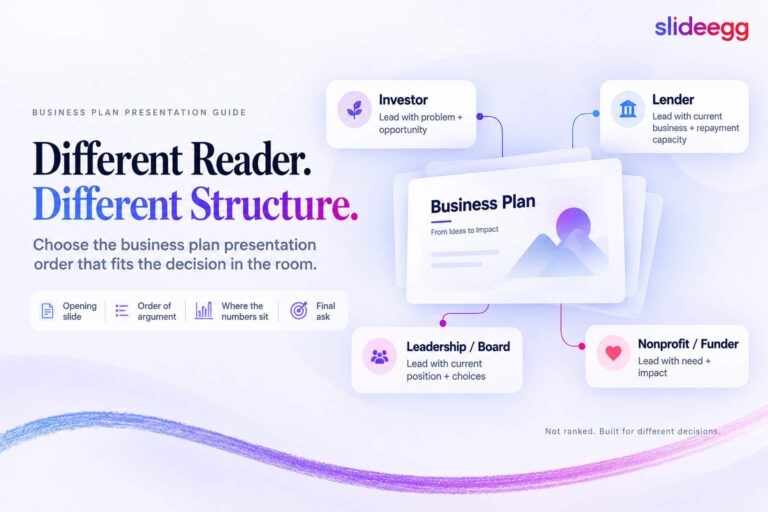
A product roadmap only works if the people who need to act on it actually believe in it. Here’s how to structure, design, and present a product roadmap that gets nods in the room — not questions about what slide 4 actually means.
You can have the best product strategy in your company and still leave a stakeholder meeting with zero alignment. The reason is almost always the presentation — not the plan itself. A product roadmap presentation fails when it’s too detailed for executives, too vague for engineers, or too visually cluttered for anyone to trust at first glance.
This guide covers the structure, content, and design principles behind effective product roadmap presentations — plus the free product roadmap templates that give you a proven visual foundation to start from.
What Is a Product Roadmap Presentation?
A product roadmap presentation is a structured slide deck that communicates the strategic direction of a product — including key features, release phases, priorities, and timelines — to a specific audience. Unlike a product backlog or sprint plan, a roadmap presentation is meant to be shared broadly, understood quickly, and used to align people around a shared plan.
It typically covers a 3-month to 12-month horizon, with the current quarter in the most detail and future quarters at a higher level of abstraction.
Who You’re Presenting To — And Why It Changes Everything
The biggest mistake product managers make is using the same roadmap slide for every audience. Your roadmap presentation needs to be tailored to who’s in the room:
| Audience | What They Care About | What to Emphasize |
| Executives / Leadership | Business impact, resource allocation, strategic fit | Business goals, phase names, expected outcomes — no feature lists |
| Engineering / Dev Team | Scope, dependencies, technical complexity | Feature details, release timing, technical milestones |
| Sales / Marketing | What to promise to customers, launch dates | Customer-facing features, release dates, what’s being announced when |
| Investors / Board | Competitive positioning, revenue potential, risk | Strategic bets, market timing, monetization milestones |
| Customers / External | What’s coming and when | High-level feature categories, target timeframes, no internal detail |
How to Structure a Product Roadmap Presentation
A product roadmap presentation that consistently earns stakeholder buy-in typically follows this slide structure:
Slide 1: The Problem / Opportunity Statement
Start with why. Before showing any roadmap, spend one slide (and 60 seconds) stating the customer problem you’re solving or the market opportunity you’re capturing. This gives your roadmap context that makes every subsequent decision feel logical, not arbitrary.
Slide 2: Product Vision (One-Liner)
State your product vision in one sentence — what the product will look like or enable in 12–24 months. This anchors the roadmap to a destination. Without this, your roadmap is a list of features. With it, it’s a plan toward something meaningful.
Slide 3: The Roadmap Slide (Visual)
This is the core of your presentation. Use a visually clear product roadmap template that shows phases (not just dates), key features or initiatives per phase, and a clear “now / next / later” structure. Avoid listing every feature — focus on the 3–5 most strategically significant items per phase.
Slide 4: Key Dependencies and Risks
Show what could change the plan — resource constraints, third-party dependencies, regulatory factors, technical blockers. This slide demonstrates maturity. It tells stakeholders “we’ve thought about what could go wrong” — which builds more trust than any optimistic projection.
Slide 5: What You Need from This Room
End with a clear ask. Whether it’s approval to proceed, a budget decision, resource allocation, or simply alignment, state what you need from the stakeholders in the room. Without a clear call to action, roadmap presentations often end with polite nods and zero commitment.
Choosing the Right Visual Format for Your Product Roadmap
The visual format of your roadmap slide significantly affects how stakeholders receive the plan. Here’s which format works best for each context:
- Now / Next / Later Columns: Best for agile teams and internal product reviews. Shows priorities without locking in specific dates — useful when timelines are uncertain.
- Quarterly Phase Roadmap: Best for executive and investor presentations. Shows progress across Q1–Q4 with initiative-level detail per quarter. Browse quarterly roadmap templates.
- Feature Release Timeline: Best for sales and marketing audiences. Shows specific releases by date — useful when teams need to build go-to-market plans around your launch schedule.
- Swimlane / Multi-Track Roadmap: Best for complex products with multiple teams. Each swimlane represents a product area, team, or theme — showing how parallel workstreams connect to a unified plan.
What to Include in Each Roadmap Phase
For each phase or quarter in your roadmap, include these elements and nothing more:
- Phase label — Q1 2026, Phase 1, “Foundation,” etc. Keep it short.
- 3–5 key initiatives — Describe each in 3–5 words. Not “Build new payment flow for enterprise clients in three currencies” — just “Enterprise Payments v2.”
- Primary outcome — One sentence on what this phase achieves: “Reduces checkout friction for B2B buyers.”
- Status indicator — Colour code each initiative: planned (blue), in progress (orange), complete (green).
The most common feedback product managers get on roadmaps is “too much detail” — not “too little.” If in doubt, remove the item. A cleaner roadmap slide is always more persuasive than a complete one.
How to Handle Pushback in the Room
Even a well-designed product roadmap presentation will face questions. Here’s how to handle the most common ones:
- “Why isn’t [feature X] on this roadmap?” — “It’s in the backlog. We prioritised these items based on [impact metric / customer data]. I’m happy to walk through the prioritization framework after this meeting.”
- “Can we move the launch date up?” — “Here’s what we’d need to deprioritise to do that. Let’s look at the trade-off.” Then reference your dependencies slide.
- “This seems optimistic — what’s the contingency?” — Point to your risks slide. If you don’t have one, add one before your next presentation.
Free Product Roadmap Templates to Get Started
A professional roadmap presentation starts with a professional visual foundation. SlideEgg’s free product roadmap templates are designed for the exact presentation structures described in this guide — with layouts for quarterly plans, feature release timelines, and swimlane roadmaps. All are fully editable in PowerPoint, Google Slides, and Canva.
For the full range of roadmap template styles — including IT, strategic, marketing, and process roadmaps — browse the complete roadmap presentation template collection.
If you’re unsure whether you need a roadmap or a timeline format for your presentation, see our comparison guide: Roadmap vs. Timeline — What’s the Difference and When to Use Each.
Ready to build your product roadmap presentation? Download a free, editable template and start presenting with confidence today.
Download Free Product Roadmap Templates →
Frequently Asked Questions
How long should a product roadmap presentation be?
For most stakeholder meetings, a product roadmap presentation should be 5–8 slides. Anything longer loses focus. The core is usually one slide for the roadmap visual, one for the vision, one for context, and one for the task. Supporting slides (risks, dependencies) can be in an appendix.
Should a product roadmap include specific dates or just phases?
It depends on your audience and confidence level. For internal teams and engineering, specific dates help with planning. For executives and external audiences, phases (Q1, Q2, “H1 2026”) are safer — they communicate timing without committing to dates that may change. Most product roadmap templates support both formats.
What’s the difference between a product roadmap and a project plan?
A product roadmap shows strategic direction — what you’re building and why, at a phase level. A project plan shows execution detail — tasks, dependencies, owners, and deadlines. A roadmap is for alignment; a project plan is for management.