Project roadmap or product roadmap — they sound similar, but they serve entirely different purposes, audiences, and time horizons. Using the wrong type in a presentation can confuse your stakeholders and undermine confidence in your planning. This guide breaks down the differences clearly, with examples, a comparison table, and free templates for both.
Both are types of roadmap presentations, and both appear on similar-looking slides. But that’s where the similarity ends. Understanding which one your situation calls for — and being able to explain the difference to your team — is a mark of strong strategic communication. Let’s break it down.
What Is a Project Roadmap?
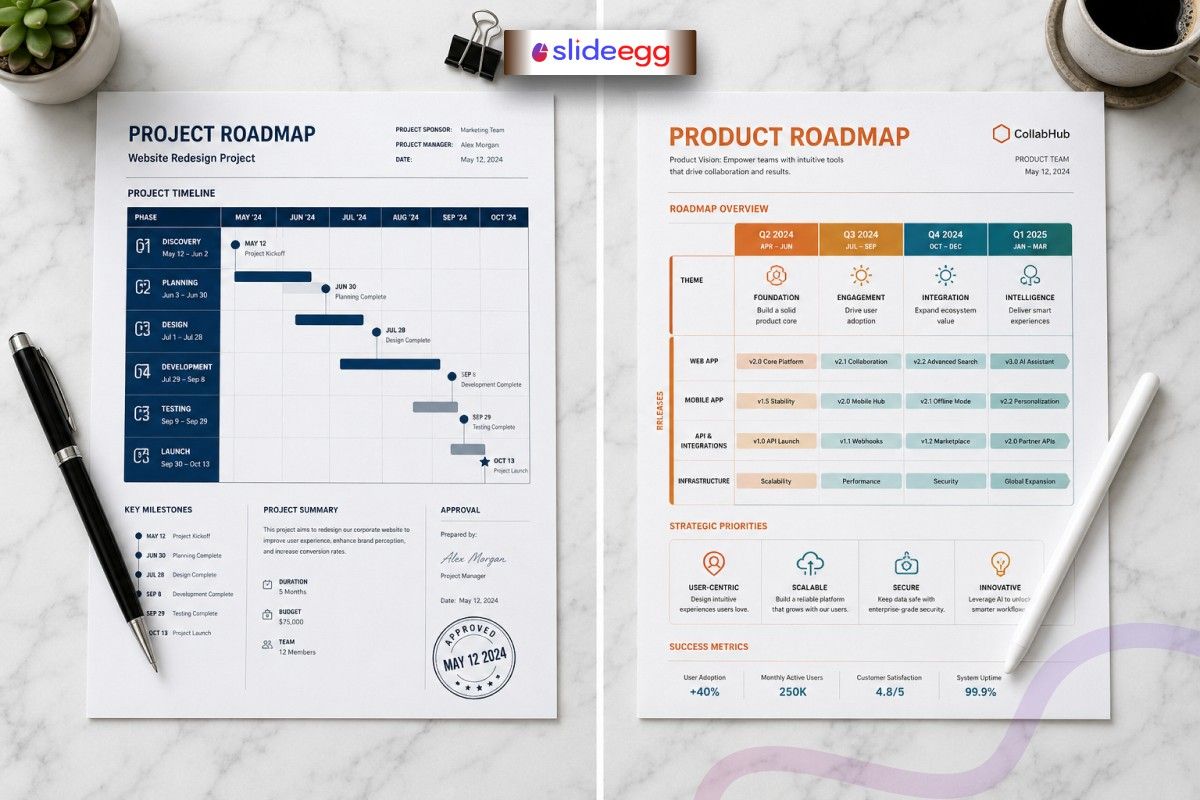
A project roadmap is a high-level visual overview of a specific project — its phases, milestones, deliverables, and timeline. It answers the question: “What are the key steps required to complete this project, and when will each be done?”
Characteristics of a Project Roadmap
- Scope: A single project with a defined start and end date
- Time horizon: Days to months — rarely more than 12–18 months
- Audience: Project manager, sponsor, client, cross-functional team
- Focus: Phases, milestones, deliverables, and dependencies
- Outcome: Completion of the project — the roadmap ends when the project ends
Examples of when to use a project roadmap: Construction project, office relocation, ERP implementation, website relaunch, marketing campaign rollout, compliance programme.
What Is a Product Roadmap?
A product roadmap is a long-term strategic plan for a product — showing what features, capabilities, and improvements will be built over time and why. It answers the question: “What will our product look like in 6, 12, or 24 months, and what are we prioritising and why?”
Characteristics of a Product Roadmap
- Scope: An evolving product that never truly “ends” — it continues as long as the product exists
- Time horizon: 3 months to 2+ years, typically on a rolling basis
- Audience: Product team, engineering, sales, marketing, customers, and investors
- Focus: Features, themes, user outcomes, and strategic priorities
- Outcome: Continuous improvement and growth of the product
Examples of when to use a product roadmap: SaaS product planning, mobile app feature releases, platform API development, hardware product iterations, customer-facing feature announcements.
Project Roadmap vs Product Roadmap — Full Comparison
| Aspect | Project Roadmap | Product Roadmap |
| Purpose | Deliver a specific outcome by a specific date | Evolve a product over time based on strategy |
| End date | Defined — project completes and roadmap is archived | Open-ended — updated continuously on a rolling basis |
| Time frame | Weeks to 12–18 months | 3 months to 2+ years (rolling) |
| Audience | Project team, client, sponsor | Product, engineering, sales, investors, customers |
| Detail level | Phases, milestones, deliverables | Features, themes, epics, user outcomes |
| Success metric | On-time, on-budget delivery | User adoption, retention, revenue impact |
| Owner | Project Manager (PM) | Product Manager (also PM — confusingly!) |
| Update frequency | Weekly/bi-weekly during the project | Monthly or quarterly on a rolling basis |
| Primary question | “How do we deliver this?” | “What should we build next, and why?” |
When to Use a Project Roadmap
Use a project roadmap when:
- You are working to a fixed deadline — a launch date, go-live date, or contractual milestone
- The work has a clear end state — once the project is “done,” the roadmap is retired
- Your primary reporting need is progress against plan — phases complete, milestones hit, budget status
- Your audience is a client, sponsor, or project steering committee rather than an ongoing product team
When to Use a Product Roadmap
Use a product roadmap when:
- You are continuously building or improving a product — there is no “done”
- You need to communicate priorities across multiple stakeholder groups with different interests (engineering wants technical clarity; sales wants committed dates; leadership wants strategic direction)
- Your planning cycle is quarterly or longer — not sprint-by-sprint
- You are making trade-off decisions about what to build versus what to defer
Many organisations use both simultaneously. A company might have a product roadmap for its SaaS platform AND a project roadmap for a specific migration project happening alongside ongoing product development. They serve different stakeholders and are maintained separately.
Can a Roadmap Be Both?
Yes — for large, complex initiatives that span both project delivery and product evolution, teams sometimes create hybrid roadmaps. A common structure is a product roadmap with a “project lane” embedded in it — showing both the ongoing feature development themes and the one-off project milestones running in parallel.
This is especially common in organisations undergoing digital transformation: the product team is continuously shipping features, while a separate project team is simultaneously migrating the infrastructure. Both streams appear on the same roadmap for leadership visibility.
Pre-made Templates for Both Types
Project Roadmap PowerPoint Template
14-slide deck with phase bars, milestone markers, and timeline view. Free, editable in PPT & Google Slides.
Project Roadmap Timeline PowerPoint Template
Detailed timeline roadmap with task bars and critical path milestones. Ideal for project status presentations.
Product Roadmap Strategy PowerPoint Template
Quarterly product roadmap with feature themes, sprint goals, and release milestones. Built for product managers.
All Roadmap Templates
Browse 100+ free roadmap templates across all types — project, product, strategic, technology, marketing, and more.
Need a project roadmap or product roadmap? Both are available free at SlideEgg — fully editable in PowerPoint, Google Slides, and Canva.
Frequently Asked Questions
Can a project manager and product manager use the same roadmap template?
They can use the same visual format, but the content should differ significantly. A project manager fills it with phases, deliverables, and deadlines. A product manager fills it with feature themes, user outcomes, and strategic priorities. The same template can serve both — just customize the labels and lanes accordingly.
Which roadmap type is better for Agile teams?
Product roadmaps are more naturally aligned with Agile — particularly outcome-based roadmaps that avoid committing to specific features or dates, instead showing themes and goals by quarter. However, Agile project teams running a fixed-scope initiative (such as a platform migration) will often use a project roadmap to track phases against a target go-live date.
Should a project roadmap show individual tasks?
No. A project roadmap is a high-level communication tool — it shows phases and milestones, not individual tasks. Task-level detail belongs in a project management tool (Jira, Asana, Monday.com, etc.) or a Gantt chart. If your roadmap slide has 40+ items, it is likely a Gantt chart in disguise — simplify it.
How far ahead should a product roadmap look?
A common and practical approach is the “Now / Next / Later” framework: Now covers the current quarter with high certainty; Next covers the following 1–2 quarters with medium certainty; Later covers everything beyond 6 months with low certainty. This approach avoids the trap of committing to specific features too far in advance.