Agile teams face a unique challenge: you need to communicate long-term direction without committing to the kind of rigid, feature-specific timelines that Agile is designed to avoid. An agile roadmap template solves this — giving teams a flexible, outcome-based planning tool that satisfies executive stakeholders without undermining the sprint-by-sprint process. Here’s how to build one.
The traditional project roadmap — fixed dates, fixed features, fixed scope — is the enemy of agile development. But the opposite extreme — “no roadmap, just sprint” — is equally problematic. Leadership needs strategic visibility. Customers and sales teams need to know what’s coming. Agile teams need a planning frame that is flexible enough to accommodate change without abandoning strategic direction.
That is exactly what an agile roadmap template provides. Let’s break down how to build one that works for your team and your stakeholders.
What Is an Agile Roadmap?
An agile roadmap is a high-level, goal-oriented visual plan that communicates what a product or development team intends to deliver over time — without locking in specific features or dates too far in advance. It shows strategic direction, themes, and outcomes rather than a fixed feature list with committed deadlines.
The key word is flexibility. An agile roadmap is designed to change. It is a living document that is reviewed and updated every sprint cycle or quarter — reflecting what the team has learned, not just what was originally planned.
Agile Roadmap vs Traditional Roadmap
| Aspect | Agile Roadmap | Traditional Roadmap |
| Commitment level | Goals and themes — not specific features | Fixed features with committed dates |
| Time horizon | Rolling 3–6 months with direction beyond | Fixed 12–18 month plan upfront |
| Update frequency | Every sprint or quarter — continuously updated | Annually or at project milestone reviews |
| Structure | Now / Next / Later or themes by quarter | Gantt-style phases and milestones |
| Stakeholder message | “Here is our direction and priorities” | “Here is exactly what we will deliver and when” |
| Tolerance for change | High — expected and built-in | Low — changes require formal re-planning |
| Risk of misuse | Too vague — stakeholders want committed dates | Too rigid — blocks pivots and learnings |
Key Components of an Agile Roadmap
1. Goals or Themes (Not Features)
Instead of listing specific features, an agile roadmap groups work into strategic themes or goals. Examples: “Reduce onboarding time by 50%,” “Expand API capability for enterprise clients,” “Improve mobile performance.” These themes guide the backlog without over-specifying what gets built.
2. Now / Next / Later Horizon Structure
The most widely used agile roadmap structure divides the plan into three time buckets: Now (current sprint or quarter — high confidence), Next (following 1–2 quarters — medium confidence), and Later (beyond 6 months — directional, subject to change). This structure is honest about uncertainty — a rare and valuable quality in strategic planning.
3. Sprint or Release Markers
Mark planned release dates or major sprint milestones where they are known. These are not detailed sprint plans — they are anchor points that show roughly when major chunks of value will be delivered. Keep dates at the quarter level for anything beyond 3 months.
4. Dependencies and Blockers
Flag known dependencies between streams (e.g., “API work must complete before mobile integration begins”) and any external dependencies (third-party releases, regulatory approvals, infrastructure work). These are critical for senior stakeholders to understand risk.
5. A Clear “Why” for Each Theme
For each theme on the roadmap, include a one-line rationale: “Driven by Q1 churn data,” “Required for enterprise contract,” “Competitive gap vs. Competitor X.” This prevents the roadmap from becoming a wish list and grounds every decision in evidence.
How to Create an Agile Roadmap in PowerPoint
1. Choose a Theme-Based or Now/Next/Later Template
Download a free agile roadmap template or use a project roadmap template with three horizontal sections labelled Now, Next, and Later. Avoid templates that have specific date columns — these lock you into traditional planning that defeats the agile purpose.
2. Define Your Strategic Themes
List 3–5 themes that represent your team’s strategic priorities for the planning period. These are not features — they are problems to solve or outcomes to achieve. Write each theme as a goal: “Improve search relevance,” “Enable self-serve onboarding,” “Reduce infrastructure cost by 30%.”
3. Plot Themes Across the Now / Next / Later Horizon
Place each theme in the appropriate time bucket as a labelled card or bar. Use card size to indicate relative effort (larger card = more significant initiative). For themes spanning multiple horizons, draw them as bars that extend across Now and into Next.
4. Add Release Markers and Key Milestones
Mark planned release dates as vertical lines or milestone diamonds — only where there is genuine confidence in the date. For anything in the “Later” horizon, use a rough quarter label (e.g., “Q3 target”) rather than a specific date. This manages stakeholder expectations honestly.
5. Add a “Confidence Level” Legend
Colour-code the roadmap by confidence: green (Now — high confidence), amber (Next — medium confidence), grey (Later — directional). This single addition transforms stakeholder conversations — it signals that the later items are plans, not commitments, and builds trust with audiences used to traditional roadmaps.
The most powerful thing you can do in an agile roadmap presentation is proactively address the “when is X feature being built?” question. Prepare a clear, honest answer: “X is in our ‘Next’ horizon — planned for Q3, subject to what we learn in Q2.” This manages expectations without undermining agile flexibility.
Free Agile Roadmap Templates from SlideEgg
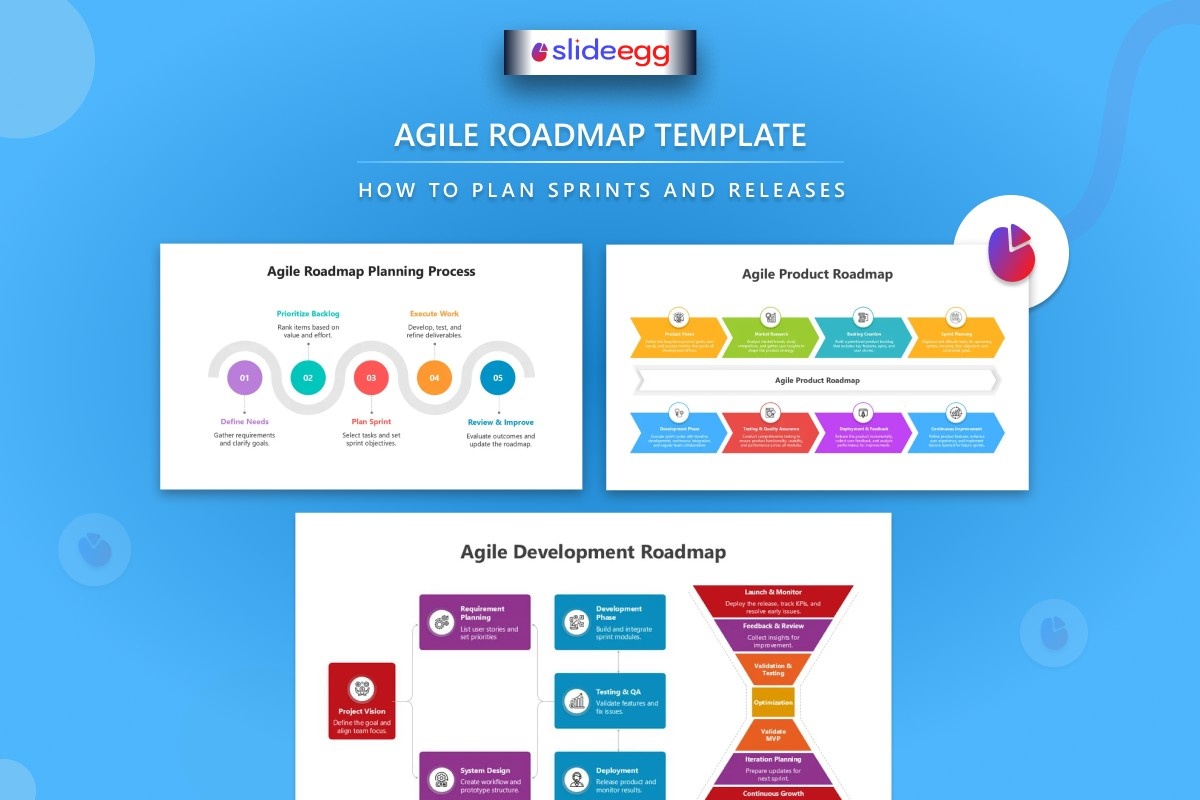
Agile Development Roadmap PowerPoint Template
Sprint cycle roadmap with workflow stages, milestone-based process visuals, and agile phase indicators.
Project Management Roadmap PowerPoint Template
Phased roadmap with deliverables and sprint-friendly milestone markers. Ideal for agile project status updates.
Product Roadmap Strategy PowerPoint Template
Quarterly feature and theme planning roadmap — easily adapted to a Now/Next/Later structure for agile teams.
Full Roadmap Template Library
100+ free roadmap templates — browse all types including agile, project, product, strategic, and technology roadmaps.
How to Handle Stakeholders Who Demand Committed Dates on an Agile Roadmap
This is the most common tension in agile roadmap presentations. Stakeholders — especially in sales, customer success, and finance — are conditioned to expect committed delivery dates. The agile roadmap’s deliberate vagueness can feel unsatisfying or even evasive. Here is how to handle it:
- Explain the value of honest uncertainty: “A committed date we miss is more damaging to your planning than a range we hit. We are giving you an honest estimate, not a promise we cannot keep.”
- Offer a “confidence range” instead of a date: “This feature is likely to ship in Q3 — 75% confidence. If Q2 learnings shift our priorities, it moves to Q4.”
- Show the evidence behind the plan: Agile roadmaps are driven by data — sprint velocity, backlog size, technical debt estimates. Sharing this data builds confidence even when dates are approximate.
- Define a clear cadence for roadmap updates: “We update this roadmap quarterly and brief leadership on any material changes. You will never be surprised.”
Plan your sprints and releases with an agile roadmap that works for your team and satisfies your stakeholders. Download a free template — editable in PowerPoint, Google Slides, and Canva.
Browse Free Agile Roadmap Templates
Frequently Asked Questions
What is the “Now / Next / Later” agile roadmap framework?
Now / Next / Later is an agile roadmap framework that replaces fixed date columns with three time horizons. “Now” covers work in progress or planned for the current sprint/quarter — high confidence. “Next” covers the following 1–2 quarters — medium confidence. “Later” covers everything beyond 6 months — directional and subject to change. The framework was popularised by Janna Bastow at ProductTank and has become a standard in product management.
Should an agile roadmap show individual user stories or epics?
Neither, at the roadmap level. Agile roadmaps show themes or goals — not individual stories or even epics. Stories and epics live in the sprint backlog (Jira, Linear, or your equivalent). The roadmap is a strategic communication tool, not a sprint planning document. If you are putting user stories on a roadmap, you have gone one level too detailed.
How does an agile roadmap handle priority changes mid-quarter?
It should be updated to reflect the new reality. The advantage of the Now/Next/Later structure is that changes to the “Later” horizon rarely need to be communicated urgently. Changes to “Now” should be flagged to stakeholders immediately with a brief explanation. The roadmap is a living document — regular updates reinforce its credibility, not undermine it.
Can an agile roadmap be used for a non-software team?
Absolutely. The agile roadmap framework works well for any team that operates in short planning cycles with evolving priorities — marketing teams, content teams, design agencies, and operations teams all benefit from the Now/Next/Later structure. The key is framing initiatives as outcomes or goals rather than specific deliverables.