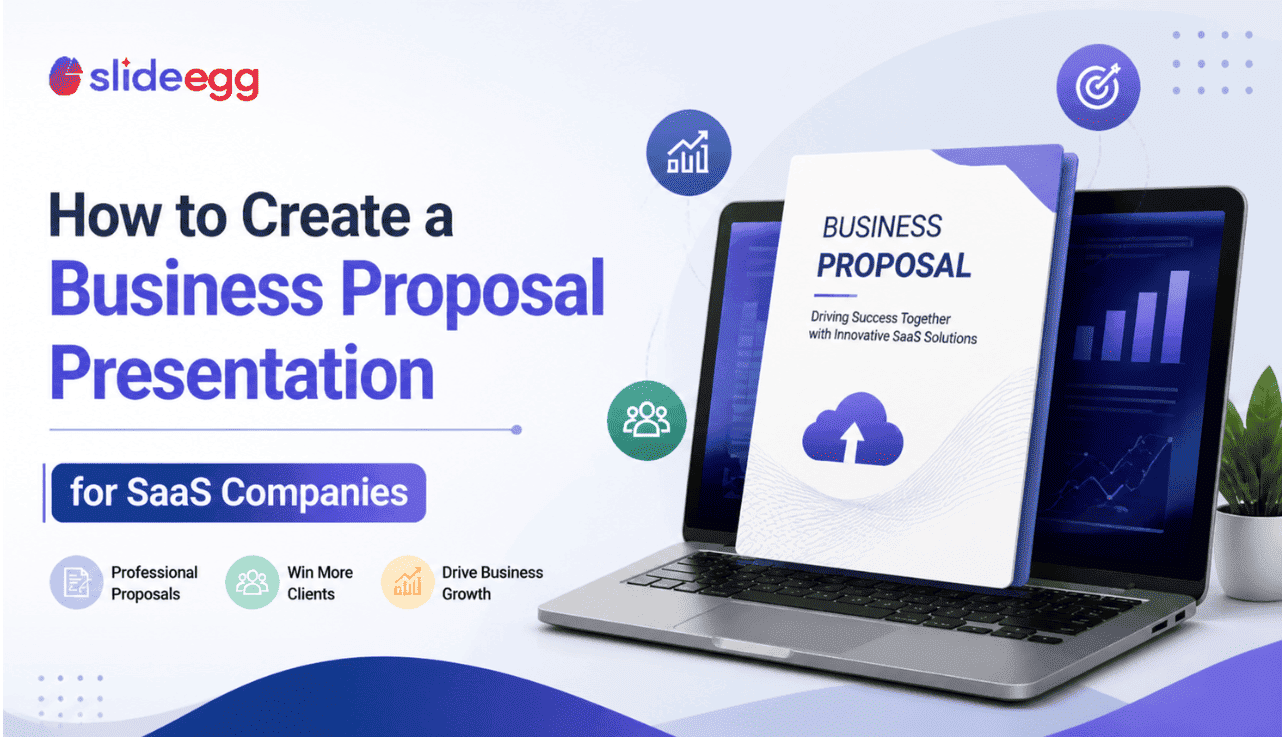
Selling software isn’t like selling a product you can hold. SaaS proposals need to address subscription economics, integration concerns, onboarding timelines, and long-term ROI — all in a format that moves fast and communicates clearly. Here’s how to build a business proposal presentation that speaks the language of SaaS buyers.
Why SaaS Proposals Are Different
A standard business proposal presents a one-time solution to a defined problem. A SaaS proposal is asking a buyer to enter an ongoing relationship — to commit to a platform, absorb it into their workflows, train their team on it, and pay for it month after month or year after year. That’s a fundamentally different task, and it requires a fundamentally different pitch structure.
SaaS buyers have specific concerns that generic proposal templates don’t address. They want to know about data security and compliance. They want to understand the onboarding process and how long it will take before they see value. They want to know about integrations with tools they already use. They want to see evidence — customer success stories, retention rates, and ROI data — not just feature lists. And they want pricing to be transparent, particularly if they’re comparing multiple vendors.
A SaaS business proposal presentation that ignores these concerns in favour of a generic structure will feel imprecise and unconvincing. The slides below are built specifically for SaaS selling contexts.
The 11-Slide SaaS Business Proposal Structure
This structure adapts the core business proposal framework — covered in detail in our guide on Business Proposal Slide Structure: 11 Slides That Win Deals — for the specific demands of SaaS selling.
Slide 01: Cover Slide — Your Brand + Their Name
Open with a personalized cover that includes your logo, the prospect’s company name or logo, the proposal title, and the date. In SaaS, personalization signals that this isn’t a template blast — it’s a considered proposal for their specific situation. Use your brand colors and keep it clean.
Slide 02: Executive Summary — One Slide, Three Sentences
The executive summary should state the prospect’s core challenge, how your SaaS platform addresses it, and what the expected outcome looks like in measurable terms. Keep it to three to four sentences. Decision-makers read this slide first — it needs to give them a reason to keep going.
Slide 03: The Problem Slide — Name Their Pain Precisely
Describe the operational challenge your prospect faces using language from your discovery conversations. SaaS buyers respond to specificity — not “teams waste time on manual processes” but “your ops team spends 11 hours a week on data entry that your CRM should be automating.” Use real data from your industry if you can’t quote their specific numbers.
Slide 04: Why Now — The Cost of Inaction
This slide is often missing from standard templates but is critical in SaaS proposals. Buyers frequently delay software decisions. Your job is to quantify what delay costs them — in time, revenue leakage, or competitive disadvantage. A simple calculation showing the monthly cost of the status quo is more persuasive than any feature slide.
Slide 05: Your Solution — Platform Overview
Present your software solution as the answer to the specific problem you named on Slide 03. Avoid listing every feature. Instead, focus on the two or three capabilities that solve the prospect’s stated pain points. Use visuals — screenshots, diagrams, or a simple product workflow — to make the solution tangible. SaaS is intangible by nature; your visuals do the work of making it feel real.
Slide 06: Integration & Compatibility Slide
This is a SaaS-specific slide that generic business proposal templates skip. List the tools your platform integrates with that the prospect already uses — their CRM, their communication stack, their data warehouse, their project management tool. Showing that your platform fits into their existing ecosystem dramatically reduces adoption friction and objection volume.
Slide 07: Onboarding Timeline & Implementation Plan
SaaS buyers are often burned by long, painful implementations. A clear onboarding timeline — showing what happens in Week 1, Month 1, and Month 3 — is one of the most reassuring slides in a SaaS proposal. Include milestones, who is responsible for each step (your team vs. theirs), and when they should expect to be fully live and generating value.
Slide 08: ROI & Expected Outcomes
This is where you quantify the value of your platform in the prospect’s specific terms. If your tool saves 8 hours per team member per week and they have 20 team members, show the annualised time saving. If your tool reduces customer churn by 15%, project what that means in retained revenue for a business their size. The more your ROI calculation uses their numbers, the more persuasive it becomes.
Slide 09: Social Proof — Customers Who Look Like Them
Feature one to three customer success stories from companies that share characteristics with the prospect — similar size, similar industry, or similar use case. Include a quantified outcome: “Reduced reporting time by 60% in 30 days.” In SaaS, social proof from a recognisable peer is often the single most persuasive element of the entire proposal.
Slide 10: Pricing & Plan Options
Present pricing clearly and without ambiguity. Where possible, offer two or three tiers so the prospect feels a sense of choice rather than take-it-or-leave-it pressure. Show what’s included in each plan, highlight the recommended option, and include any implementation or onboarding fees separately so there are no surprises. If you offer an annual commitment discount, call it out explicitly — it reduces churn and gives the prospect a tangible financial incentive.
Slide 11: Next Steps — Make It Easy to Say Yes
Close with a clear, low-friction next step. In SaaS, this is often a 30-minute kickoff call, a trial activation link, or a contract review with your legal team. Avoid a vague “let us know what you think.” Name the specific action, the person responsible for it, and a suggested timeframe. Proposals that end with a clear next step close significantly faster than those that don’t.
Design Principles for SaaS Proposals
SaaS brands tend to use clean, modern visual systems — minimal clutter, strong typography, and data presented in visual formats rather than dense tables. Your proposal should reflect that aesthetic. If you’re a SaaS company, your proposal is a product touchpoint. It should feel like your software: intuitive, polished, and easy to navigate.
Use consistent brand colours throughout. Replace stock imagery with product screenshots wherever possible — they’re more credible than generic visuals. Keep each slide focused on a single point. If a slide needs a paragraph of explanation, it needs to be two slides.
Design tip: Build your proposal in a template that matches your SaaS brand’s visual identity. A proposal that looks like your product landing page builds subliminal trust — the prospect is already forming an impression of what it will feel like to work with you.
Common SaaS Proposal Mistakes to Avoid
The most common mistake in SaaS proposals is feature overload. Sales teams often feel compelled to list every capability on every pricing tier, worried that leaving something out might cost them the deal. In practice, the opposite is true. A proposal crammed with feature checkboxes overwhelms buyers and obscures your key differentiators. Choose the features that directly address the prospect’s stated needs and lead with those.
The second common mistake is generic social proof. Featuring a household brand name that has nothing in common with your prospect is less persuasive than a mid-market company in the same industry that achieved a specific, quantified result. Relevance matters more than fame.
Finally, many SaaS proposals fail on the pricing slide by being opaque about what happens after the initial term — renewal rates, price escalation clauses, or seat expansion costs. Transparency on pricing builds trust, and trust is what closes SaaS deals.
Which Templates Work Best for SaaS Proposals?
SlideEgg’s business proposal PowerPoint templates include options well-suited to SaaS selling contexts — clean, modern layouts with data visualization slides, pricing comparison tables, onboarding timeline layouts, and social proof slide formats. All templates are fully editable in PowerPoint and Google Slides.
If you’re building a SaaS proposal from scratch and want to see how the top template options compare before choosing, our guide to the 12 Best Business Proposal PPT Templates for 2026 includes picks specifically suited to technology and software companies.
And if you want to understand how free and paid template options differ before you invest, our comparison guide on Free vs Paid Business Proposal Templates walks through exactly what each tier gives you and when it’s worth upgrading.
Build Your SaaS Proposal Today
Browse SlideEgg’s business proposal templates — including clean, modern designs built for tech and SaaS presentations, fully editable in PowerPoint and Google Slides.
Frequently Asked Questions
How long should a SaaS business proposal presentation be?
For most SaaS sales contexts, 10 to 14 slides is the right range. The structure above covers 11 core slides, which is enough to tell a complete story without overwhelming the buyer. Add slides only if the prospect’s situation genuinely requires more detail — a complex enterprise deal or a multi-phase implementation.
Should a SaaS proposal include a product demo?
The proposal itself should not function as a product tour. Demos are most effective in a live call where questions can be addressed in real time. Your proposal should include a compelling product screenshot or workflow diagram to make the software feel real, then direct the prospect to a scheduled demo as the next step.
How do I handle pricing in a SaaS proposal when there are multiple tiers?
Present two to three options, highlight your recommended tier, and make the comparison easy to scan. Show what’s included in each plan, flag any per-seat or usage-based components that could affect the final price, and include any discounts for annual commitment explicitly. Clarity on pricing reduces back-and-forth and speeds up the decision process.