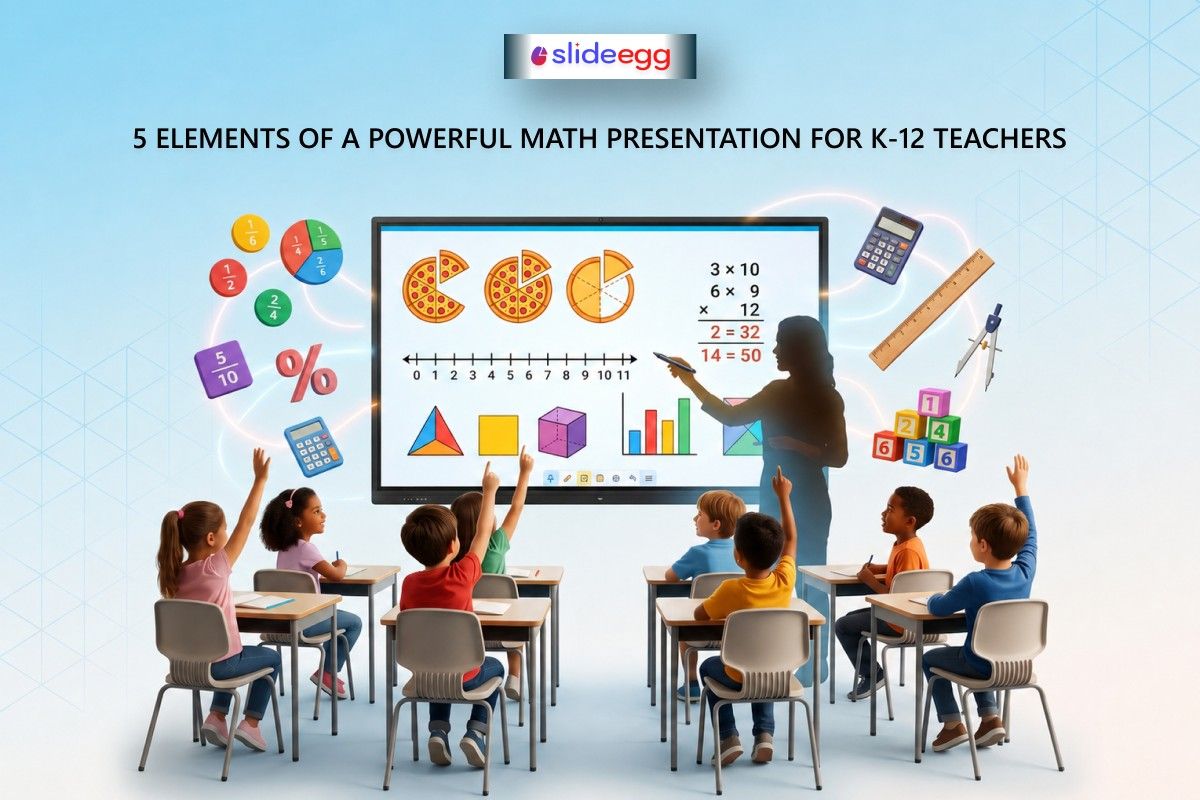
Teaching math in a K–12 classroom is not just about solving equations on the board. It’s about helping students see math, feel math, and slowly build confidence in it. A strong presentation can completely change how students respond to a topic.
But here’s the real challenge many teachers face:
Even great lessons lose impact when the presentation feels flat, confusing, or too text-heavy.
Let’s break that cycle.
In this guide, we’ll walk through 5 practical elements that make a math education presentation truly powerful—especially for K–12 teachers and school educators who want better engagement in the classroom.
1. Start with a Real-Life Connection
Students often ask, “Why are we learning this?”
If your presentation answers that question early, half the battle is won.
Instead of jumping straight into formulas, begin with something familiar:
- Shopping discounts for percentages
- Sharing pizza for fractions
- Sports scores for averages
- Phone battery usage for percentages and ratios
Think of it like opening a door before showing the room inside. When students see math in their daily life, it stops feeling abstract.
A well-structured education presentation template can help you place these real-life hooks right at the beginning, so your lesson flows naturally.
Tip for teachers: Always start your slide with a question like, “Have you ever wondered how discounts are calculated during sales?”
2. Keep Visuals Simple but Meaningful
Math becomes difficult when it’s only numbers. Visuals act like bridges between confusion and understanding.
But here’s the key: simple visuals work better than complex ones.
Use:
- Bar graphs instead of long tables
- Number lines for fractions
- Shapes for geometry concepts
- Color coding for steps in problem-solving
Imagine explaining fractions using a pizza image. Suddenly, “3/4” becomes something students can see and relate to.
This is where teaching becomes more effective with a simple step-by-step explanation. You can present ideas slowly, highlight key parts, and reveal answers one stage at a time—just like peeling layers of an onion so students can understand clearly.
Tip for teachers: Avoid overcrowding slides. One idea per slide is enough.
Break Concepts into Small Learning Steps
One of the biggest mistakes in math teaching presentations is overload.
Students don’t struggle because math is hard—they struggle because too much is shown at once.
Think of learning math like climbing stairs, not jumping a wall.
Break lessons into:
- Step 1: Understand the concept
- Step 2: See an example
- Step 3: Try a guided problem
- Step 4: Practice independently
For example, when teaching multiplication of fractions:
Don’t show the final answer immediately. Walk through each step slowly, like narrating a story.
A good free presentation template often comes with structured slide sequences that already support this step-by-step flow, saving teachers valuable preparation time.
Tip for teachers: Pause after each step and ask a quick question to check understanding.
4. Add Interaction, Not Just Information
A presentation should not feel like a lecture. It should feel like a conversation.
When students participate, they remember better.
Simple ways to make your math presentation interactive:
- Ask prediction questions (“What do you think will happen next?”)
- Include mini quizzes between slides
- Let students solve one step on their own
- Use think-pair-share activities
For example, before showing the solution to a word problem, ask students to guess the next step. Even if they are wrong, they are thinking actively—and that matters more than perfection.
An interactive presentation tool helps you add polls, clickable answers, and animated feedback that keeps students engaged like a game.
Tip for teachers: Wait 3–5 seconds after asking a question. Silence often encourages thinking.
5. End with Reflection and Real Understanding
A strong math presentation doesn’t end with the final answer—it ends with understanding.
Instead of simply saying “That’s the solution,” guide students to reflect:
- “What method did we use today?”
- “Where else can we use this concept?”
- “What step was most important?”
This turns memorization into real learning.
Think of it like cooking—you don’t just serve the dish, you help students understand the recipe.
You can also include a final summary slide using an education presentation template that highlights key formulas, steps, or takeaways in a clean and visual way.
Tip for teachers: End every lesson with one simple takeaway sentence.
Benefits of a Powerful Math Presentation
When these five elements come together, the classroom changes completely.
✔ Better student engagement
Students stop passively listening and start participating.
✔ Improved understanding
Complex concepts become easier to visualize and remember.
✔ Higher confidence in math
Students feel less afraid and more willing to try.
✔ Time-saving for teachers
Well-structured slides reduce explanation effort.
✔ More interactive classrooms
Lessons feel dynamic instead of monotonous.
FAQs
1. Why are presentations important in math teaching?
They help simplify abstract ideas using visuals, structure, and step-by-step learning.
2. How can I make my math presentation more engaging?
Use real-life examples, ask questions, add visuals, and include student interaction in every lesson.
3. Do I need design skills to create good presentations?
No. Using ready-made templates or tools can help you focus more on teaching than design.
4. What is the biggest mistake teachers make in math presentations?
Overloading slides with too much information instead of breaking content into simple steps.
5. Can digital tools really improve math learning?
Yes. When used correctly, digital tools make abstract concepts easier to understand and more interactive.
Final Thought
A powerful math presentation is not about flashy slides or complicated designs. It’s about clarity, connection, and curiosity.
When you teach math like a story instead of a formula sheet, students don’t just learn—they understand.
And that is what makes a real difference in every K–12 classroom.