You have worked hard to build your real estate business. You have closed deals, earned trust, and grown your team. But when a potential investor or client asks, “Can you send me your company profile?” — do you have something impressive to send back?
If the answer is “not quite,” you are not alone. Many real estate founders pour everything into their operations but leave their company profile as an afterthought. That is a missed opportunity. A strong real estate company profile is often the first and most important impression you make before any meeting, pitch, or deal.
In this guide, we will walk you through 10 clear, actionable steps to build a real estate company profile that gets noticed, builds trust, and drives results.
What Is a Real Estate Company Profile?
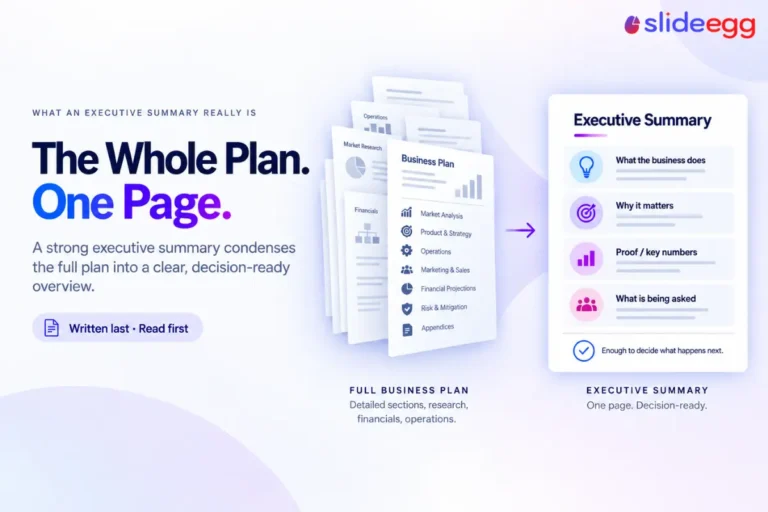
A real estate company profile is a professional document or presentation that tells the story of your business. It covers who you are, what you do, where you operate, your achievements, and why clients or investors should work with you.
Think of it as your business’s resume. A great one opens doors. A weak one gets ignored.
Why a Strong Company Profile Works
Before we jump into the steps, here is why this matters so much in real estate specifically:
• It is a relationship-driven industry. Credibility is currency.
• Investors and developers make decisions based on trust and track record.
• Clients compare multiple agencies. A polished profile sets you apart immediately.
• A well-structured profile doubles as a sales tool, a pitch deck, and a brand statement all in one.
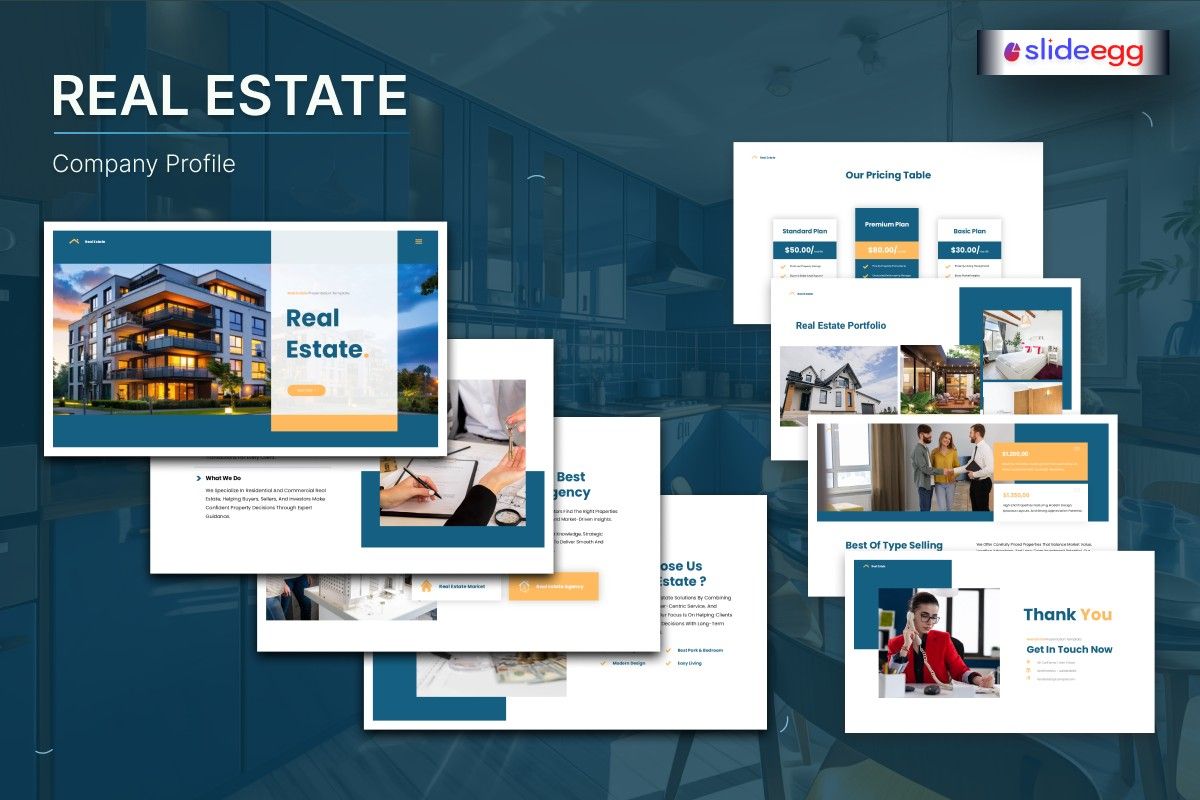
Using a company PowerPoint template helps you keep this profile clean and consistent, so your services, proof, and portfolio are easy to scan in the first few minutes.
Pro Tip: Real estate companies with a professional profile document are 3x more likely to close high-value investor partnerships on the first meeting. First impressions truly count.
The 10 Steps to Create a Strong Real Estate Company Profile
Step 1: Start With a Powerful Company Introduction
- Your opening should instantly tell people who you are and what makes you different. Include your company name, founding year, and a one-line mission statement.
- Avoid generic phrases like “we are a leading real estate company.” Instead, be specific: “We help first-time homebuyers in Dallas find their dream home within 60 days or less.”
Pro Tip: Write your one-line positioning like this: Audience, Location, Outcome, and Timeframe (only if real). If you can’t prove the timeframe, remove it.
Step 2: Highlight Your Mission, Vision, and Values
- This is not just filler content. Investors and clients want to know what drives your company. Write a clear mission (what you do today), a vision (where you are headed), and two to three core values that guide your decisions.
- Keep each statement to two sentences max. Clarity wins here.
Pro Tip: Make values behavior-based, not words. Replace “Integrity” with “We share pricing comparisons and fees upfront before site visits.”
Step 3: Showcase Your Services Clearly
- Do not bury your services in a wall of text. List each service you offer — residential sales, commercial leasing, property management, investment consulting — with a brief two-line description.
- Clients should instantly know if you can help them without having to read between the lines.
Pro Tip: List services in the order clients buy: Core revenue service first, then add-ons. Put “What you deliver” and “Typical result” in two lines.
Step 4: Feature Your Key Statistics and Achievements
- Numbers tell your story better than adjectives. Include metrics like total properties sold, years in business, cities covered, client satisfaction rate, and total portfolio value.
- Even if you are relatively new, use the numbers you have — 50 deals closed, 12 cities, 98% client retention — they add instant credibility.
Pro Tip: Use credible metrics: closed deals, sq ft leased, AUM (assets under management), avg days on market, repeat clients. Add a small note: “Data as of 2026”.
Step 5: Include Your Portfolio and Case Studies
- Show real projects you have handled. A short case study format works well — describe the challenge, what you did, and the result.
- For example: “Helped a commercial developer sell 80% of a 200-unit project in 90 days by repositioning the marketing strategy.” This is far more convincing than any claim you can make about yourself.
Pro Tip: Use a strict 3-line format: Problem → Action → Result. Include one number every time (days, %, ₹, units, sq ft).
Step 6: Introduce Your Team
- People buy from people. Introduce your leadership team with brief bios — name, role, years of experience, and one notable achievement.
- A friendly professional photo goes a long way, too. This humanizes your brand and reassures clients that real experts are behind the scenes.
Pro Tip: Don’t dump bios. Use role + specialty + proof (example: “Leasing Lead | Retail & Office | 1.2M sq ft closed”).
Step 7: Add Client Testimonials and Social Proof
- Ask your best clients for a short quote. Even two or three genuine testimonials can dramatically boost your profile’s credibility.
- Include the client’s name (with permission), their city, and what they said. If you have been featured in the media or have industry awards, include those here as well.
Pro Tip: Choose testimonials that mention a measurable outcome (speed, price, rental yield) instead of “great service.” One strong quote beats five weak ones.
Step 8: Define Your Target Market and Coverage Area
- Be clear about who you serve and where you operate. This helps prospects self-qualify. If you specialize in luxury properties in South Mumbai or commercial real estate in Austin, say so directly.
- A map graphic of your coverage area can make this section very visual and easy to absorb.
Pro Tip: Name your niche clearly: property type, price band, and area. This filters bad leads and makes you look more specialized.
Step 9: Present a Clean, On-Brand Visual Design
- Your profile must look as professional as it reads. Use your brand colors, consistent fonts, high-quality images, and a logical layout. A poorly designed profile, even with great content, signals that you do not take details seriously.
- This is where using a well-structured PowerPoint presentation template saves you enormous time and effort. A clear layout keeps your content organized, maintains visual consistency, and helps your audience follow the flow easily—so you can focus on delivering your message instead of adjusting slide formatting.
Pro Tip: Use one simple rule: one message per slide and one visual per slide. If a slide needs explaining, it’s too crowded.
Step 10: Close With a Strong Call to Action
- Do not let readers finish your profile without knowing what to do next. Include a clear call to action: Schedule a consultation, visit your website, call your office, or email your team.
- Make it easy. Provide every contact detail — phone, email, website, and social media handles — on the final page.
Pro Tip: Use only one primary CTA (e.g., “Book a consultation”). Add a second option only if needed (WhatsApp or email), not five links.
Quick Comparison: Weak vs. Strong Company Profile
| Weak Profile | Strong profile |
| ✗ Generic mission statement | ✓ Specific, client-focused mission |
| ✗ No numbers or data | ✓ Key stats: deals closed, years, cities |
| ✗ Lists services only | ✓ Services with descriptions and benefits |
| ✗ No team introduction | ✓ Named team bios with photos |
| ✗ No testimonials | ✓ Real client quotes with names |
| ✗ Dense paragraphs, no design | ✓ Visual layout with brand consistency |
| ✗ No call to action | ✓ Clear next step with contact details |
Pros and Cons of Investing in a Professional Company Profile
| PROS | CONS |
| Instantly builds trust with clients | Takes time and effort to create properly |
| Speeds up investor and partner conversations | Needs regular updates as your business grows |
| Works as a sales tool 24/7 | Poor execution can hurt more than help |
| Sets you apart from competitors | May require designer involvement for best results |
Final Thoughts
Your real estate company profile is one of the most powerful business tools you have — and most founders underestimate it. It works while you sleep, speaks on your behalf before you enter the room, and tells your story to people you have never met.
Follow these 10 steps, be honest about your strengths, back up your claims with data, and present it all in a clean, professional format. You do not need to reinvent the wheel. Start with a solid template, add your story, and let the results speak for themselves.
The best time to build a strong company profile was when you started your business. The second-best time is today.
Frequently Asked Questions (FAQ)
1. How long should a real estate company profile be?
There is no fixed rule, but 8 to 15 slides (or pages) is the sweet spot. Long enough to be comprehensive, short enough to hold attention. Every section should earn its place — if it does not add value, cut it.
2. Should I create it as a PDF, Word document, or PowerPoint?
PowerPoint or Google Slides format is the most versatile. You can present it live, convert it to PDF for email, and update it easily as your company grows. A PDF alone can feel static, and a Word document lacks the visual impact a presentation format delivers.
3. Do I need a professional designer to create one?
Not necessarily. Today, professionally designed presentation templates make it easy for founders to create a polished profile without design experience. Platforms like SlideEgg offer fully editable real estate company profile templates that you simply fill in with your own information.
4. How often should I update my company profile?
At a minimum, review it every six months. Update your statistics, add recent projects, refresh team bios, and check that your services still reflect what you actually offer. An outdated profile can undermine trust just as quickly as a strong one builds it.
5. What is the most common mistake real estate companies make in their profile?
Being too vague. Phrases like “experienced team,” “trusted by clients,” and “excellent service” mean nothing without evidence. Back every claim with a number, a name, or a specific result. That is what turns a mediocre profile into a compelling one.