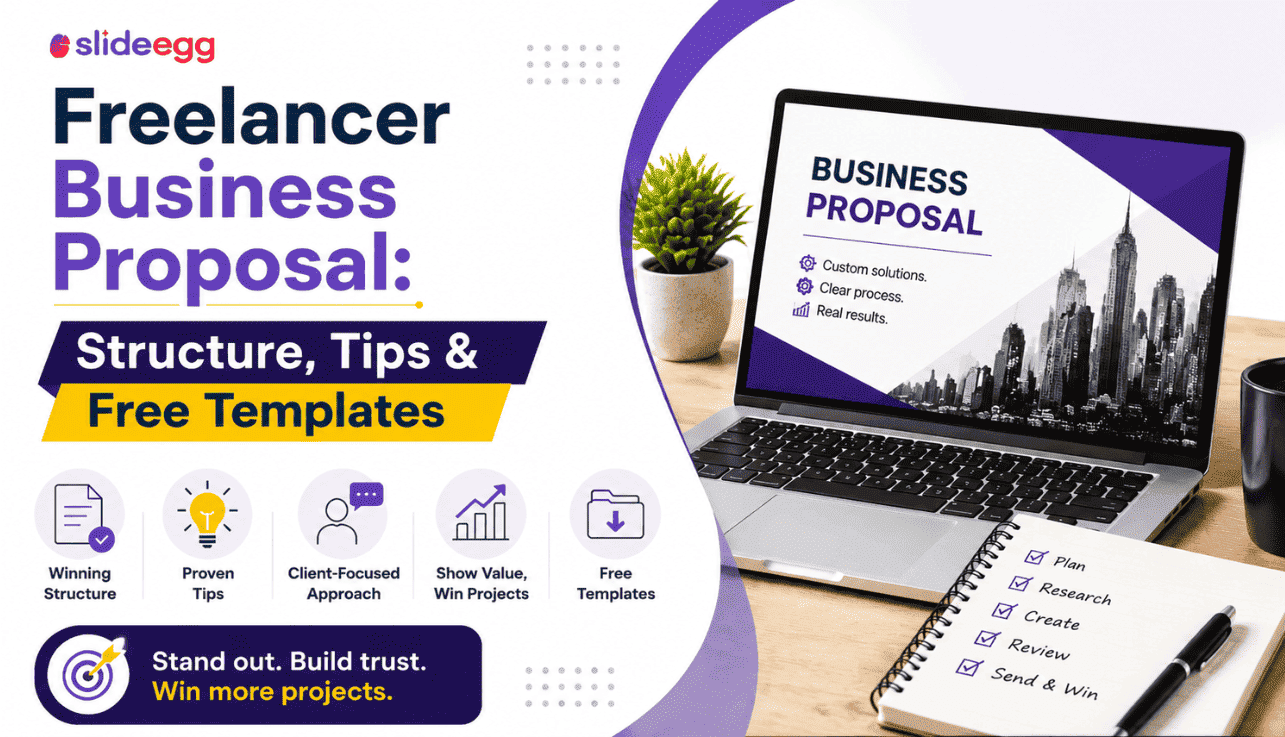
Freelancers lose clients not because their work is weak — but because their proposal looks uncertain. A scattered brief, undefined scope, and a rate buried at the end signals inexperience. Here’s how to write a freelancer proposal that reads like a professional’s.
Why Freelancer Proposals Need a Different Approach
A freelancer proposal has a unique challenge: you’re not hiding behind a brand. There’s no team slide with six faces, no client logo wall with Fortune 500 names. You are the product. Which means your proposal has to do more work — it needs to establish your credibility, demonstrate your thinking, and close the deal, all without the institutional weight of a company behind it.
The good news is that freelancer proposals can be leaner, more personal, and more persuasive than corporate decks — when they’re built correctly. Clients hiring freelancers often value clarity and directness over polish. They want to know: do you understand what I need, can you deliver it, what will it cost, and what happens next?
Your proposal needs to answer all four — in that order. Understanding the full structure before you start writing is essential. Our guide on Business Proposal Slide Structure: 11 Slides That Win Deals covers each section in detail — the same logic applies whether you’re a solo operator or a ten-person agency.
What a Freelancer Proposal Should Include
01. A clear understanding of the client’s brief
Open by restating the client’s objective in your own words — not copied from their brief, but interpreted. This proves you’ve processed what they actually need, not just what they said. Example: “You want to increase organic traffic from the blog by 30% before Q4 without increasing your current content budget.” That’s worth more than three paragraphs about your experience.
02. Your proposed solution — specific, not general
Don’t write “I will improve your website’s SEO.” Write “I’ll start with a full audit of your top 20 pages, identify the three highest-impact technical fixes, and build a 90-day content plan targeting 15 keyword gaps your competitors are ranking for.” The more specific your solution, the more confident the client feels about hiring you. Vague proposals get vague responses.
03. Scope — what’s in and what’s out
Define exactly what the project covers and, critically, what it doesn’t. This protects both parties. A freelance web design proposal should specify the number of pages, the number of revision rounds, whether copywriting is included, and whether hosting and domain setup are in scope. Scope disputes are the number one source of client conflict for freelancers — prevent them in the proposal, not during delivery.
Template: “This proposal covers [deliverable A, B, C]. It does not include [X, Y, Z]. Any additional work outside this scope will be quoted separately.”
04. Your process — how you work
Clients hiring a freelancer for the first time are taking a risk on an unknown process. Show them what working with you actually looks like. A brief three-phase breakdown — Discovery, Execution, Review — is enough to signal that you have a repeatable method, not a “wing it” approach. This is where a timeline slide earns its place.
05. Pricing — presented as value, not a bill
Don’t bury your rate at the bottom. Present your pricing with context: what each component costs, what the client gets at each level, and why the investment makes sense relative to the outcome. If you offer a fixed-price project, show what’s included. If you charge hourly, estimate the total hours and cap. Ambiguous pricing kills freelance proposals faster than any other mistake.
06. One proof point — a result you’ve delivered before
You don’t need a case study page — you need one specific result. “I rebuilt the content strategy for a SaaS company in this space and increased their blog-driven signups by 40% in four months” does more persuasion work than a list of client logos. Pick your most relevant result and state it in a single sentence.
07. A direct next step
End with one action. Not “I look forward to your thoughts” — an actual instruction: “If this looks good, reply to confirm and I’ll send the contract and deposit invoice.” The more frictionless the next step, the faster it happens. Include your response timeline (“I’m holding this slot until [date]”) to create legitimate urgency.
How a Freelancer Proposal Differs From a Corporate Proposal
| Element | Freelancer Proposal | Corporate Proposal |
| Length | 5–8 slides or 3–5 pages | 10–20 slides |
| Team section | Your bio + relevant result | Full team bios + org chart |
| Credibility signals | One specific result or testimonial | Client logo wall, case studies |
| Pricing format | Fixed project or hourly estimate | Tiered packages or enterprise quotes |
| Tone | Direct, personal, first-person | Brand voice, third-person |
| Follow-up | Personal email or message | Account manager or sales team |
Pricing Section: How to Present Your Rate Without Losing the Client
This is where most freelancers go wrong. They present a number with no context and wait for rejection. Instead, anchor your rate to the output and the outcome.
* Weak version
Project total: $2,400
* Stronger version
Full site content audit + 90-day content plan + 8 long-form articles: $2,400
↳ Includes 2 rounds of revisions on all deliverables
↳ Delivered over 8 weeks
↳ 50% deposit on signing, 50% on final delivery
The second version answers four client questions before they’re asked: what am I paying for, what’s included, when will it be done, and when do I pay? If you’re comparing whether a free or premium template handles this kind of structured pricing presentation better, see Free vs Paid Business Proposal Templates for a direct breakdown.
Before You Send: A Quick Freelancer Proposal Checklist
Before sending any proposal, run through the Business Proposal Pre-Send Checklist — it covers the 10 most common gaps in any proposal, including scope clarity, call-to-action strength, and file format. Takes under five minutes and catches the mistakes that cost deals.
Free Templates Built for Freelancer Proposals
Starting from scratch is the slowest way to send a proposal. SlideEgg’s business proposal template collection includes free, fully editable decks that work for freelancers in design, development, marketing, consulting, and content. Each is structured with the sections above already in place — you’re filling in specifics, not building from blank slides.
If your proposal is for a specific service type, the following individual templates map directly to freelance use cases covered in our 12 Best Business Proposal PPT Templates for 2026 guide: the Digital Marketing Proposal, SEO Proposal, Web Design Proposal, Social Media Proposal, and Consulting Proposal — all free, all editable.
Get a Proposal Template That Does the Heavy Lifting
Browse SlideEgg’s free business proposal templates — structured for freelancers and agencies, editable in PowerPoint, Google Slides, and Canva.
Frequently Asked Questions
How long should a freelancer proposal be?
Five to eight slides or three to five pages is the right range for most freelance proposals. Short enough to respect the client’s time, detailed enough to answer scope, pricing, process, and next steps. If your proposal is longer than that, cut the sections that describe you rather than the client’s problem.
Should a freelancer use a proposal template or write from scratch?
A template built for your proposal type — design, SEO, marketing — gives you the right sections in the right order without the blank-page problem. The key is customising the content so it reads as if it was written specifically for that client. A generic template with personalized content beats a custom-built document with generic content every time.
Is it better for a freelancer to send a proposal before or after a call?
After a call, almost always. A discovery call lets you tailor the proposal to the client’s actual priorities — not your assumptions about them. Sending a proposal cold forces you to guess at their brief, which almost always produces a weaker, more generic result.
How do I handle a client who says my freelance rate is too high?
Don’t reduce the rate — reduce the scope. Offer a smaller version of the project at a lower investment level. This holds your rate per hour or deliverable consistent while giving the client a lower entry point. Discounting trains clients to negotiate on every future project; scoping down does not.