Opening a restaurant is exciting — but without a solid business proposal, even the best concept can fail to get off the ground. Whether you’re pitching to investors, applying for a bank loan, or simply mapping your vision, a well-structured business plan is your most powerful tool.
This guide walks you through every essential component of a restaurant business proposal presentation in 2026 — clear, practical, and ready to use.
What Is a Restaurant Business Proposal?
A restaurant business proposal is a formal document that outlines your restaurant concept, strategy, and financial projections. It serves two key purposes:
• Internal roadmap — helps you make smart decisions before and after launch
• External tool — convinces banks, investors, and partners to back your idea
A good business plan is typically 15–25 pages and covers everything from your menu concept to your break-even timeline.
Why You Need One Before Opening
Many first-time restaurateurs skip the business plan. That’s a costly mistake. Here’s why it matters:
| Purpose | What It Helps You Do |
| Funding | Secure loans or attract investors with credible data |
| Clarity | Validate your concept before spending money |
| Risk Planning | Spot financial and operational risks early |
| Team Alignment | Get your partners and staff on the same page |
| Legal Setup | Guide your choice of business structure and permits |
The 9 Core Sections of a Restaurant Business Plan
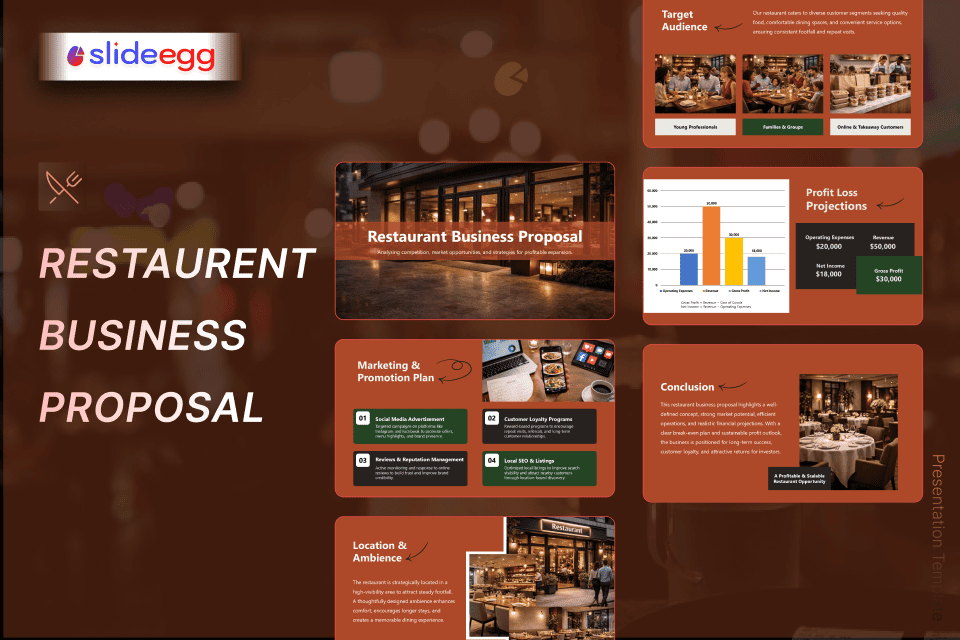
Every strong restaurant business proposal includes a few essential sections. When you turn it into a business proposal presentation, the goal is not to impress with fancy slides—but to communicate your idea clearly, step by step, so anyone can understand how your restaurant will work in the real world.
Here’s a simple, natural flow you can follow for your restaurant business proposal presentation template:
1. Executive Summary
This is your elevator pitch — written last but placed first. Keep it to 1–2 pages. Cover your concept, target market, location, and key financial highlights. Make it compelling enough that readers want to continue.
2. Team & Ownership
Introduce the people behind the restaurant. Highlight qualifications, roles, and relevant experience. Investors back people as much as ideas — show them your team is capable.
3. Restaurant Concept & Vision
Answer these questions:
• What type of restaurant is it? (fine dining, casual, food truck, café, QSR)
• What cuisine and atmosphere?
• What gap in the market does it fill?
• What is your unique value proposition?
4. Market Analysis
Research your target area:
• Who are your ideal customers? (age, income, habits)
• Who are your direct and indirect competitors?
• What are the local dining trends?
• Is there unmet demand you can serve?
Use real local data wherever possible. This section shows you understand your environment.
5. Menu & Pricing Strategy
Include a sample menu that reflects your concept. Explain your pricing approach — how your prices cover food cost, labor, and overheads while staying competitive. Highlight signature dishes or seasonal specials.
6. Marketing & Sales Plan
How will you get customers in the door — and keep them coming back?
• Social media presence (Instagram, Google, Zomato/TripAdvisor)
• Opening promotions and launch events
• Loyalty programs and referral incentives
• Local press, influencers, and community outreach
7. Operations Plan
Cover the day-to-day mechanics:
• Opening hours and service flow
• Staffing structure and hiring plan
• Key suppliers and sourcing strategy
• Technology tools (POS, reservation systems, delivery integrations)
• Health, safety, and compliance standards
8. Financial Projections
This is the heart of your proposal. Include:
• Startup costs (fit-out, equipment, licenses, working capital)
• Monthly revenue forecast for Year 1–3
• Cash flow statement
• Break-even analysis
• Profit & Loss projection
Be realistic. Overly optimistic numbers will lose investor confidence.
9. Funding Request
Be specific: how much do you need, what will you use it for, and what are the proposed repayment terms or equity arrangements?
Presentation Tips for 2026
When presenting your proposal to investors or lenders, keep these in mind:
• Keep the deck to 10–15 slides for pitch meetings; save the full document as a leave-behind
• Lead with your concept story — why this, why now, why you
• Use visuals: location maps, mood boards, sample menus, and financial charts
• Practice your numbers — know your break-even point and margins cold
• Tailor your pitch: a bank wants security; an investor wants returns
Common Mistakes to Avoid
• Unrealistic revenue projections in Year 1
• Ignoring competition or underestimating their strength
• No clear target customer — trying to serve everyone
• Skipping the operations section — investors want to know you can execute
• Weak executive summary — most readers won’t get past page 2
• No contingency plan for slow months or unexpected costs
Quick Checklist Before You Submit
Use this before sending your proposal to anyone:
1. Executive summary is punchy and under 2 pages
2. Team bios highlight relevant experience
3. Market analysis uses local, current data
4. Menu includes realistic food cost percentages
5. Financial projections cover at least 3 years
6. Break-even point clearly calculated
7. Funding request is specific with a usage breakdown
8. No typos — proofread at least twice
Frequently Asked Questions (FAQ)
How long should a restaurant business plan be?
Aim for 15–25 pages for a full document, excluding appendices. For pitch presentations, condense key points into 10–15 slides.
Do I need a business plan if I’m self-funding?
Yes. Even without external investors, a business plan forces you to stress-test your idea and plan your finances. It dramatically improves your chances of long-term success.
What is the most important section of a restaurant business plan?
Financial projections are usually the deciding factor for lenders and investors. But a weak executive summary means many won’t even reach that section — so both matter.
What startup costs should I include?
Include fit-out and renovation, kitchen equipment, furniture, licenses and permits, initial inventory, staff recruitment, technology setup, marketing for launch, and 3–6 months of working capital buffer.
How do I calculate break-even for my restaurant?
Break-even = Fixed Costs ÷ (Revenue per Cover – Variable Cost per Cover). Know your average spend per customer, seating capacity, and target covers per week to work backwards to profitability.