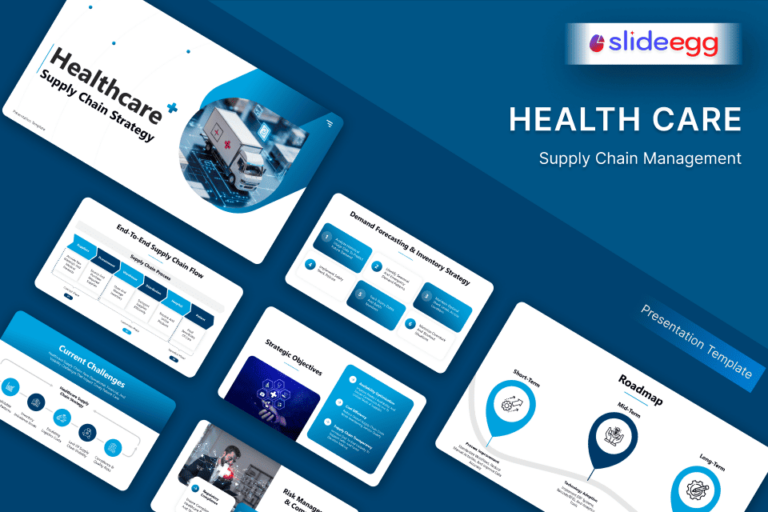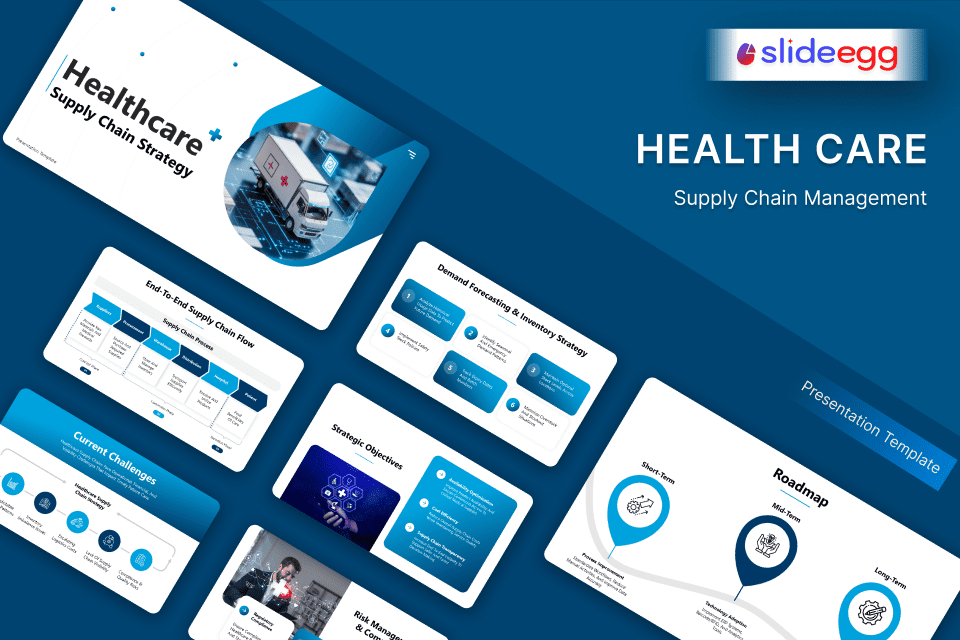
Healthcare supply chains are inherently complex. From raw material sourcing to the moment a patient receives medication or a surgical device, there are dozens of steps, stakeholders, and handoffs involved. When you are asked to present this process—whether to hospital administrators, investors, regulatory teams, or new staff—the challenge is not just understanding the chain itself. The real challenge is making it easy for your audience to follow.
A confusing slide deck can lead to miscommunication, missed decisions, and wasted time. A clear one builds trust, speeds up approvals, and helps teams act with confidence. Using a well-designed supply chain PowerPoint template can make this much easier. Instead of spending time arranging diagrams and layouts, a structured template helps you present each stage of the supply chain in a logical flow, so your audience can quickly see how materials move, where decisions happen, and why each step matters.
This guide walks you through how to structure and present a healthcare supply chain flow in a way that actually makes sense to your audience in 2026.
Why Clarity Matters More Than Ever in 2026
Post-pandemic healthcare systems have gone through major restructuring. Procurement teams are managing larger vendor networks, regulatory bodies are demanding more transparency, and digital integration has added new layers of complexity to traditional supply chains. When presenting to stakeholders today, they want to see not just what the chain looks like, but also where the risks are and how the flow is being managed.
A well-designed presentation does more than inform. It positions you as someone who has a firm grip on the process, and that alone can make a significant difference in how your message lands.
Start With the Big Picture Before Going Into Detail
One of the most common mistakes in supply chain presentations is jumping straight into detailed process steps without giving the audience a sense of the overall structure first. Before showing step-by-step flows, open with a high-level overview that answers a few basic questions.
• Who are the key players in this supply chain?
• What is the general flow from start to finish?
• What are the two or three most important stages to understand?
Once your audience has that foundation, the detailed slides will make far more sense to them. Think of it like giving someone a map before asking them to navigate a specific route.
Choosing the Right Visual Format for Your Flow
Not every supply chain presentation needs the same type of visual. The format you choose should match both the complexity of the chain and the knowledge level of your audience. Here is a quick reference to help you decide.
| Visual Format | Best For | Audience Type |
| Linear Flow Diagram | Simple, step-by-step processes | General or non-technical audience |
| Swimlane Chart | Multiple departments or stakeholders | Internal teams and operations staff |
| Network/Web Diagram | Complex supplier networks | Procurement leads and executives |
| Timeline View | Showing delivery phases and milestones | Project managers and investors |
| Map-Based Visual | Geographic distribution of supply | Logistics and global health teams |
For most healthcare presentations, a combination of a high-level linear diagram followed by a swimlane chart for specific stages tends to work well. It keeps things accessible while still showing the necessary detail.
Breaking Down the Core Stages of a Healthcare Supply Chain
When structuring your slides, consider organizing the supply chain into these core stages. Each one can serve as its own slide or section, depending on how deep you need to go.
1. Sourcing and Procurement
This is where materials, medications, or devices are identified and sourced from approved vendors. Highlight any vendor qualification processes, compliance requirements, or preferred supplier agreements that are relevant.
2. Manufacturing and Quality Control
Show how products are made, tested, and cleared for distribution. If your audience includes clinical or regulatory stakeholders, this section will need more detail than it would for a financial audience.
3. Warehousing and Inventory Management
Explain how stock is stored, tracked, and managed. Include cold chain requirements (temperature ranges, excursion handling, and monitoring points) if applicable, because this is a major risk area for pharmaceuticals and biologics.
4. Distribution and Logistics
Cover how products move from storage to healthcare facilities. Mention transportation partners, delivery timelines, and any last-mile challenges that are relevant to your organization.
5. Point of Care Delivery
This is the final stage where the product reaches the patient or care setting. It is worth showing how this connects back to demand forecasting and reorder cycles so the chain feels complete.
Design Tips for a Cleaner Presentation
Even if your content is well organized, poor visual design can make it hard to follow. Here are a few practical design choices that make a real difference.
• Use consistent color coding for each stage so viewers can track them across multiple slides.
• Limit text on flow diagrams. Let the visuals carry the structure, and use speaker notes or a separate slide for explanations.
• Use icons to represent stakeholders instead of writing out their names repeatedly. It saves space and makes the slide easier to scan.
• Include a legend if you are using color coding or symbols. Never assume your audience will figure it out.
• Keep fonts readable at a distance. Slides that look good on a laptop screen often fall apart when projected in a room.
If you are working with a template from a site like SlideEgg, look for healthcare or supply chain-specific layouts that already follow these principles. Customizing a well-structured template is almost always faster than building from scratch.
Handling Complexity Without Overwhelming Your Audience
Some healthcare supply chains are genuinely complex, involving multiple tiers of suppliers, regulatory checkpoints across different countries, and real-time inventory systems. When you are dealing with this level of complexity, the goal is to present it in layers rather than all at once.
Start with the simplified version and then offer to walk through specific sections in more detail based on what your audience needs. This approach respects their time and keeps the main message clear, while still showing that you have a thorough understanding of the whole picture.
Another helpful technique is to use a dedicated slide for risks and bottlenecks. Rather than crowding your flow diagram with warning labels, pull the key vulnerabilities into their own section. This makes it easier for decision-makers to focus on what matters most.
Common Presentation Mistakes and How to Fix Them
| Mistake | Why It’s a Problem | Simple Fix |
| Too much text on flow slides | Audience reads instead of listening | Use visuals with brief labels only |
| Skipping the overview slide | The audience loses context quickly | Always start with a big picture summary |
| Inconsistent terminology | Confuses teams | Use a glossary slide or standardized labels |
| No risk or bottleneck section | Decision-makers miss key concerns | Add a dedicated risks slide |
Final Thoughts
Presenting a healthcare supply chain clearly is a skill that takes deliberate thought about structure, visuals, and audience. The process may be complex, but your presentation does not have to be. When you start with the big picture, choose the right visual format, organize stages in a logical order, and design for clarity, your audience walks away with real understanding—and more confidence in how you manage the operation.
Whether you are building your deck from scratch or using a supply chain PowerPoint template, the priority stays the same: make it easy to follow. A clean template helps you keep timelines, handoffs, KPIs, and risks consistent across slides, so viewers focus on decisions instead of decoding the layout. A presentation your audience can scan and understand will always outperform one that tries to show everything you know.
Frequently Asked Questions
1. How many slides should a healthcare supply chain presentation have?
There is no fixed number, but a solid presentation usually falls between 10 and 18 slides. You want enough to cover the full chain without losing your audience. An overview, one or two slides per major stage, a risk section, and a summary slide is a good starting framework.
2. Should I use PowerPoint or a different tool for this type of presentation?
PowerPoint and Google Slides both work well for healthcare supply chain decks. The tool matters less than having a clean template and diagrams that are easy to follow. If you need something fast and polished, start with a ready-made healthcare-focused template so you spend more time on the message and less time fixing the layout.
3. How do I present a supply chain to a non-technical audience?
Focus on outcomes rather than processes. Instead of showing every technical handoff, explain what each stage means for patient care or cost management. Use plain language, limit jargon, and lean on visuals over text. A story-based approach where you trace a single product from source to patient can be very effective.
4. What is the best way to show risks in a supply chain presentation?
A dedicated risk matrix or a color-coded section of your flow diagram works well. Using red, yellow, and green to flag high, medium, and low risk areas is immediately readable for most audiences. Pair each risk with a brief mitigation note so the presentation feels solution-oriented rather than just identifying problems.
5. Can I use the same presentation for different audiences?
You can use the same base deck, but you should adjust the depth and focus depending on who you are presenting to. Executives want the overview, financials, and risks. Clinical teams want quality and compliance detail. Operations staff need the process steps and logistics. Having a few audience-specific slide variations ready is worth the extra preparation time.