Most technology presentations fail for one simple reason: the presenter tries to cover everything and forgets what the audience actually needs to do. Students need clear points to earn marks. Managers need enough clarity to make a decision. Founders need people to trust the idea. Content creators need a story that lands fast and stays memorable.
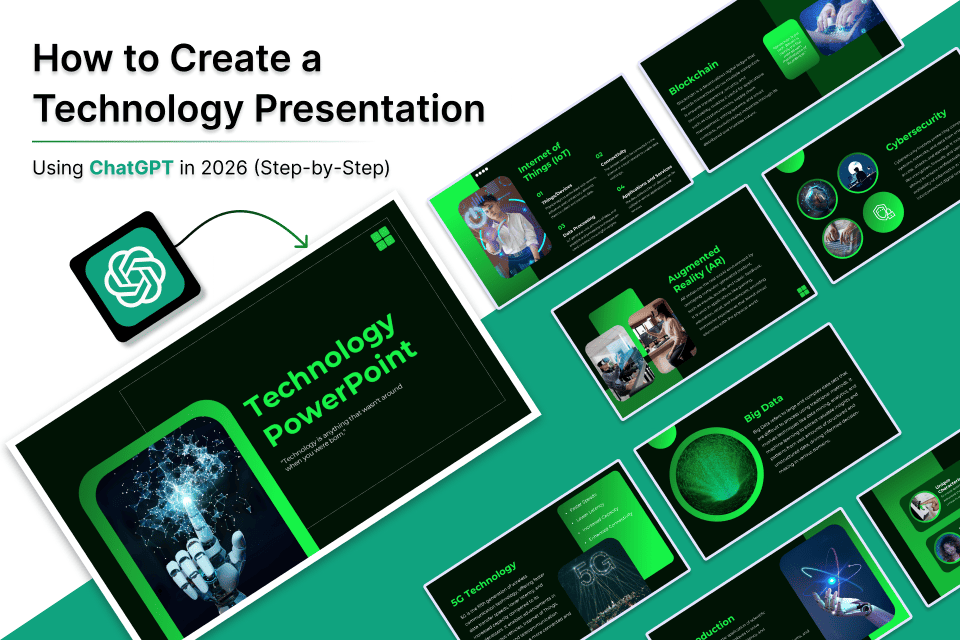
ChatGPT can handle the heavy lifting, but only if you use it with control. If you ask, “Make me a PPT,” you will get generic filler. Treat it like a structured writing partner instead: define the goal, build the flow, and turn ideas into clean, slide-ready points. Then place that content into the right technology PowerPoint templates, so your message looks organized and easy to follow instead of scattered.
This guide gives you a practical, step-by-step method that works for students, business teams, and creators.
What Is ChatGPT’s Role in Making a Presentation?
ChatGPT acts as a planning and writing assistant. It helps you turn your topic into a clear and structured presentation.
It can:
- Create a slide outline
- Organize your ideas logically
- Simplify complex technology concepts
- Generate short bullet points
- Draft speaker notes
- Suggest real-world examples
- Refine language for your audience
Can ChatGPT Create a PowerPoint Presentation?
Yes, ChatGPT can create the content for a PowerPoint presentation.
It can generate:
- Slide outlines
- Titles and bullet points
- Speaker notes
- Examples and summaries
However, it does not directly design slides in PowerPoint. You need to copy the content into your slide tool and format it.
In simple terms, ChatGPT prepares the content. You handle the design and final layout.
Step 1: Decide the exact outcome (one sentence)
Before you touch slides, write a single sentence that explains what success looks like.
Examples:
- Students: “Explain how edge computing reduces latency in IoT systems, with one example and one diagram.”
- Business: “Convince a leadership team to fund a cybersecurity upgrade with clear risk and cost impact.”
- Creator: “Teach beginners how AI image models work in a simple, visual story.”
Now feed that sentence to ChatGPT.
Prompt you can use:
“Act as a presentation strategist. My audience is [students/managers/general]. My topic is [topic]. The goal is [one sentence]. Give me 3 possible angles and the best one with reasons.”
Pick one angle. Do not combine all three.
Step 2: Collect your inputs (so the slides are not vague)
ChatGPT is fast. It is not your source of truth. Your slides need real inputs.
Collect:
- 3 to 5 key facts (numbers, dates, study results, standards)
- 1 real example or case
- 1 simple definition for the main concept
- 1 visual idea (diagram, timeline, comparison table)
Then paste those into ChatGPT.
Prompt:
“Use only the facts I provide. Do not add new facts. Build a slide outline for a [X]-minute technology presentation. Facts: [paste]. Audience: [who].”
This single step reduces errors and makes your deck feel grounded.
Step 3: Build a strong structure
A good technology talk has a predictable spine.
Structure A: Explainer (students, teachers, webinars)
- What it is
- Why it matters
- How it works
- Example
- Limits and risks
- Summary
Structure B: Decision deck (business leaders, founders)
- Problem
- Impact
- Options
- Recommendation
- Cost and timeline
- Risks and next steps
Structure C: Tutorial (content creators, workshops)
- What you will learn
- Step-by-step workflow
- Mistakes to avoid
- Tools checklist
- Quick recap
Prompt:
“Use Structure B. Create a slide-by-slide outline with titles that sound like conclusions, not labels. Keep it to 10 slides.”
Step 4: Generate slide content
Do not ask for all slides at once. You will lose control. Generate one slide, refine it, then move.
Prompt:
“Write slide 3 content in bullet points. Rules: max 5 bullets, each bullet under 12 words, no buzzwords, simple language. Include one short example.”
Repeat slide-by-slide.
If you need speaker notes:
Prompt:
“Add speaker notes for this slide in a natural speaking style. 45 to 60 seconds.”
Step 5: Create visuals that actually explain something
Most tech decks use random icons. Better: use simple visuals that reduce thinking effort.
Ask ChatGPT for visual instructions, not “a nice design.”
Prompt:
“Suggest one visual for this slide that can be built in PowerPoint. Describe shapes, labels, and layout. Keep it simple.”
Visual types that work:
- Before vs after comparison
- Flow diagram (input, process, output)
- Timeline (problem to solution)
- Table of options (3 columns, 4 rows)
- Architecture diagram (layers)
Step 6: Make it audience-ready (students vs business vs creators)
Now tune the same deck for your audience.
For students and academics
- Add one definition slide early
- Add a simple example before a deep explanation
- End with key takeaways and 2 discussion questions
For business professionals
- Put the cost, risk, and timeline in plain terms
- Use fewer technical details, more impact
- Add a clear decision ask at the end
For creators
- Keep slides lighter
- Add a story hook and one surprising fact
- Include a “common mistakes” slide
Prompt:
“Rewrite slide titles and bullets for [audience]. Keep meaning the same. Make it easier to understand.”
Step 7: Do a quality check
Use a short checklist:
- Does every slide answer “so what?”
- Are there any claims without your input?
- Can a beginner follow the first 3 slides?
- Are there too many words on any slide?
Prompt:
“Review this slide content. Flag unclear parts, long bullets, and missing transitions. Suggest edits using simple words.”
Benefits of using ChatGPT for technology presentations
- Faster planning
- Cleaner structure
- Stronger wording
- Better consistency
- Less blank-page stress
What’s different in 2026 compared to older workflows
Earlier, people used AI as a shortcut to generate a full, messy deck. In 2026, the better approach is controlled collaboration: you provide the facts, and ChatGPT helps with the phrasing. For the final polish, always rely on professional PowerPoint templates to ensure your design matches the quality of your AI-assisted content.
FAQ
1) Can ChatGPT make the entire presentation for me?
It can draft content, but you should guide it slide-by-slide and provide your facts. Otherwise, your deck will sound generic and may include wrong details.
2) How many slides should a technology presentation have?
For most cases, 8 to 12 slides are enough for a 10 to 15-minute talk. Add more only if each slide has a clear job.
3) How do I keep the presentation simple without losing accuracy?
Use a definition, one example, and one diagram early. Keep deep detail for speaker notes or backup slides.
4) What should I paste into ChatGPT to get better results?
Your audience, goal, time limit, and a short list of facts and examples. That is the difference between vague output and useful output.
5) How do I make the deck feel original?
Use your own case example, your own data, and your own point of view. ChatGPT should help you express it clearly, not replace it.