In the 2026 hospitality landscape, traditional “vibe-based” business plans are a primary cause of insolvency. Rising labor floors and volatile commodity pricing require a shift to Unit Economic Integrity. If your plan cannot justify every operational dollar from a $0.00 baseline, it is a fiscal liability. In this article, we break down the math of failure and the specific blueprints required to navigate it.
1. The 12-Month Runway: A Month-by-Month Framework
A survival framework must address the specific challenges of each phase of the first year.
| Months | Phase | Primary Objective | Key KPI & Threshold |
| -6 to 0 | Pre-Opening | Capital Preservation | Secure 6 months of fixed-cost liquidity; never reallocate for decor. |
| 1 to 3 | Launch | Throughput Speed | Implement tiered labor scheduling to survive the “Death Valley” mid-day lull. |
| 4 to 8 | Optimization | Yield Control | Audit extraction yield (EY%) to ensure 16g precision doses maintain profile. |
| 9 to 12 | Growth | Retention | Calculate LTV (Lifetime Value) vs. CAC (Customer Acquisition Cost). |
2. Zero-Based Budgeting (ZBB): The “Hidden Killer” Audit
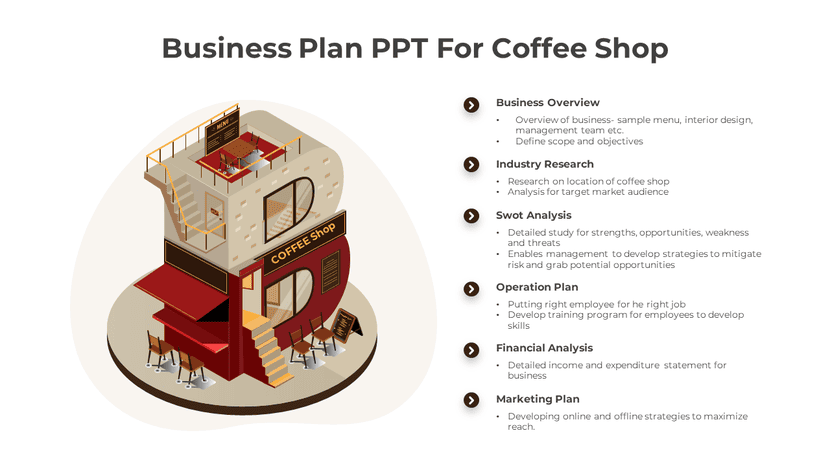
Standard templates rely on generic expense percentages that fail in a volatile market. A Zero-Based Plan builds the budget from the ground up, starting every line item at $0.00. To communicate this level of fiscal transparency to lenders, many founders use Business Plan PowerPoint Templates to map out their survival path visually.
To prove operational viability, your ZBB must account for specific “hidden killers” unique to coffee retail:
- Water Filtration Lifecycle: Quarterly reverse-osmosis cartridge replacements to prevent scale-induced boiler failure.
- Preventative Maintenance (PM): Scheduled espresso machine gasket and screen service every 3–4 months to avoid $2,000 emergency repair calls.
- Compliance Logistics: Fixed monthly costs for professional grease trap pumping and mandated sanitation cycles.
- The Target: Aim for a Prime Cost (Ingredients + Total Labor) of 55%. In 2026, reaching 65% is the statistical threshold for bankruptcy.
3. The Pre-Opening Burn: Your Solvency Buffer
Most cafes fail from exhausting liquidity before the first ticket is ever rung.
- The Rent Void: Expect 4–6 months of “dead rent” while navigating permitting and construction delays.
- The Survival Formula:(Monthly Fixed Costs + Utilities + Compliance Fees) x 6 = Essential Liquidity
- The Guardrail: Never reallocate this liquidity for custom décor; if you cannot survive six months of zero revenue, do not sign the lease.
4. The $80 Rule: Managing Labor Productivity
In a $20/hr minimum wage environment, you must manage by Sales Per Labor Hour (SPLH) to maintain a sustainable 25% labor cost.
- The Benchmark: An SPLH of $80.00 is the non-negotiable floor for sustainability.
- The Math: $20(Wage) / $80(Sales) = 25%(Labor Cost)
- Operational Lever: To maintain $80 SPLH, implement a Station Efficiency Checklist to minimize “Takt Time” (prep time) and maximize throughput during peak windows.
5. Station Efficiency Checklist
Every 1% of wasted motion is a leak in your $80 SPLH target.
- The 2-Step Rule: Can the barista reach milk, cups, and grinders within two steps? If not, the station geometry is a fiscal liability.
- The Zero-Waste Dose: Are you utilizing precision baskets (IMS/VST)? Moving to high-extraction 16g doses reduces dry goods waste by 10-20% compared to traditional 20g doses.
- Workflow Automation: Deploy grind-by-weight systems and automated milk texturing to decouple quality from manual labor speed.
6. Dominating Local Search (Hyper-Local Utility)
Generic “brand awareness” is a sunk cost. In 2026, you must rank for Utility Attributes in the Google Maps Local Pack.
- Utility Optimization: Optimize for specific intent: “Specialty coffee + 1Gbps Wi-Fi + 20+ power outlets + open now”.
- Schema Integration: Use local schema markup to ensure search crawlers index your amenities, not just your menu.
7. Inventory Intelligence: The Variance Audit
“Spillage” is often a euphemism for theft or lack of portion control.
- The Formula:
- Theoretical Usage – Actual Sales = Variance
- The Threshold: Aim for a variance of <1.5%. If you are missing more than two gallons of milk per week beyond sales, your workflow is broken.
8. 2026 Financial Stress Test (Scenario Modeling)
| The Risk | Market Pressure | The Pivot Strategy |
| Labor Inflation | +15% Wage Hike | Deploy self-service kiosks; eliminate mid-day shift overlaps. |
| Commodity Spike | +20% Bean Price | Yield Optimization: Shift to 16g precision doses to preserve margins. |
| Traffic Drop | -25% Volume | SKU Reduction: Cut menu by 50% to save cash; avoid Ghost Kitchens (15-30% commissions). |
9. Frequently Asked Questions (FAQ)
- Why is ZBB better than traditional budgeting?
It prevents “Expense Creep” by forcing you to justify the ROI of every labor hour before you spend the cash. - Why avoid the “Ghost Kitchen” model during slow periods?
Between aggregator commissions (30%) and specialized packaging, the margins on a $6 latte vanish instantly.
Conclusion: Data or Defeat
In 2026, the distinction between a thriving independent café and a closed storefront is Operational Rigor. Moving from a “dream” to a “data-backed system” proves to lenders and investors that you are a risk-averse, disciplined operator. Master the math of the $80 SPLH and the precision of your yield, or expect the market to terminate your logic.