Direct and Indirect Tax in India Presentation Template
The main question this topic answers: Who bears the tax, and how does it reach the government?
That is the real difference between direct and indirect tax. A good presentation on this topic should make that distinction obvious. It should not stop at definitions. It should show the route of payment, the role of the taxpayer, the role of the seller or service provider, and the common taxes that fall into each group.
How the slides support that comparison
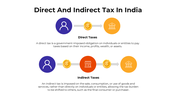
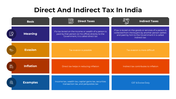
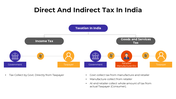
The deck is built around a side-by-side explanation. It compares direct and indirect taxes through the meaning, collection method, inflation effect, tax burden, and examples. It also uses flow layouts to show how tax moves in India, from the taxpayer to the government in direct taxation, and through goods or services in indirect taxation.
What the audience can understand faster with this deck
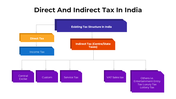
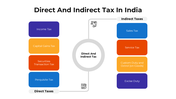
A topic like this often becomes confusing when all tax types are listed without structure. These slides solve that by grouping the subject into two clear branches. Income tax, capital gains tax, securities transaction tax, and perquisite tax sit on one side. GST, sales tax, service tax, customs duty, and excise duty sit on the other. That makes the comparison easier to present and easier to remember.
Where the deck fits best
Useful for tax awareness sessions, business presentations, employee training, academic explanation, and classroom use, where the goal is to explain the Indian tax structure in a simpler and more organized way.
Use these slides when you need to explain direct and indirect tax in India through a clear comparison instead of scattered definitions.
Features of this template:
- Fully editable presentation slides.
- Available in 16:9 and 4:3 formats.
- Compatible with PowerPoint, Google Slides, and Canva.
- Easy to customize text, icons, and colors.
- Built around comparison, not isolated explanation.
- Covers meaning, payment flow, tax burden, inflation effect, and examples.
- Includes diagrams that show how taxes move through the Indian system.
- Groups direct taxes and indirect taxes into separate visual branches.
- Helps explain income tax, GST, customs duty, service tax, capital gains tax, and related examples.
- Useful for tax education, training, awareness, and business discussions.





 Canva
Canva